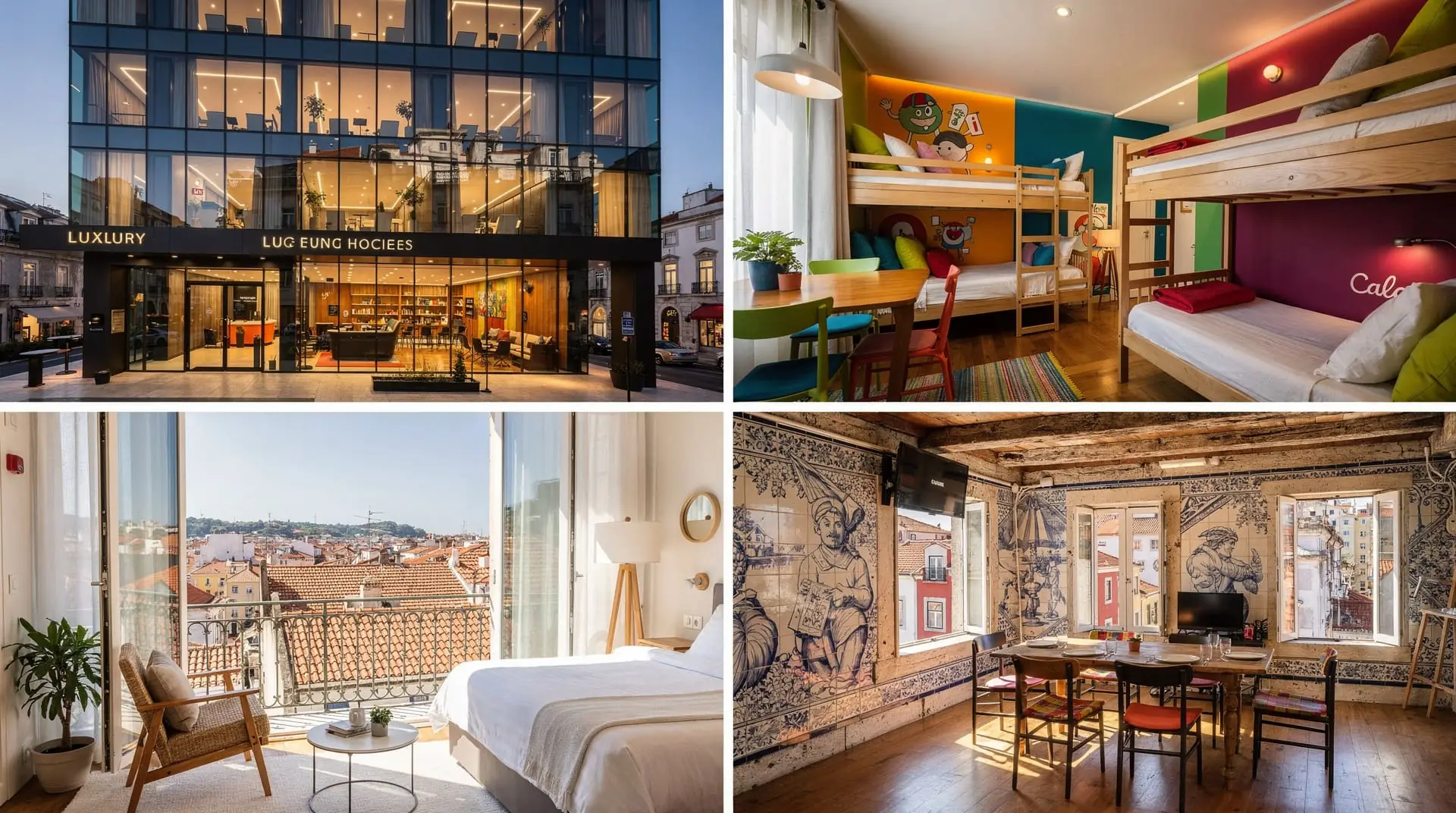
Where to stay in Lisbon — best neighbourhoods for every type of traveller
Last reviewed
What is the best area to stay in Lisbon?
For first-timers: Baixa-Chiado is central, walkable, and close to everything. For boutique charm without the crowds: Príncipe Real or Santos. For authentic atmosphere but with noise: Alfama. For luxury: Avenida da Liberdade. For quiet with easy metro access: Lapa or Estrela. Avoid Alfama if you are a light sleeper — it gets very loud on weekends.
The neighbourhood overview — before you decide
Lisbon’s accommodation is spread across genuinely distinct neighbourhoods that suit very different types of visit. Unlike some cities where the choice is mainly about price, here the neighbourhood determines your experience: how flat or hilly your mornings are, how quiet or noisy your nights, how close you are to which type of restaurant, and how easy day trips become.
The areas below cover everything tourists realistically consider, with honest notes on the downsides that most booking sites omit.
| First-timers | Baixa or Chiado — flat, central, direct metro |
| Atmosphere over convenience | Alfama — steep and noisy weekends, but the most photogenic base |
| Nightlife | Bairro Alto — only if you’re out past midnight |
| Families | Parque das Nações — flat, modern, near the Oceanarium |
| Quiet and residential | Lapa or Estrela — 20 minutes from the centre by transport |
| Budget | Mouraria, Intendente, or Arroios — cheaper, still well-connected |
Baixa — the central grid
What it is: The flat, Pombaline-grid central district rebuilt after the 1755 earthquake. Wide streets, grand squares (Rossio, Praça do Comércio), and the most tourist-dense area of Lisbon. Rua Augusta is the main pedestrian shopping street.
Best for: First-time visitors who want to walk everywhere without thinking. Maximum proximity to monuments, restaurants, trams, and metro.
Accommodation: Mostly mid-range hotels and apartment rentals. Some of Lisbon’s best mid-range hotels are here (Bairro Alto Hotel, Hotel Lisboa Plaza nearby). Budget options include several good hostels. Luxury is limited — for that, look to Avenida.
Price range: Mid-range €90-180/night for a double in 2026. Significant variation by season.
Honest notes: Baixa itself is not particularly characterful. The streets are pleasant but can feel generic-tourist in peak season. Praça do Comércio is touristy but beautiful at dawn and dusk. Noise is generally moderate — far less than Bairro Alto or Alfama.
Transport: Excellent. Blue and green metro lines both pass through. Trams 28E and 15E depart from nearby. Rossio station for Sintra trains is 10 minutes on foot.
Chiado — Baixa’s stylish neighbour
What it is: The neighbourhood above and west of Baixa, connecting to Bairro Alto on one side and Cais do Sodré on the other. Bookshops, design hotels, good restaurants, the Praça Luís de Camões.
Best for: Those who want central Lisbon with more character than Baixa provides. Good food and café scene. Walkable to most major sights.
Accommodation: Boutique hotels and upscale guesthouses. Several excellent options in the €120-250/night range. Fewer budget options.
Honest notes: Popular and therefore never cheap. Some streets (Rua do Carmo) are very crowded with tourists and souvenir shops. The quieter streets off Praça Luís de Camões are better residential choices.
Transport: Baixa-Chiado metro station (blue and green lines). A short flat walk or funicular ride away from Bairro Alto.
Príncipe Real — the boutique choice
What it is: A residential neighbourhood north of Chiado, centred on the leafy square of Praça do Príncipe Real and its Saturday antique market. Excellent independent restaurants, wine bars, concept stores, and the highest concentration of good mid-range and boutique hotels relative to neighbourhood quality.
Best for: Couples, design-conscious travellers, repeat visitors who know the main sights. The best neighbourhood for a comfortable stay with local character.
Accommodation: Strong boutique hotel scene. Options like the Bairro Alto Hotel (technically on the border) and several excellent guesthouses in the €130-250/night range. Also good Airbnb stock in renovated palacetes.
Honest notes: The neighbourhood is genuinely hilly — your hotel may require climbing a steep street with bags. Some properties are in narrow buildings with no lift. Confirm before booking if mobility matters. Noise is minimal by Lisbon standards.
Transport: A 10-15 minute walk from Chiado metro, or uphill from Rato metro (yellow line). Not the most transport-connected — Uber is useful for getting to and from.
Alfama — atmosphere at a cost
What it is: The oldest neighbourhood in Lisbon, a labyrinth of steep alleys, miradouros, fado houses, and the São Jorge Castle above. The most photogenic area of the city.
Best for: Travellers who want maximum atmosphere and do not mind the inconveniences.
Accommodation: A mix of guesthouses, small hotels, and Airbnbs. Several good mid-range options; fewer chains. The Santa Luzia and Portas do Sol area has some excellent small hotels with castle views.
Honest notes — do not skip these:
- Noise: Fado houses run until midnight or later. Weekend nights (particularly Thursday-Saturday) in lower Alfama involve significant street noise until 01:00-02:00. If you are a light sleeper, Alfama will disrupt your sleep.
- Hills: Many Alfama streets are steep, cobbled, and not wheelchair-accessible. Bags are difficult. Consider whether your hotel has lift access.
- Distance: The nearest metro stations (Martim Moniz, Terreiro do Paço) are 15-20 minutes on foot. You will use Uber frequently.
Transport: No direct metro access. Tram 28E runs through (unreliable timing). Bus 737 from Rossio. Uber is practical for trips beyond the neighbourhood.
Bairro Alto — only if you are there for the nightlife
What it is: Lisbon’s main nightlife district, crammed with bars, restaurants, and fado houses on steep streets above Chiado.
Best for: Travellers who plan to stay out late and sleep in. The neighbourhood itself is quieter during the day and comes alive after 22:00.
Accommodation: Mostly small hotels and guesthouses. Some good options in converted townhouses. Price range mid-range.
Honest notes: Do not stay in Bairro Alto if you are not there for the nightlife. Friday and Saturday nights are extremely loud on the main streets until 03:00-04:00. The party in Bairro Alto largely happens on the streets — this is not muffled by building walls. Earplugs will not fully help. If you go to bed before midnight, stay somewhere else.
See the Bairro Alto nightlife guide if you are specifically interested in the nightlife scene.
Santos and Cais do Sodré — the emerging option
What it is: The riverfront area west of Baixa, around the ferry terminal and the famous Pink Street. Once industrial, now full of restaurants, bars, and creative businesses. LX Factory is here.
Best for: Travellers who want a local-feeling neighbourhood with good transport to Belém and Cascais (the train from Cais do Sodré). Younger, budget-conscious visitors.
Accommodation: Growing stock of boutique hotels and good hostels. Some excellent value mid-range options.
Honest notes: Pink Street (Rua Nova do Carvalho) is fun in the evening but loud at night. Streets near the main bar strip have similar issues to Bairro Alto on weekends. Choose a hotel on the quieter streets towards Santos rather than right on the Pink Street strip.
Avenida da Liberdade — luxury at scale
What it is: Lisbon’s main luxury boulevard, a wide Champs-Elysées-style avenue running north from Restauradores. Flagship fashion brands, grand hotels, business visitors.
Best for: Business travellers, those who want 5-star luxury and proximity to everything without being in the thick of tourist crowds.
Accommodation: Tivoli Lisboa (5-star, rooftop pool, excellent), Hotel Avenida Palace (historic grande dame near Rossio), and several international luxury brands. Prices start around €200/night and go well beyond €400 in peak season.
Honest notes: The Avenida itself is grand but not intimate. The luxury hotel experience is excellent; the neighbourhood for wandering is less so compared to Chiado or Príncipe Real.
Transport: Avenida metro (blue line) and Restauradores metro (blue line) are on the avenue.
Lapa and Estrela — quiet and residential
What it is: West of Bairro Alto, Lapa is a residential diplomatic quarter. Estrela is a quiet neighbourhood around the large Jardim da Estrela park and the domed Basílica da Estrela.
Best for: Travellers who want quiet nights, walking in a local environment, and do not mind being 20 minutes from the main sights.
Accommodation: Limited but good options. A few small hotels and many apartment rentals. Genuine residential feel.
Honest notes: The neighbourhood is calm and pleasant but you will be Ubering or bussing to most main sights. Good if you are staying longer than 4 days and want to feel like a resident rather than a tourist.
Parque das Nações — families and modern Lisbon
What it is: Eastern Lisbon’s regenerated Expo 98 site, now a modern waterfront district with the Oceanarium, cable car, and Oriente station.
Best for: Families with children (Oceanarium, flat riverfront for cycling and walking), business travellers using the convention centre, those arriving by international train.
Accommodation: Several large international hotels (Myriad, Epic Sana, Corinthia). Generally lower price than comparable central hotels because of the distance from historic centre.
Honest notes: The neighbourhood is pleasant but feels modern and somewhat soulless compared to historic Lisbon. The 20-minute metro ride to Baixa-Chiado means you spend time in transit. Worth considering for families where the Oceanarium is a priority.
Lisbon Oceanário entrance ticket — the Oceanarium is one of Europe’s best, and staying in Parque das Nações means being 10 minutes on foot from it.
Neighbourhood comparison at a glance
| Area | For | Central | Noise | Hills | Metro |
|---|---|---|---|---|---|
| Baixa | First-timers | Yes | Low-medium | Flat | Direct |
| Chiado | Stylish, central | Yes | Medium | Some | Direct |
| Príncipe Real | Boutique, character | 10 min | Low | Yes | 15 min walk |
| Alfama | Atmosphere | 15 min | High weekends | Very steep | 20 min walk |
| Bairro Alto | Nightlife only | Yes | Very high at night | Some | 10 min walk |
| Santos/Cais do Sodré | Young, local | 10 min | Medium | Flat | Direct |
| Avenida | Luxury, business | 5 min | Low | Flat | Direct |
| Lapa/Estrela | Quiet, residential | 25 min | Very low | Some | 15 min walk |
| Parque das Nações | Families, Expo | 20 min by metro | Low | Flat | Direct |
For budget planning by area, the Lisbon travel budget guide has 2026 accommodation ranges for each neighbourhood. The accessibility guide has specific notes on which areas and hotels are wheelchair-accessible.
Specific hotel and accommodation recommendations by tier
Budget (under €80/night for a double)
Lisbon Chillout Hostel (Alfama area): Genuine Alfama location with double rooms available. Friendly staff, good social atmosphere. The location means hills and noise — but also the real neighbourhood.
Home Lisbon Hostel (Baixa): Family-run feel in the most central location. Both dorms and private rooms. Breakfast included. One of Lisbon’s most consistently well-reviewed budget options.
Pensão Londres (Marquês de Pombal area): Historic guesthouse, eccentric décor, fair prices, clean and functional. Lift, central location, the kind of place that has been accommodating travellers for decades.
Mid-range (€80-180/night for a double)
My Story Hotel Rossio (Baixa): Excellent location directly on Rossio square. Modern rooms, good breakfast, strong reviews. A reliable choice for first-time visitors who want central without surprises.
Hotel Portugal (Baixa): Historic building, renovated, reasonable prices for the location. Basic but clean.
LX Boutique Hotel (Cais do Sodré/Santos area): Boutique styling, river-view rooms worth the premium, genuinely good breakfast. Close to the ferry terminal and the train to Cascais.
Dear Lisbon House (Príncipe Real): A handful of rooms in a converted palace. The kind of place that people book specifically and return to. Limited availability — book well ahead.
Luxury and boutique (€180+/night for a double)
Bairro Alto Hotel: The most celebrated boutique hotel in Lisbon. On the border of Chiado and Bairro Alto. Rooftop restaurant, attentive service, beautifully designed rooms. Consistently ranked among Portugal’s best hotels.
Memmo Alfama: Perched on the edge of Alfama with Tagus views from its terrace. The location is special; the rooms are contemporary; the rooftop pool has extraordinary views. Noise from the neighbourhood at night is real — ask for a room away from the main street.
Tivoli Lisboa (Avenida da Liberdade): Grande dame of Lisbon luxury hotels. Rooftop pool, beautiful public spaces, business-class service. One of the city’s most consistently reliable 5-star properties.
Palácio do Governador (Belém): A renovated governor’s palace in Belém, near the tower and monastery. Boutique property with a garden and a specific sense of history. For those who prefer Belém’s calmer riverside setting over central Lisbon.
Apartment rentals — the case for self-catering
For stays of 4+ nights, a serviced apartment or Airbnb can offer significantly better value than a hotel, particularly for groups or families. Lisbon has extensive Airbnb stock in all central neighbourhoods.
Advantages:
- Kitchen access reduces food costs (breakfast in particular)
- More space for the price compared to hotel rooms
- Local neighbourhood feel
- Washing machine access for longer trips
Disadvantages:
- No hotel services (no reception 24h, no room service)
- Variable quality vs hotel standards
- Some buildings have accessibility issues (no lift in older buildings)
- Airbnb regulations in Lisbon are changing — some listings are in restricted zones
Best areas for apartments: Príncipe Real, Mouraria, Intendente, and Arroios have good stock at reasonable prices. Alfama apartments are atmospheric but check noise levels carefully.
Booking timing by season
July-August: Book 6-8 weeks in advance minimum. Central hotels in mid-range and luxury tiers sell out completely in peak season. Prices are highest.
May, June, September: Book 2-4 weeks ahead for preferred options. Good choices still available, but the best-value mid-range spots fill quickly.
April, October: 1-2 weeks generally sufficient, sometimes less. Good availability and reasonable prices.
November-March: 3-7 days often sufficient. Some small hotels close for renovation in January; verify before booking.
Santo António week (June 12-13): Treat as peak season regardless of other factors — accommodation specifically for this period books months in advance.
Practical advice before booking
Ask about lifts: Many Lisbon buildings, including many charming boutique hotels, are in historic structures without lifts. If climbing 4 flights of stairs with luggage is an issue, confirm explicitly that there is a lift and that it is working.
Ask about noise: Ask specifically about whether the room is street-facing and what the street noise is like on weekend nights. Many hotels will give honest answers if asked directly.
Check the cancellation policy: Lisbon accommodation has moved toward non-refundable pricing for the best rates. If your dates are uncertain, book the refundable option and adjust later — the difference is usually 10-20%.
Location vs price: The flat areas (Baixa, Cais do Sodré, Avenida) are physically easier to navigate. A room in these areas at a slightly higher price often means less time and energy spent on transport. The calculus is particularly clear for visitors with mobility considerations or who plan to pack in many daily sights.
Use the best time to visit guide to understand how pricing varies by month, and the Lisbon travel budget guide for what a night in each neighbourhood realistically costs across the year.
Day-trip logistics: does your neighbourhood matter?
If Sintra, Cascais, or Évora are on your itinerary, where you sleep affects your morning. Baixa is the strongest base for day trips: Rossio station (Sintra trains) and Cais do Sodré (Cascais trains) are both a short walk or one metro stop away, and Sete Rios (Évora and other coach departures) is a direct metro ride on the blue line. Alfama and Bairro Alto add 15-20 minutes of walking or an Uber to reach the same stations, which matters if you’re catching an early train to beat the Sintra crowds. See the trains to Sintra and Cascais guide for exact platform and timing information from each starting point.
Second-time visitors: where to base yourself differently
If this isn’t your first Lisbon trip and you’ve already covered Baixa and Alfama on foot, consider basing in a neighbourhood that rewards slower, more local exploration. Santos and Cais do Sodré put you closer to the Cascais train line and LX Factory without the tourist density of the historic centre. Lapa and Estrela suit a longer stay (5+ nights) where you want to feel like a temporary resident rather than a sightseer working through a checklist. Príncipe Real remains a strong choice on a repeat visit precisely because you already know how to navigate to the main sights from its slightly-off-centre position — see the first-time Lisbon tips guide for how the logistics differ between a first and second visit.
A note on short-term rental regulations
Lisbon’s Alojamento Local (short-term rental licensing) rules have tightened in recent years, particularly in historic centre parishes. Licensed listings display an AL registration number, which is worth checking for on Airbnb or Booking.com listings, especially in Alfama and Baixa where enforcement has been strictest. An unlicensed listing isn’t necessarily unsafe, but a licensed one gives you a clearer path to recourse if something goes wrong with the booking.
Related guides

How many days do you need in Lisbon? An honest answer
2, 3, 4, 5, or 7 days in Lisbon: what you can realistically see and do at each length. Honest advice without filler itineraries.

Accessibility in Lisbon — an honest assessment for disabled visitors
Honest accessibility in Lisbon: cobblestones and hills are brutal for wheelchairs, but several great museums, lifts, and adapted routes work.

Best time to visit Lisbon — month-by-month breakdown
When to visit Lisbon: April-June and September-October are ideal. Summer is hot and crowded. Winter is cheap and mild. Month-by-month guide with real data.

First-time Lisbon tips — 25 things worth knowing before you go
25 essential tips for first-time visitors to Lisbon: comfortable shoes for hills, booking Sintra in advance, the couvert rule, tram 28 realities, and more.
Ready to book? Top tours for this guide
We earn a small commission if you book through GetYourGuide — at no extra cost to you. Every tour is hand-picked and verified.

Lisbon: 48-Hour Hop-On-Hop-Off Bus Tour and Oceanarium Entry
Lisbon: MAAT Entry Ticket & Dolphin Watching Boat Tour
Lisbon: Alfama, Mouraria Walking Tour with Fado Night, Tapas
Lisbon: Hop-On Hop-Off Bus Tour
Lisbon: 1-or 2-Day Hop-On Hop-Off Bus Tour