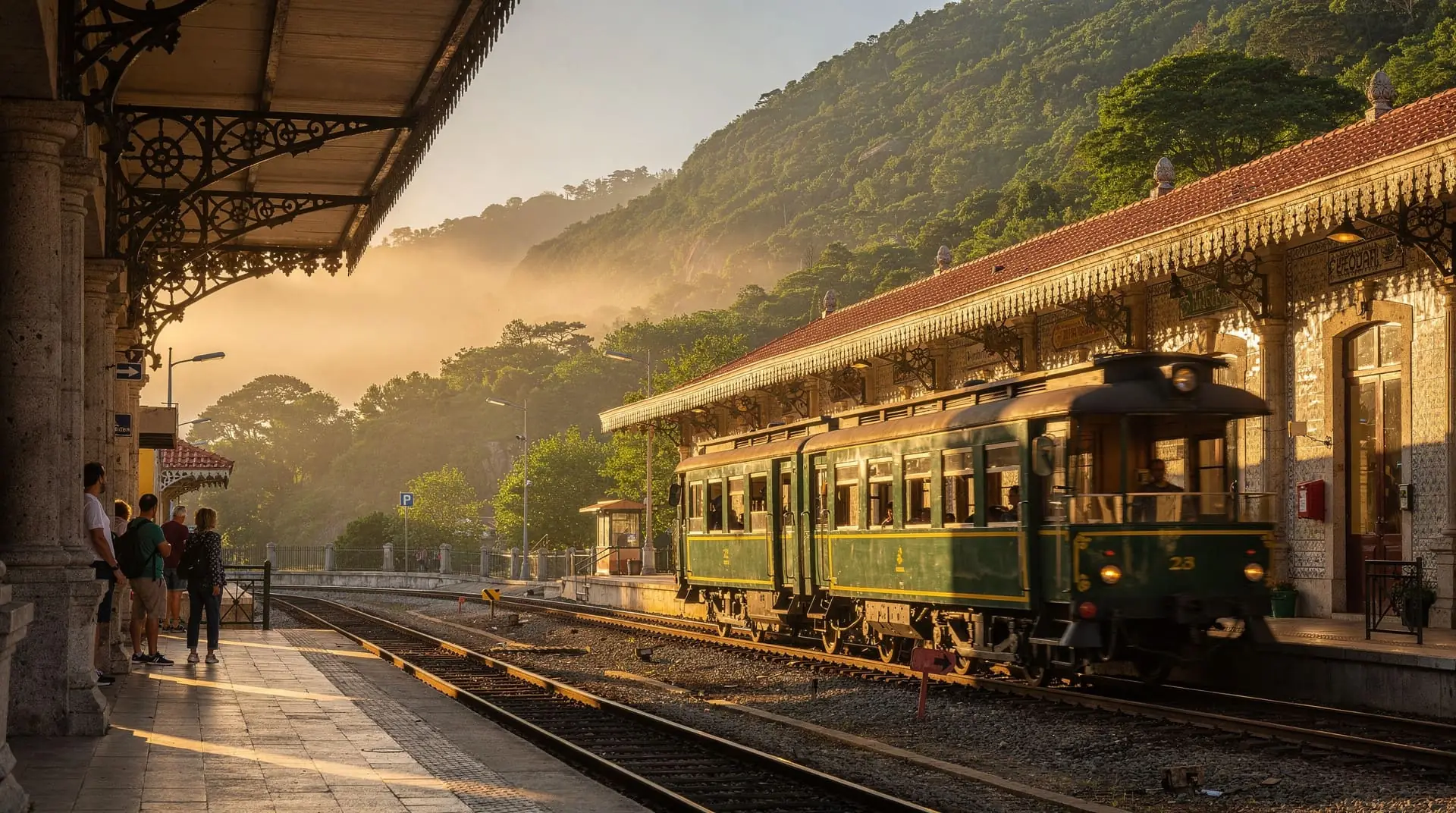
Trains to Sintra and Cascais from Lisbon — timetables, prices, tips
Last reviewed
How do I take the train from Lisbon to Sintra and Cascais?
Sintra train departs from Rossio station, Linha de Sintra, roughly every 20-30 minutes, journey 40 minutes, €2.40 return. Cascais train departs from Cais do Sodré station, Linha de Cascais, every 20-30 minutes, journey 38-40 minutes, €2.40 return. Use a Viva Viagem card or Lisboa Card — no need to buy separate tickets.
| Where | Rossio station (Sintra line) or Cais do Sodré station (Cascais line) |
| Cost | around €2.40 return on either line with a Viva Viagem card |
| Time needed | 38–43 minutes each way |
| Getting there | trains every 20–30 minutes, roughly 05:30 to midnight/1am |
| Best time | first departure of the day (before 09:30) to beat both queues and crowds |
Two lines, two completely different destinations
Sintra and Cascais are both roughly 40 minutes from central Lisbon by train, but they could not be more different. Sintra is the forested serra with fairytale palaces, cold in winter and dangerously crowded in summer. Cascais is a breezy coastal town with a marina, beaches, and a pleasant esplanade. Both are day-trip staples from Lisbon, and both are easily reached by train without a car.
The key logistical point: they depart from different stations.
Train to Sintra — Linha de Sintra from Rossio
Departure station: Rossio (Estação do Rossio), a beautiful neo-Manueline building on Praça Dom Pedro IV in central Lisbon. Metro: Rossio (blue line) or a short walk from Restauradores.
Arrival station: Sintra (Estação de Sintra), at the bottom of the village, within walking distance of Sintra National Palace but a steep 45-minute walk (or bus ride) from Pena Palace.
Journey time: 38-43 minutes nonstop. Some services are slightly slower with intermediate stops.
Frequency: Every 20-30 minutes throughout the day. First train approximately 05:30, last train from Sintra back to Rossio around 01:00 (check the CP website for exact times, as they change seasonally).
Price: €2.40 return using a Viva Viagem card (zapping). Single is €1.85. If you have a Lisboa Card, travel is included — one of the key reasons the card often pays off for visitors including Sintra. See the Lisboa Card break-even guide.
Platform: Platforms 1-4 at Rossio. Check the departure board for the next Sintra service and the correct platform, as other services also depart from Rossio.
Buying tickets at Rossio: Ticket machines are available (multilingual, card-accepting). You can also load the journey directly onto a Viva Viagem card at the machines. There are sometimes queues on weekend mornings — arrive 15 minutes early if possible.
Getting from Sintra station to the palaces
This is where many visitors are caught out. The train drops you in the village centre, but the palaces — particularly Pena Palace — are on the steep ridge above.
Sintra National Palace: 5 minutes on foot from the station. Walk up through the main village square.
Pena Palace, Moorish Castle, Regaleira: 45 minutes on foot (steep), or:
- Bus 434: Runs from outside the train station up to the Pena Park entrance via the Moorish Castle and Regaleira. Runs every 30-40 minutes. Cost: €6.90 hop-on hop-off on this route (covers all stops). Buy at the station kiosk or on board.
- Bus 435: Runs from the station to Monserrate Palace (the other direction). Cost included in the same 434/435 ticket.
- Tuk-tuk: Multiple operators at the station offer tuk-tuk rides up to the palaces. Expect €15-25 per person for a return. Good for groups, expensive for solo.
- Taxi/Uber: A taxi from the station to the Pena Palace entrance costs €8-12. Uber is available in Sintra but less reliably so at the palace exits — book the return before you need it.
Do not attempt to drive up from Sintra village — the road to Pena is narrow, parking is minimal, and in high season (June-September) there are often queues that mean arriving by car takes longer than the bus. Come by train.
Booking palace tickets before you go
The train is easy. The queues at Sintra are not.
Pena Palace tickets routinely sell out on weekends and summer weekdays. Quinta da Regaleira and the Moorish Castle also have timed entry systems. Buy tickets online before you travel — ideally a week in advance in July and August, a few days in advance in shoulder season.
Sintra Pena Park and Palace skip-the-line ticket — online booking with reserved entry time, so you arrive knowing your slot rather than hoping space remains.
Quinta da Regaleira skip-the-line ticket with audio guide — Regaleira is the most atmospheric spot in Sintra, with its initiation wells and romantic Gothic architecture. Also sells out.
For a guided approach that handles logistics:
Sintra day trip from Lisbon with entry tickets — transport, palace entry, and a guide included in one booking.
Train to Cascais — Linha de Cascais from Cais do Sodré
Departure station: Cais do Sodré (Estação de Cais do Sodré), on the Tagus waterfront at the bottom of the green metro line. Metro: Cais do Sodré. Also a major bus terminal. The train station is inside the same building complex.
Arrival station: Cascais (Estação de Cascais), right in the centre of the town, a 5-minute walk from the marina and the main beach at Cascais.
Journey time: 38-42 minutes, with several intermediate stops including Oeiras, Estoril, and Cascais. The line runs along the coast — window seats on the right side (going towards Cascais) give sea views from Estoril onwards.
Frequency: Every 20-30 minutes throughout the day, more frequent during rush hours. First train approximately 05:30, last return from Cascais around midnight.
Price: Identical to Sintra — €2.40 return using Viva Viagem, included with Lisboa Card.
The scenic experience: The Linha de Cascais is one of Portugal’s more pleasant commuter train rides. After Oeiras, the line hugs the coast past Estoril (casino, beach, grand old hotels) and through Cascais town. Worth a window seat.
Estoril — easy stop on the Cascais line
Estoril is one stop before Cascais and worth knowing about. The famous Casino Estoril (the largest in Europe, inspiration for Ian Fleming’s Casino Royale) sits directly above the station. The town has a quiet beach and a promenade, and is a pleasant complement to Cascais if you have time.
Stopping at Estoril adds 20 minutes to a Cascais visit — easy to do by just boarding the next train from Estoril to Cascais after a brief look around.
From Cascais — beaches and further
From Cascais train station, several beach options are accessible:
- Praia de Cascais and Praia da Rainha: Directly from the station, 5-10 minutes on foot.
- Praia do Guincho: 9 kilometres from Cascais town (Atlantic-facing, surf beach). Bus 405 from Cascais bus station, approximately 30 minutes, several services per day. Or taxi/Uber.
- Cabo da Roca (westernmost point of mainland Europe): Reachable from Cascais by bus 403, journey about 30 minutes.
For Sintra from Cascais (connecting both in one day), bus 403 runs between Cascais and Sintra via Cabo da Roca — a popular day-trip combination. Journey Cascais to Sintra: approximately 60-75 minutes. See Sintra without a car for the full logistics.
Using the Lisboa Card vs Viva Viagem for these journeys
The return train to Sintra (€2.40) and Cascais (€2.40) can meaningfully affect whether the Lisboa Card is worth it.
Quick example: Lisboa Card 48h (€37). Two metro journeys (€3.70), one return train Sintra (€2.40), one return train Cascais (€2.40), two museum entries (€10 + €8). Total without card: €26.50. Card: €37. Not quite even yet — but add two funicular rides and another museum entry, and the card wins by €8-15.
Run your exact numbers at the Lisboa Card calculator.
Practical summary — what to do the night before your Sintra or Cascais day
- Buy palace tickets online if visiting Sintra (Pena, Regaleira, Moorish Castle).
- Check train times on the CP website (comboios.pt) or Google Maps.
- Make sure your Viva Viagem card has at least €5 credit, or confirm your Lisboa Card is loaded.
- If going to Sintra: pack water, wear comfortable shoes, and have a rain layer (the serra is cooler and wetter than central Lisbon even in summer).
- Plan to be at Rossio station by 09:00 at the latest on weekends — the 10:00 and 11:00 trains arrive in Sintra when queues at the bus 434 stop are longest.
The how many days in Lisbon guide has suggested itinerary structures that incorporate these day trips sensibly.
What to expect at Rossio station
Rossio station is one of Lisbon’s architectural landmarks — the neo-Manueline façade (horseshoe arches, intricate stonework, built 1890) is striking enough that first-time visitors sometimes stop to photograph it rather than going inside. The interior is functional and relatively easy to navigate.
Finding the Sintra train: Enter from Praça Dom Pedro IV (Rossio square), go up the escalators to the platforms. Check the electronic departure board — platforms 1-4, with “Sintra” clearly marked. Each train service has the final destination shown. The Sintra trains run as a self-contained line with only one destination.
Buying tickets at Rossio: Automatic machines are on the concourse (multilingual, card-accepting). If using a Viva Viagem card, you can load the return trip value onto the card at the machine. There is also a ticket office window, usually open 07:00-21:00. Weekend mornings see queues at the machines from about 09:00 — arrive early or load credit the evening before.
Accessibility: Rossio station has lifts, though they can be slow. The platforms themselves have a gap between the train and the platform edge — manageable but worth being aware of with large luggage or mobility aids.
What to expect at Cais do Sodré station
Cais do Sodré is a larger, more complex transport hub — metro terminus (green line), ferry terminal, bus terminal, and rail station all share the same complex.
Finding the Cascais train: Enter from the waterfront side (following “Comboios” or “CP” signs, distinct from “Ferries” which leads to the Transtejo terminal). The Cascais train platforms are inside — the station is roofed and open-sided facing the river. The platforms are clearly signed.
Buying tickets: Same as Rossio — machines and ticket window. The Cascais line is popular with both commuters and tourists; machines are frequently busy on weekend mornings. Having a loaded Viva Viagem card eliminates queue time.
The view from the train: Position yourself on the right side of the train as you leave Cais do Sodré (the river side). The line hugs the coast increasingly closely as it passes Oeiras, and the views of the Tagus estuary and then the Atlantic open up progressively. By Estoril, the casino and the beach are visible from the window. Worth a seat rather than standing.
Accessibility on the Sintra and Cascais lines
CP commuter trains are modern and generally accessible, with wide doors, step access at most stations, and spaces for wheelchairs. However:
- Rossio station has escalators and lifts; some may be out of service.
- Sintra station has a lift but also stairs; confirm current accessibility status.
- Cascais station is at ground level with step-free access.
- The palace sites themselves (particularly Pena Palace) involve significant uphill terrain. Even with a car, wheelchair access is limited. Plan around specific accessible sites.
For visitors with mobility limitations, Cascais town itself is more accessible than Sintra — flat centre, accessible beach promenades, step-free access to the main attractions.
Combining Sintra, Cascais, and Cabo da Roca in one day
This is the “classic circuit” day trip:
- Train to Sintra (morning), palace(s) visit
- Bus 403 from Sintra to Cabo da Roca (westernmost point of mainland Europe): approximately 40 minutes
- Bus 403 continues to Cascais: approximately 30 minutes more
- Explore Cascais, dinner optional, train back to Lisbon
It is a long day and requires good organisation. Buses 403 run every 1-2 hours in each direction — check the Scotturb timetable (scotturb.pt) and plan your Sintra departure time accordingly. Missing the bus from Cabo da Roca means waiting up to 2 hours in a car park on a cliff with no facilities.
Alternatively, organised tours handle this routing and take the timing stress away:
Sintra: Moorish Castle, Pena Palace, Cabo da Roca, and Cascais — guided tour covering all four on a single day with transport included.
From Lisbon: Sintra, Cascais, and Cabo da Roca tour — alternative group tour version of the classic circuit.
How full-day guided Sintra tours compare to the train
Some visitors prefer to take a guided coach tour to Sintra rather than the independent train option. The comparison:
| Factor | Train (independent) | Guided tour |
|---|---|---|
| Cost | €2.40-28 total (train + bus + 1 palace) | €50-80 all-in |
| Flexibility | High — set your own pace | Fixed itinerary |
| Ticket logistics | Book palaces yourself | Usually included |
| Context/information | Self-guided (audio guide available) | Live guide |
| Best for | Experienced independent travellers | First-timers, those who want logistics handled |
The train is nearly always the better option for anyone comfortable with independent travel. The guided tour is worth it if you are anxious about Sintra’s logistics, want a guide’s interpretation, or are combining Sintra with multiple other day trip sites in a way that a car tour handles more efficiently than public buses.
Crowds, timing, and the summer reality
Sintra peak season logistics in detail
In July and August, Sintra is one of the most visited sites in Portugal. On a Saturday in mid-August, the queue to board bus 434 at Sintra station can be 45 minutes. The queue to buy tickets at Pena Palace (for people who did not book online) can be 90 minutes. The overall visitor count at Pena Palace on a summer weekend is in the range of 7,000-9,000 people per day.
What this means practically:
- Online tickets are not optional in summer — they are mandatory if you want a specific entry time.
- The 08:40 or 09:10 train from Rossio arrives in Sintra at approximately 09:20-09:50, before the main crowd surge. This is the correct approach.
- The bus 434 queue is worst between 10:00 and 12:30. Arriving on the 09:10 train gets you ahead of the 10:30-11:00 train arrivals.
- Coming down from Pena Palace at 14:00 and visiting Sintra village in the afternoon reverses the typical visitor flow and means you descend as others are still ascending.
Cascais in summer — more relaxed
Cascais gets crowded on summer weekends, particularly at the beach, but the town itself is more manageable than Sintra. The main constraint is: arrive by 11:00 if you want a spot at the central beaches. Guincho beach (9 km west) stays less crowded because it requires a bus or taxi.
Connecting to other day trips from Sintra and Cascais
From Sintra station:
- Mafra Palace: Bus 1256 from Sintra bus station, approximately 45 minutes.
- Ericeira (surf town and World Surfing Reserve): Bus 1266 from Sintra, approximately 40 minutes.
- Cabo da Roca: Bus 403, approximately 40 minutes.
From Cascais station:
- Sintra: Bus 403 westward, approximately 75-90 minutes via Cabo da Roca.
- Guincho beach: Bus 405, approximately 25 minutes.
- Cabo da Roca: Bus 403, approximately 30 minutes.
- Estoril: One train stop back toward Lisbon. Casino, beach, heritage.
Frequently asked questions about the Sintra and Cascais trains
Can I take a bicycle on the train to Sintra or Cascais?
Yes. CP trains allow bicycles in designated areas of certain carriages. A small supplement may apply and space is limited — check the CP website for current bicycle rules before bringing one.
Is there luggage storage at Sintra or Cascais station?
There are no left-luggage facilities at Sintra or Cascais stations. Book accommodation first or leave bags at your Lisbon hotel if doing a day trip.
What happens if I miss the last train back?
The last train from Sintra to Rossio departs around 00:30-01:00 (check current CP timetables). Missing it means waiting for the first morning train (around 05:30) or taking an Uber (Sintra to Lisbon: €30-45). Uncommon and recoverable.
Can I get a day pass that covers all transport to Sintra including the train?
The Lisboa Card covers the Sintra train as part of unlimited transport. It is the only single pass that does. Standard Viva Viagem top-up or 24h passes do not extend to CP trains. See Lisboa Card worth-it for the calculation.
Which line to pick if you only have one day trip in your schedule
A common planning question is whether to spend a single available day trip on Sintra or Cascais. They serve different moods, and the honest answer depends on what you actually want from the day.
| If you want… | Choose | Why |
|---|---|---|
| Palaces, forest, dramatic architecture | Sintra | Pena Palace, Regaleira, Moorish Castle — nothing comparable near Lisbon |
| A relaxed coastal day, beach and marina | Cascais | Flatter, easier logistics, less queueing |
| A long, active day covering multiple sights | Sintra + Cabo da Roca + Cascais | The classic circuit, doable by bus 403 or tour |
| Minimal planning and low stress | Cascais | Fewer moving parts, no timed-entry tickets to juggle |
| Photography and dramatic scenery | Sintra | The serra’s mist and the palaces reward a camera far more than Cascais’s esplanade |
If pressed to choose one for a first-time visitor with a single spare day, Sintra wins for most people — the palaces are genuinely unique in Europe. Cascais is the better choice if your trip already includes enough palace-and-castle time, or if you simply want an easy, low-stress beach afternoon. See Sintra vs Cascais for a fuller side-by-side if this is the decision you’re facing.
Travelling with kids on the Sintra or Cascais line
Both lines are straightforward with children — modern CP trains have wide doors, and journeys are short enough (under 45 minutes) that restlessness rarely becomes a problem. Cascais is the easier destination logistically: the station sits flat in the town centre, the beach is a five-minute walk, and there’s no uphill palace trek required. Sintra with kids works well too, but factor in the bus 434 queue and the uphill walk if you skip it — strollers cope better with the bus than the steep village streets. See Sintra with kids for age-specific pacing advice, and pack snacks and water for either line since neither station has much beyond a kiosk. Toilets are available at both Rossio and Cais do Sodré, and again at Sintra and Cascais stations, so plan bathroom breaks around departures rather than mid-journey.
Doing both without a car: a realistic two-day plan
Trying to cram Sintra and Cascais into one day via the Cabo da Roca bus route works, but it’s a long day with real queueing risk at both ends. A calmer alternative for travellers with the time: Sintra on day one via Rossio, focusing purely on Pena Palace and Regaleira with an early train; Cascais on day two via Cais do Sodré, with a stop at Estoril on the way and a relaxed beach afternoon. This avoids the bus 403 bottleneck entirely and lets each destination breathe. The Sintra day trip guide and the Cascais day trip guide each cover a single-destination day in full detail.
Related guides

Ferries across the Tagus — routes, prices, and the Cacilhas crossing
Lisbon's Tagus ferries: Cais do Sodré to Cacilhas and beyond. Prices around €1.50, 10-minute crossings, and some of the best views in the city.

Getting from Lisbon airport to the city centre — all options compared
Metro, Aerobus, Uber, taxi: how to get from Humberto Delgado airport to central Lisbon. Real prices 2026, journey times, and scam warnings.

Getting around Lisbon — the complete transport guide
Metro, trams, funiculars, ferries, buses: everything you need to navigate Lisbon in 2026. Real prices, routes, and honest tips.

How to get to each day trip from Lisbon — transport guide 2026
Bus, train, or guided tour: how to reach Évora, Óbidos, Nazaré, Fátima, Sintra, Cascais, Arrábida, and more from Lisbon. Real prices and journey times.
Ready to book? Top tours for this guide
We earn a small commission if you book through GetYourGuide — at no extra cost to you. Every tour is hand-picked and verified.

Lisbon: 48-Hour Hop-On-Hop-Off Bus Tour and Oceanarium Entry
Lisbon: MAAT Entry Ticket & Dolphin Watching Boat Tour
Lisbon: Alfama, Mouraria Walking Tour with Fado Night, Tapas
Lisbon: Hop-On Hop-Off Bus Tour
Lisbon: 1-or 2-Day Hop-On Hop-Off Bus Tour