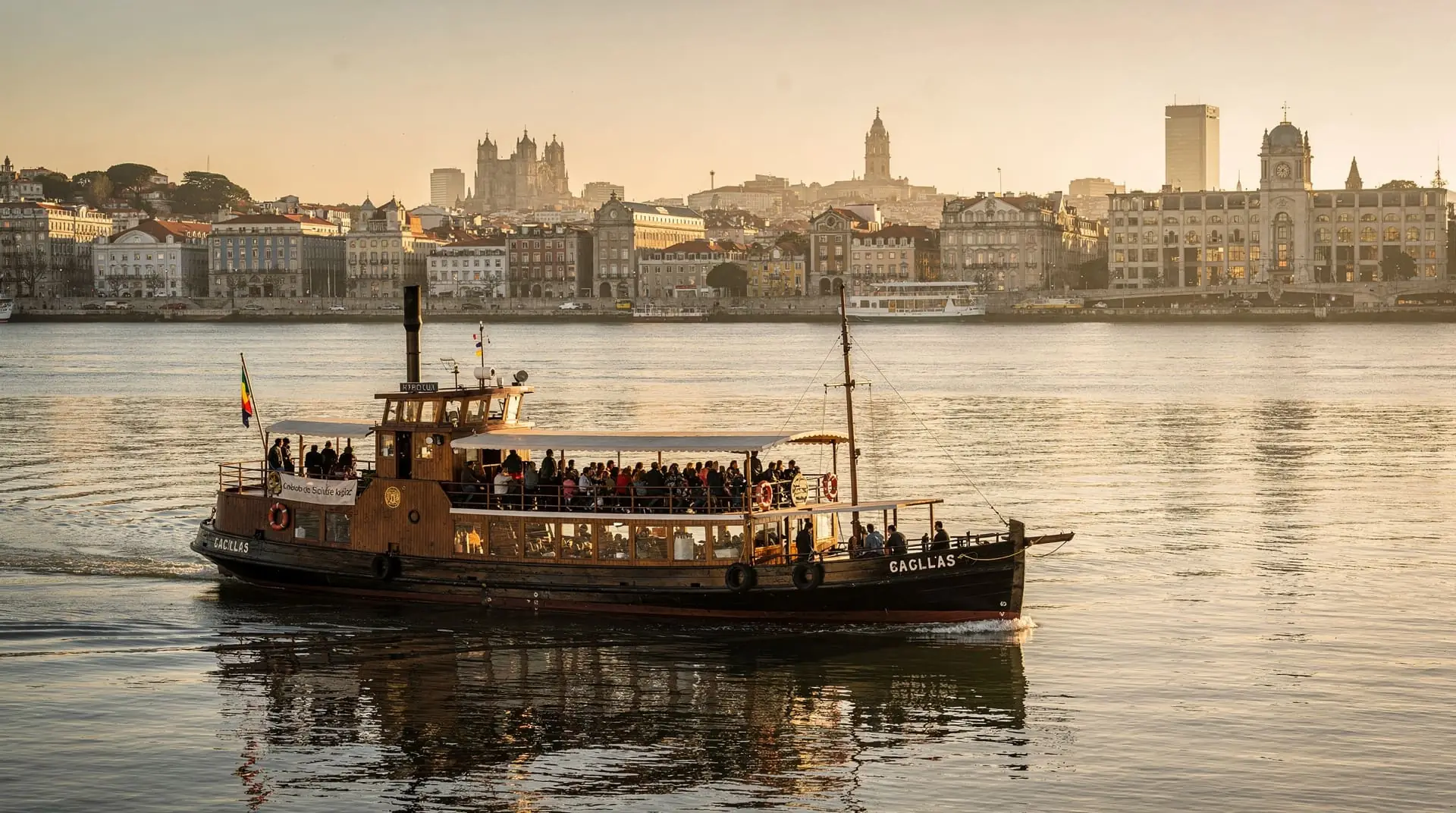
Ferries across the Tagus — routes, prices, and the Cacilhas crossing
Last reviewed
How do I take the ferry across the Tagus from Lisbon?
The main commuter ferry runs from Cais do Sodré to Cacilhas in 10 minutes for about €1.50 each way. Ferries run every 15-30 minutes from early morning until late evening. The crossing gives some of the best panoramic views of Lisbon's waterfront and is a genuine locals' route, not just a tourist experience.
| Main route | Cais do Sodré → Cacilhas, 10 min |
| Cost | Around €1.50 each way (Viva Viagem or Lisboa Card) |
| Frequency | Every 15-30 min, ~05:30-02:00 |
| Best for | Cristo Rei views, Cacilhas seafood, sunrise/golden-hour light |
| Tourist cruises | €25-40/person, 1-2 hours, separate from the commuter ferry |
The Tagus ferries — not just tourist boats
The Tagus (Tejo in Portuguese) is 2.5 kilometres wide at central Lisbon. For the south-bank commuter communities of Almada, Barreiro, Seixal, and Montijo, the ferry is the morning commute. This is not a tourist circuit — these are the same boats used by thousands of Lisbon workers every weekday, with fares calibrated accordingly.
For visitors, the ferries offer three distinct advantages: cheap transport to the south bank, spectacular river views of Lisbon’s waterfront (an angle you cannot get from land), and access to Cristo Rei and the Almada seafront that no land route matches efficiently.
The main routes — Transtejo and Soflusa
Two companies operate Tagus ferry services: Transtejo (shorter routes from central Lisbon) and Soflusa (longer routes to Barreiro on the south bank, used primarily for train connections south).
Cais do Sodré → Cacilhas
The one you will use. This is the classic Lisbon river crossing, running every 15-30 minutes throughout the day and evening.
- From: Cais do Sodré ferry terminal (adjacent to the train station and metro, Linha Verde terminus)
- To: Cacilhas, a waterfront suburb of Almada
- Journey time: 10 minutes
- Frequency: Every 15-30 minutes, first service around 05:30, last around 02:00
- Price: Approximately €1.50 each way (buy at the terminal or use a Viva Viagem card / Lisboa Card)
- Views: Looking back at Lisbon from the ferry — you get the full width of the Baixa waterfront, the Praça do Comércio, the hills of Alfama rising behind, and on clear days the castle — this is the classic postcard view that Instagram cannot fully capture because the scale requires being on the water.
At Cacilhas: The waterfront has several seafood restaurants (A Bica do Sapato is the famous one, though the best local find is the simpler tasca with a river terrace). The Cacilhas Shipyard Museum (Arsenal do Alfeite, viewing from outside only) and the Rio restaurant scene make the 10-minute crossing worthwhile even if you come back immediately.
Cristo Rei from Cacilhas: The giant Christ statue on the Almada cliffs above is a 10-minute taxi ride or a shuttle bus ride from Cacilhas. It is a genuinely impressive viewpoint looking back across the entire sweep of Lisbon and the 25 de Abril bridge. Entry €8.
Cais do Sodré → Montijo
A longer service (45-60 minutes) to Montijo on the southeast bank. Used mainly by commuters and of limited tourist interest.
Terreiro do Paço → Barreiro (Soflusa)
From the Praça do Comércio pier, Soflusa ferries run south to Barreiro (55-60 minutes) — the old rail connection for trains running south before the 25 de Abril bridge existed. Now used for south-bank train connections and day trips to the Alentejo coast.
Belém → Trafaria and Porto Brandão
A seasonal service from Belém across to Trafaria on the south bank, used historically for access to the beaches at Costa da Caparica. Check current status with Transtejo, as this route operates seasonally and has had schedule changes. From Trafaria, buses connect to Costa da Caparica beach (around 20 minutes).
Cais do Sodré → Seixal
A longer service (around 50 minutes) to the far southeast bank. Primarily a commuter route.
Buying tickets
At the terminal: Ticket windows at Cais do Sodré terminal operate during service hours. Straightforward: ask for a single or return to your destination.
Viva Viagem card: The card works at the Cais do Sodré and Terreiro do Paço terminals. Tap at the turnstile or hand to the attendant at smaller piers.
Lisboa Card: Included. Unlimited use of Transtejo and Soflusa ferry services during the card validity period.
Cash: Accepted at ticket windows. No need for exact change.
The view from the river
The Cacilhas ferry ride is a travel experience in itself, not just a crossing. Standing on the open deck as the boat pulls away from Cais do Sodré, the view of Lisbon opens up progressively: first the Praça do Comércio and its arch, then the waterfront towers and Alfama’s orange roofscape, then the castle silhouette, then the hills of Mouraria and Graça stacked behind. The 25 de Abril bridge (red, like the Golden Gate in San Francisco, built 1966) frames the western skyline with the Cristo Rei statue directly below it.
On the return crossing, looking north from the south bank gives you a slightly different angle — the city in wider context, the Tagus broad and silvery.
The ferry is particularly recommended at golden hour. Take the 17:30-18:30 crossing in spring and autumn — the light on the Alfama tiles from the ferry is exceptional.
Tagus river cruises — the tourist option
Beyond the commuter ferries, a large number of tourist cruise operators run Tagus River tours of various lengths. These are completely different from the commuter services — higher price, narrator commentary, sometimes wine or food included.
Lisbon: Tagus River sunset cruise in a traditional vessel — a traditional wooden boat sunset cruise departing from the waterfront, approximately 2 hours, with drinks.
Lisbon: 1 or 2-hour Tagus River cruise — daytime or evening options covering the main waterfront including passing under the 25 de Abril bridge.
The tourist cruises are worthwhile if you want a guided explanation of the waterfront monuments and an extended time on the water. For simple crossing and views, the commuter ferry at €1.50 is hard to beat.
See the Tagus sunset cruises guide for detailed comparison of cruise options.
Practical tips for the Cais do Sodré ferry
Getting to the terminal: The Cais do Sodré ferry terminal is directly adjacent to the train station and metro station of the same name. From the green metro line, follow signs to “Ferries” rather than “Comboios” (trains). The ferry terminal is the modern glass building on the water side.
Crowds and timing: The early morning and evening rush hours (07:30-09:00 and 17:30-19:30) see heavy commuter traffic. The boat fills up quickly, and queueing to board can be slow. At other times, the terminal is relaxed and boarding is quick.
Weather: The Tagus can be choppy in winter, particularly with westerly winds. Spray on the open deck is possible. In summer the crossing is generally smooth. The boats have indoor seating as well as open decks.
Photography: The upper open deck gives the best angles for Lisbon waterfront shots. Grab a position on the right side of the boat (facing Lisbon as you return from Cacilhas, standing on the bow as you depart from Cais do Sodré). Early morning light on the city from the ferry is excellent for photography.
Day trip integration
The Cacilhas ferry fits naturally into a half-day that includes:
- Ferry from Cais do Sodré to Cacilhas
- Lunch at a Cacilhas seafood restaurant
- Taxi or bus to Cristo Rei
- Ferry back to Lisbon
Total time: 3-4 hours, cost per person under €20 including lunch at a modest tasca.
For Costa da Caparica beaches (south bank Atlantic beaches, 30 km south), the routing is:
- Cacilhas by ferry, then bus to Caparica (TST bus 135 from the Cacilhas terminal bus stop, around 45-60 minutes)
- Or TST express buses from Praça de Espanha metro station, direct to Caparica in about 30-40 minutes
The Costa da Caparica beaches guide covers this in more detail. For Almada itself, see the Almada destination page.
For river transport that integrates with your overall Lisbon itinerary, the getting around Lisbon guide has the full picture.
The south bank — what is there beyond Cacilhas
Visitors to Lisbon rarely explore the south bank properly, which is part of what makes it interesting. Cacilhas is the starting point for several distinct experiences.
Cristo Rei
The giant Christ statue on the Almada clifftop is 15 minutes by taxi from Cacilhas (around €8-10). The statue itself (110 metres tall including pedestal) is impressive; the lift to the observation platform gives a panoramic view of Lisbon, the 25 de Abril bridge, and the Tagus that rivals any miradouro in the city — and faces the opposite direction, which means you are looking at Lisbon rather than from it. Entry approximately €8.
Cacilhas waterfront
The Cacilhas waterfront has a row of restaurants specialising in grilled fish and seafood. These are genuinely local places, not tourist-facing — the clientele is almost entirely south-bank residents having lunch on weekdays. The most famous is the large restaurant complex near the ferry terminal, but the smaller tascas a few streets back are typically better value.
Almada town
Almada proper (the town centre, not the Cacilhas waterfront) is a 15-minute walk uphill from the ferry terminal or a short bus ride. The Fortaleza de Almada (medieval fortress) overlooks the river with excellent views. The old town has a quiet charm that Lisbon’s tourist-heavy historic areas have largely lost. Worth an afternoon if you have the time.
Ferry schedules and practical information
Cais do Sodré to Cacilhas — detailed schedule:
- Weekdays: first ferry approximately 05:30, last approximately 02:00. Departures every 15 minutes 06:00-21:00, every 30 minutes at other times.
- Saturdays: similar to weekdays in terms of frequency.
- Sundays: slightly reduced frequency, every 20-30 minutes for most of the day.
Terreiro do Paço to Barreiro:
- Soflusa ferries, approximately 8 services per day on weekdays, less frequent on weekends.
- Journey 55-60 minutes.
- Useful for: Setúbal via rail (Comboios de Portugal trains south from Barreiro), Alcácer do Sal, and Alentejo coastal towns.
Key information to check before travelling:
- Strikes (greves) do occur occasionally on Portuguese ferry services. Check Transtejo’s website or Twitter/X feed before an important travel day.
- Strong westerly winds (Nortada) can slow or briefly suspend the Cacilhas crossing in winter. This is uncommon and brief.
Sunrise and early morning on the ferry
The Cais do Sodré to Cacilhas crossing at dawn (approximately 07:00 in winter, 06:30 in summer) is one of the underrated Lisbon experiences. The city is quiet, the light on the water is extraordinary, and the commuters around you going about their morning create a genuine sense of the city’s real rhythm. If you are an early riser or a photographer, this is worth doing specifically for the light — not as transport, but as experience.
The reverse (Cacilhas to Cais do Sodré) at the same hour gives the full Lisbon waterfront shot with the early morning light catching the buildings. The Praça do Comércio arch, the Alfama roofscape, and the Castelo de São Jorge are all visible in a single sweeping view as the boat approaches the Lisbon terminal.
Tagus River boat tours — the tourist circuit in detail
Beyond the commuter ferry, a dozen or more boat tour operators work from the Lisbon waterfront (primarily from the piers near Praça do Comércio and Cais do Sodré). These range from traditional wooden vessels (barco típico) to modern catamarans to party boats.
Sunset cruises (most popular): Depart 18:00-19:00, return 20:00-21:00. Duration 1-2 hours. Price €25-40 per person typically. Many include a welcome drink (wine, beer, or soft drink). The itinerary usually includes passing under the 25 de Abril bridge and a return view of the Alfama waterfront at golden hour.
Morning and daytime cruises: Less popular but pleasant — the river is calmer in morning, light is different, and prices are often lower. Good option if you prefer the light or want to avoid sunset-crowd boats.
Traditional barco típico: Wooden boats with a single sail, the traditional vessel of the Tagus. Several operators use authentic or replica traditional boats. The experience feels different from a catamaran — slower, more romantic, more intimate.
Lisbon: Tagus River cruise with welcome drink — 2026 — a 2-hour river cruise with drink included, covering the main waterfront sights.
Lisbon: sunset catamaran boat tour with music and drinks — the party version: music, drinks, catamaran, sunset. Different atmosphere to the traditional vessel tours.
For a complete comparison of all Tagus boat tour types, see the Tagus sunset cruises guide and the which Tagus cruise guide.
Kayaking and paddleboarding on the Tagus
Beyond motor boats, the Tagus near central Lisbon supports kayaking and stand-up paddleboarding. Several operators run guided SUP and kayak tours from the waterfront, typically departing from near Belém or Cais do Sodré.
These are particularly good in spring and autumn when the water is calm and temperatures comfortable. In summer, the Nortada afternoon wind picks up (typically from 14:00 onwards) and makes conditions choppy for paddling. Morning sessions are recommended.
See the kayaking and SUP in Lisbon guide for specific operators and what to expect.
The Tagus from above — bridge and viewpoint perspectives
The 25 de Abril bridge offers two perspectives worth knowing about. From Belém or the waterfront, the bridge’s red towers (remarkably similar to the Golden Gate in San Francisco — they share the same engineering firm) frame the western approach to the Tagus. From the bridge itself, looking back toward Lisbon, the panorama is extraordinary — but the bridge has no pedestrian path, so this view is available only from a car or bus crossing it.
The Pilar 7 Bridge Experience (pier beneath the bridge on the north bank) offers an ascent to the bridge’s structure with panoramic views, and is included in the Lisboa Card. An unusual and undervisited attraction in Belém.
On the south bank, the Cristo Rei viewpoint (accessible from Cacilhas by taxi) faces north directly at Lisbon and the bridge — the best angle for photographing both together.
Integrating the ferry into a Lisbon itinerary
The Cacilhas ferry is one of the most underused tourist experiences in Lisbon — partly because it does not appear prominently in most travel itineraries and partly because it is primarily a commuter service. For visitors, it offers genuine value that goes beyond transport.
Best integration points:
A half-day south bank excursion fits naturally into a 3-5 day Lisbon visit. The structure:
- Morning: explore central Lisbon (Chiado, Baixa, Praça do Comércio)
- 12:30: ferry from Cais do Sodré to Cacilhas (10 minutes)
- Lunch: seafood at a Cacilhas riverside restaurant
- Afternoon: taxi to Cristo Rei, visit the viewpoint and statue
- 15:30-16:00: taxi back to Cacilhas, ferry back to Lisbon
- Evening: Tagus sunset cruise departing from Praça do Comércio piers (different experience from the commuter ferry)
Total additional transport cost: €1.50 (ferry each way) + €8-10 (taxi to Cristo Rei) = under €13.
For families with children: Children find the ferry crossing genuinely exciting — the scale of the Tagus at crossing point (2.5 km wide) is impressive, the boat movement is gentle, and the views are immediately understandable even to young children. Cristo Rei is large and visually striking for children. The half-day south bank excursion is one of the better family-friendly Lisbon activities.
The Lisboa Card and ferry travel
The Lisboa Card covers unlimited use of Transtejo and Soflusa ferries throughout its validity period. This is worth factoring into the break-even calculation, particularly if you plan to do the Cacilhas crossing multiple times (morning for a view, return for lunch, potentially another evening crossing for the golden-hour return vista).
At €1.50 per crossing, two return trips to Cacilhas (four crossings) cost €6 — over 25% of the 24h Lisboa Card cost. Combined with museum entries and metro journeys, the ferry inclusion helps the card pay off.
See the Lisboa Card worth-it guide for the full calculation.
Historical context — why Lisbon faces the river
Lisbon’s orientation toward the Tagus is a function of its entire history. The city was a major Atlantic trading port from the Age of Discoveries (15th-16th centuries), when Portuguese navigators charted routes to Africa, Brazil, and Asia. The riverfront — Praça do Comércio, the docks, the marble quays — was the commercial and administrative heart of an empire.
The 25 de Abril bridge (1966) was the first fixed crossing of the Tagus near Lisbon, ending 500 years in which the only crossings were ferries. Before the bridge, getting from Lisbon to the south bank by anything other than a boat was a significant undertaking. The commuter ferry to Cacilhas is a direct continuation of a practice that predates the 1755 earthquake.
Understanding this history makes the ferry crossing feel different: you are using the same route that residents and merchants used for five centuries, looked at the same city from the same angle, and arrived at a south bank that is genuinely and historically separate from the north.
For the broader Lisbon transport picture, see getting around Lisbon. For the broader Tagus river experience, see the Tagus sunset cruises guide and which Tagus cruise guide.
Combining the ferry with Almada beyond Cacilhas
Cacilhas itself is only the landing point; Almada council covers a wider stretch of the south bank worth knowing about if you have more than an hour to spare. Beyond Cristo Rei, the Fórum Almada shopping centre and cinema complex is a 10-minute bus ride from Cacilhas — useful on a rainy day, though not a reason to cross the river on its own. Further south, the Costa da Caparica beaches are reachable by bus from Cacilhas terminal (TST bus 135, 45-60 minutes), making a ferry-plus-beach combination possible for a full day rather than a quick crossing. See the Costa da Caparica beaches guide for the beach half of that day, and the Almada destination page for the wider area.
Almada’s viewpoints — beyond Cristo Rei — include a series of miradouros along the clifftop that look back at Lisbon from angles most visitors never see, since the vast majority of ferry passengers go straight to Cristo Rei and back. For a quieter version of the same panorama, the clifftop path near the Elevador Panorâmico da Boca do Vento (a public lift connecting the clifftop to the riverside, free to use) gives an alternative route down to the water without retracing your steps through Cacilhas.
Ferries with children and limited mobility
The Cacilhas ferry is one of the more accessible Tagus experiences for families and visitors with mobility considerations. The terminal at Cais do Sodré has a level, ramped approach from the metro and train station, and the boats themselves have both open-deck and enclosed seating, so a child (or an adult) who does not want to stand in the wind has a comfortable indoor option. Buggies and wheelchairs board without difficulty via the ramped gangway — this is a genuine advantage over trams and the funiculars, which involve steps.
At Cacilhas, the terminal area itself is flat, but the walk up to Almada town or the taxi rank requires a short uphill stretch. For Cristo Rei specifically, a taxi from the terminal is the practical option with a buggy or for anyone who finds hills difficult — walking is possible but steep.
Cost comparison: ferry versus alternatives to the south bank
For visitors weighing whether the ferry crossing is worth building into an itinerary, here is how it compares to the alternatives for reaching the south bank and Cristo Rei:
| Method | Cost per person | Time | Notes |
|---|---|---|---|
| Ferry + taxi to Cristo Rei | ~€1.50 + €8-10 taxi | ~25 min total | Best views, cheapest combined option |
| Taxi/Uber via the bridge directly | €15-25 one-way | ~20-25 min | No river views, more expensive, faster door-to-door |
| Organised half-day tour incl. Cristo Rei | €35-55 | Half day | Guided, no logistics to manage |
| Tourist river cruise (no south-bank stop) | €25-40 | 1-2 hours | River views without landing on the south bank |
The ferry-plus-taxi combination is consistently the cheapest way to see both the river and Cristo Rei, which is part of why it remains popular with budget-conscious visitors despite being less well known than the tram or metro.
Related guides
Getting around Lisbon — the complete transport guide
Metro, trams, funiculars, ferries, buses: everything you need to navigate Lisbon in 2026. Real prices, routes, and honest tips.
Trains to Sintra and Cascais from Lisbon — timetables, prices, tips
How to take the train from Lisbon to Sintra (40 min, €2.40 return) and Cascais (40 min, €2.40 return). Stations, frequency, and honest planning advice.
Getting from Lisbon airport to the city centre — all options compared
Metro, Aerobus, Uber, taxi: how to get from Humberto Delgado airport to central Lisbon. Real prices 2026, journey times, and scam warnings.

How to get to each day trip from Lisbon — transport guide 2026
Bus, train, or guided tour: how to reach Évora, Óbidos, Nazaré, Fátima, Sintra, Cascais, Arrábida, and more from Lisbon. Real prices and journey times.
Ready to book? Top tours for this guide
We earn a small commission if you book through GetYourGuide — at no extra cost to you. Every tour is hand-picked and verified.

Lisbon: 48-Hour Hop-On-Hop-Off Bus Tour and Oceanarium Entry
Lisbon: MAAT Entry Ticket & Dolphin Watching Boat Tour
Lisbon: Alfama, Mouraria Walking Tour with Fado Night, Tapas
Lisbon: Hop-On Hop-Off Bus Tour
Lisbon: 1-or 2-Day Hop-On Hop-Off Bus Tour