Almada
South bank across the Tagus: Cristo Rei statue, Cacilhas seafood, the 10-minute ferry from Lisbon, and panoramic views back to the capital.
Quick facts
Top tours and experiences
We earn a small commission if you book through GetYourGuide — at no extra cost to you. Every tour is hand-picked and verified.
Setubal & Tróia: Sado Estuary Dolphin Watching Boat Trip
Sesimbra: Arrábida Beaches & Caves Boat Tour with Snorkeling
Sesimbra: Secret Bays and Beaches Boat Tour with Snorkeling
Sesimbra: Private Boat Tour-Wild beaches, secret bays, Caves
Sesimbra: Scenic Boat Tour & Snorkeling/Paddle Boarding
Sesimbra: Boat Tour with Lunch at Portinho da Arrabida
Almada is what most Lisbon visitors see from across the Tagus: the south bank cliff with Cristo Rei’s arms spread wide above the 25 de Abril Bridge. It is a city of 175,000 people, almost none of whom are tourists, and that demographic gap is one of its main attractions. Take the 10-minute ferry from Cais do Sodré to Cacilhas, walk up the hill to the old town for lunch at a cervejaria that has been feeding dockers and sailors since the 1960s, then continue to Cristo Rei and spend an hour looking back at Lisbon from a platform with arguably the best view of the capital.
This is a half-day excursion, not a major sight. But it is one of the most undervisited half-days available from Lisbon, and the ferry crossing alone — standing on the top deck as Lisbon recedes and the 25 de Abril Bridge comes level with you — is worth the €1.50 ticket price.
| Where | South bank of the Tagus, opposite Lisbon, via a 10-minute ferry |
| Cost | Ferry ~€1.50 each way; Cristo Rei platform ~€6 |
| Time needed | Half a day (2–4 hours) |
| Getting there | Ferry from Cais do Sodré to Cacilhas |
| Best time | Clear afternoons, 3–4pm, for the best light on Lisbon |
Getting to Almada
By ferry from Cais do Sodré — the standard and best approach. Transtejo commuter ferries depart from the Cais do Sodré terminal (adjacent to the train station and Metro) throughout the day; the journey to Cacilhas takes about 10 minutes and costs approximately €1.50 each way. Ferries run roughly every 10–15 minutes in peak hours. This is a commuter service, not a tourist boat — buy a single ticket or use a Viva Viagem card and it works like any other transit.
By bus from Praça de Espanha — TST operates services from Lisbon to Almada, but the ferry is faster, cheaper, and more enjoyable.
By car — cross the Ponte 25 de Abril (Lisbon side, toll applies southbound) and follow signs for Almada/Cristo Rei. Parking is available near the Cristo Rei lift. A taxi from Cacilhas to Cristo Rei costs €8–10.
For the ferries guide and general south bank transport, including connections onward to Costa da Caparica, see the detailed guide.
What to see and do in Almada
Cacilhas waterfront and old town
The ferry lands at Cacilhas, a neighbourhood of Almada on the waterfront directly opposite Lisbon. From the ferry terminal, the view back across the Tagus takes in Alfama, the 25 de Abril Bridge, and the Belém waterfront in one sweep — this is one of the best vantage points for photographing Lisbon, and it costs nothing.
The streets immediately behind the ferry terminal make up old Cacilhas: narrow, quiet, with tilework on the building facades, old café signs, and the smell of grilled fish from the restaurants that have clustered here since the neighbourhood functioned as a ferry stop for Lisbon workers.
Cervejaria O Pescador and the Cacilhas seafood strip
Rua Cândido dos Reis in Cacilhas is the main restaurant street, running parallel to the waterfront. It is lined with cervejarias and seafood restaurants that cater almost entirely to Portuguese clientele — workers, families, south-bank commuters returning via Lisbon. The prices are noticeably lower than comparable restaurants in Lisbon’s Baixa or Bairro Alto.
Cervejaria O Pescador is one of the oldest and most respected. The fish is displayed on ice at the entrance — bream, bass, sole — and grilled simply with olive oil and salada mista. A full lunch for two with wine costs €30–40. No booking needed for lunch on weekdays; weekend lunches can wait.
Atira-te ao Rio on the waterfront is a larger, more tourist-aware option with river views. The food is good but priced closer to Lisbon standards (€20–25 for a fish main). Better for the ambiance than the value.
Ponto Final is further along the waterfront toward the Cristo Rei side — a small restaurant almost underneath the 25 de Abril Bridge with exceptional views. Arrive before 12:30pm for a table at lunch.
Cristo Rei
The Cristo Rei statue is not a copy of Rio’s Christ the Redeemer — it predates it in concept (construction began in 1949, completed in 1959) and differs in style. The figure stands atop an 82-metre concrete tower on a 28-metre pedestal on the Almada clifftop. A lift takes you to the 75-metre observation platform; an additional flight of stairs reaches the statue’s feet.
Views — the platform gives a 360-degree panorama: Lisbon’s full waterfront spread across the north bank, the 25 de Abril Bridge at eye level to your right, the Arrábida hills to the south, and the Sado Estuary visible on clear days. For photographers, the late-afternoon light hitting Lisbon from the west is exceptional — consider timing your visit for 3–4pm in summer.
Getting from Cacilhas to Cristo Rei — walk (35–40 minutes uphill through the old town and past the municipal gardens, with good views along the way) or take a local bus from Cacilhas ferry terminal (bus 101 or 135, around 15 minutes). Taxis are also available at the terminal (€8–10).
Entry — the lift is ticketed, around €6 per adult. A small chapel and gift shop at the base are free to enter.
Queue warning — the lift to the observation platform can have a 20–45 minute queue in summer. Arrive early (it opens at 9am) or later in the afternoon when cruise ship groups have moved on.
From Lisbon: private full-day trip Serra da Arrábida, Sesimbra and SetúbalAlmada old town (Villa Velha)
The old quarter of Almada sits on the cliff above Cacilhas — a small grid of streets with a church (Igreja de Santa Maria do Castelo), a ruined castle, and residential buildings whose backyards face north over the Tagus toward Lisbon. It is quiet, authentic, and receives almost no tourist visitors despite the views. The Museu da Cidade de Almada on Rua de São João covers local history; modest collection, free entry on Sundays.
The cliff promenade (Passeio Panorâmico)
Below Cristo Rei and along the clifftop, a promenade follows the Tagus shore. The Elevador Panorâmico da Boca do Vento links Cacilhas waterfront to the old town level (elevator costs €1, runs most days). From the upper level, the promenade to Cristo Rei is pleasant on a clear day and usually quiet.
Where to eat in Almada
The Cacilhas seafood strip on Rua Cândido dos Reis is the destination. Beyond the options above:
O Faroleiro has been on this street for decades — a traditional cervejaria serving grilled fish, perceves, and amêijoas à Bulhão Pato. Good for a long lunch; expect €25–35 for two with a bottle of local white wine.
Café Central de Almada near the ferry terminal is the place for a morning coffee and pastel de nata while you wait for the ferry to depart — nothing fancy, but genuinely local.
Where to stay in Almada
Almada has hotels but they cater mainly to business travellers and visitors who cannot find accommodation in Lisbon. For tourists, staying in Almada rather than Lisbon is not recommended — the south bank is well-connected by ferry, but Lisbon’s restaurant and cultural life is on the north side.
If you need to stay: Hotel Cristal Beira Rio (3-star, near Almada town centre, from €65–80/night) is functional; Hotel Holiday Inn Almada (4-star, from €90–120) near the Cruz de Pau area is the most reliable business-class option.
How long to spend
Two to three hours is the natural length of an Almada visit: ferry over, 45 minutes in Cacilhas for a coffee and waterfront views, 20-minute bus or walk to Cristo Rei, 45–60 minutes at the statue and platform, return to Cacilhas for lunch.
Half a day lets you add the old town promenade, a proper sit-down lunch, and a relaxed ferry back. This is the pace that makes the outing feel worthwhile rather than rushed.
Almada plus Costa da Caparica (combined day) works well: morning at Cristo Rei, lunch in Cacilhas, TST bus to Costa da Caparica for an afternoon on the beach, bus back to Praça de Espanha. See the Costa da Caparica guide.
Honest tips and traps
The Cristo Rei lift queue is real. In July–August, particularly on weekends and whenever a cruise ship is in port at Lisbon, queues for the observation platform lift can reach 45 minutes. Arrive at opening (9am) or after 4pm.
The ferry schedule thins late at night. Last ferries from Cacilhas to Lisbon typically run around midnight, but frequency drops significantly after 10pm. If you plan a late dinner in Cacilhas, check the return schedule before you go.
Almada is not Lisbon. The south bank has its own character — quieter, more residential, less international. Some visitors find it refreshingly authentic; others find it dull. Go for the ferry crossing, the Cristo Rei view, and the lunch; do not go expecting the energy of Alfama or Chiado.
The climb to the old town is steep. Walking from Cacilhas waterfront up to Villa Velha or Cristo Rei on a hot day is tiring. Use the elevator (Elevador Panorâmico) for the first section, or take a bus.
How Almada fits an itinerary
Almada is the most natural half-day excursion for visitors who have already covered Lisbon’s main sights. It requires no planning beyond knowing the ferry times and costs virtually nothing to reach. It pairs particularly well with:
- Costa da Caparica for an afternoon beach extension
- An afternoon walk back along the Tagus waterfront in Lisbon itself (take the ferry back to Cais do Sodré and walk east to Alfama)
- A Tagus river cruise in the evening departing from Belém — you can see Cristo Rei from the water as the sun sets
For overview planning, see day trips from Lisbon and best Lisbon viewpoints. Almada appears in the Lisbon 3-day itinerary as an optional half-day addition to a south bank afternoon.
Almada’s history on the south bank
Almada’s relationship with Lisbon is as old as the city itself. The south bank was always the necessary complement to Lisbon’s north: a working ferry crossing existed at Cacilhas in Roman times (the crossing was called Portus Alaabiae), and the cliff above Cacilhas was fortified throughout the medieval period as a defensive position covering the Tagus.
The 25 de Abril Bridge, built 1962–1966, was a transformative moment for Almada — it became commuter territory for Lisbon’s growing population, and the city expanded rapidly through the 1970s and 1980s into the flat hinterland south of the cliff. The Cristo Rei statue, completed in 1959, predates the bridge — it was built partly in thanks for Portugal avoiding active involvement in World War II, and partly as a counterpart to the Christ the Redeemer statue in Rio de Janeiro, which Portuguese bishops had admired on a visit in 1934.
The old fishing village of Cacilhas, now a neighbourhood of Almada rather than a separate settlement, has preserved its pre-bridge character more than most of the south bank. The restaurant strip on Rua Cândido dos Reis still looks and functions much as it did in the 1970s. The dockers who used to cross to work in Lisbon’s industries have been replaced by office workers, but the cervejaria culture remains intact.
Walking route: ferry to Cristo Rei on foot
For visitors who prefer to walk rather than take a bus, the route from Cacilhas to Cristo Rei through the old town is enjoyable and takes around 40 minutes:
- From the Cacilhas ferry terminal, walk along the waterfront briefly, then turn left up Rua Cândido dos Reis (past the cervejarias).
- Follow the road as it curves uphill into the old quarter. The Elevador Panorâmico da Boca do Vento is on your left — take the elevator (€1) to the upper cliff level if you prefer not to climb the steepest section on foot.
- At the top, follow the clifftop promenade westward toward the Cristo Rei base. The views of Lisbon across the Tagus are excellent throughout.
- The statue’s base is reached after approximately 35 minutes of walking from the elevator top station.
This route passes through the old town (Villa Velha) where the Igreja de Santa Maria do Castelo and the ruined castle are accessible. It is a pleasant alternative to the bus and gives you a better sense of the Almada cliff geography.
The best photo spots
Almada’s real draw for photographers is the reverse angle it gives on Lisbon — a city that, from its own hills, is hard to see whole. The Cacilhas ferry terminal forecourt is the easiest win: step off the boat and Alfama, the 25 de Abril Bridge and the Belém waterfront line up in a single frame, at eye level, for free. The Cristo Rei observation platform goes higher and wider — the full north bank from Parque das Nações to Belém, with the bridge running directly beneath you. Go in the late afternoon (around 3–4pm in summer) when the light comes from the west and rakes across Lisbon’s rooftops rather than flattening them from directly overhead.
The clifftop promenade below Cristo Rei gives a quieter, uncluttered version of the same view without the platform queue — useful if you only want the shot and not the lift ticket. For a different subject entirely, the Cacilhas seafood strip at dusk, with the cervejaria signs lit and the fishing boats moored opposite, is a less obvious but genuinely characterful frame. None of these require special access or timing beyond avoiding the midday flat light; see the best Lisbon viewpoints guide for how Almada’s angle compares with the city’s own miradouros, and getting around Lisbon for combining the ferry with the rest of a day’s transport.
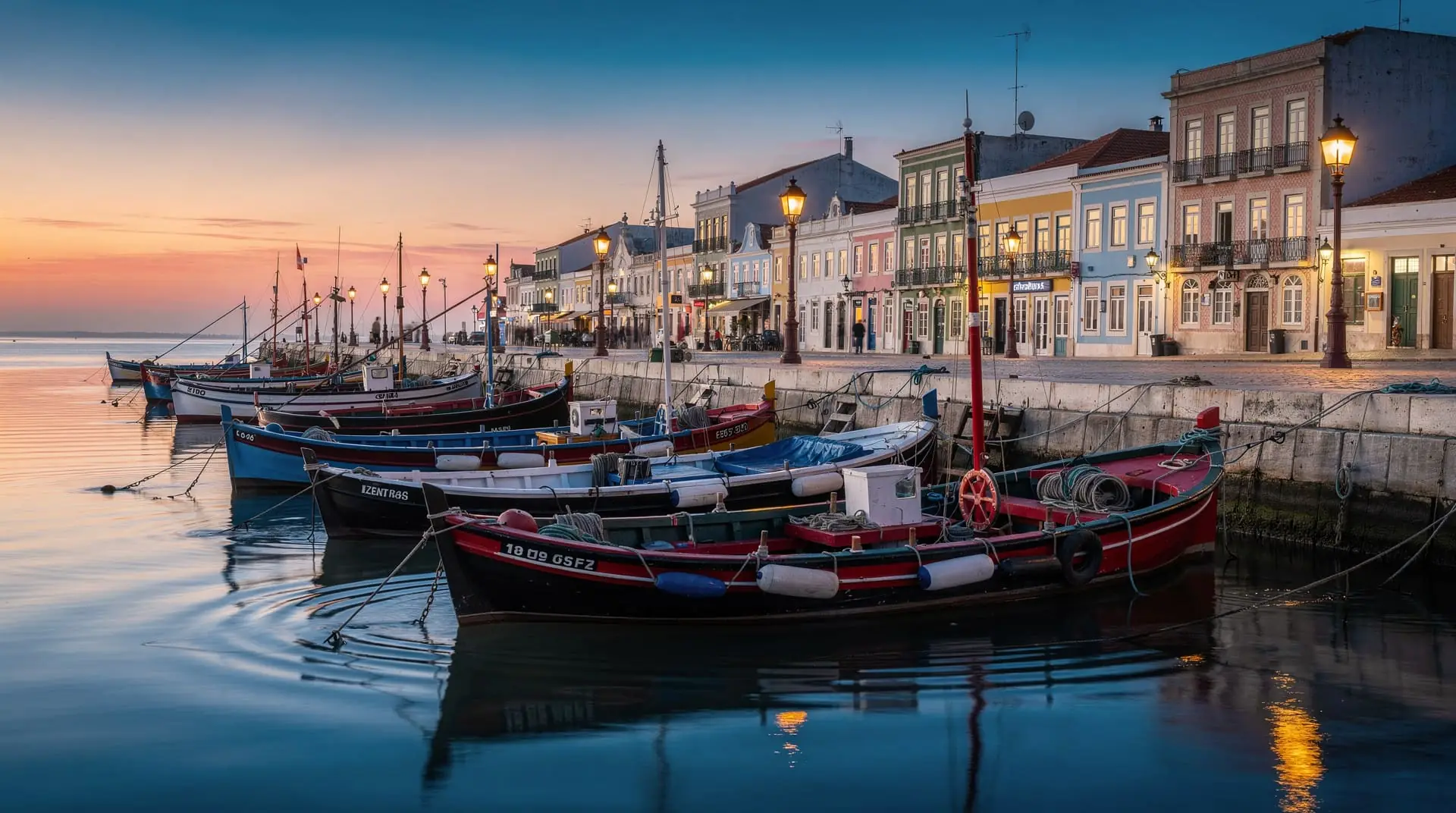
The ferry crossing itself is worth treating as a photo opportunity rather than dead travel time. Stand on the open top deck rather than inside the cabin — most passengers sit indoors, so the best rail positions are usually free. The crossing takes only 10 minutes each way, so if the light isn’t working on the outbound trip, the return leg gives a second, differently lit chance at the same skyline. Late afternoon crossings, when the sun sits low over Lisbon’s rooftops, consistently produce the strongest results.
None of these spots require a tripod or specialist gear — a phone camera handles all of them well given how much natural contrast the scene already provides between water, stone, and sky. The one piece of equipment worth having is a lens cloth: the sea spray on the open ferry deck settles on phone cameras faster than most visitors expect, and a smeared lens ruins more Almada photos than bad weather does.
Frequently asked questions about Almada
How do I get from Lisbon to Cristo Rei without a car?
Ferry from Cais do Sodré to Cacilhas (10 min, ~€1.50). From Cacilhas ferry terminal, take TST bus 101 or 135 to Cristo Rei (about 15 minutes) or walk uphill through the old town (35–40 minutes). The ferry runs every 10–15 minutes in peak hours; buy a single ticket at the terminal or use a Viva Viagem card.
How much does Cristo Rei cost to visit?
The observation platform is ticketed — around €6 per adult in 2026. The chapel and grounds at the statue’s base are free. The lift to the platform can have significant queues in summer; arrive early (opens around 9am) to minimise waiting time.
Is the view from Cristo Rei better than Lisbon’s miradouros?
Different rather than better. Cristo Rei gives you an unobstructed view of Lisbon across the Tagus — the full north bank from Belém to Alfama to Parque das Nações. Lisbon’s own miradouros (Senhora do Monte, Portas do Sol) give interior city views and are free. For the definitive Lisbon-across-the-water panorama, Cristo Rei is the option; for the in-city sunset view, Senhora do Monte wins. The best Lisbon viewpoints guide compares them all.
What is the food like at the Cacilhas restaurants?
The Cacilhas seafood strip on Rua Cândido dos Reis serves traditional Portuguese cervejaria food — grilled fish, shellfish, petiscos — at prices around 20–30% lower than equivalent Lisbon tourist restaurants. The clientele is almost entirely local, which is a reliable quality indicator. Cervejaria O Pescador is the most consistently recommended; arrive before 1pm at weekends to get a table without waiting.
Can I combine Almada and Costa da Caparica in one day?
Yes. Morning ferry to Cacilhas, bus to Cristo Rei (or walk through the old town), lunch at Cacilhas, TST bus from Almada to Costa da Caparica (~30 min), afternoon on the beach, TST bus 161 back to Praça de Espanha in Lisbon. A manageable and enjoyable full day with no car required.
Does the Lisboa Card cover the ferry to Cacilhas?
The Lisboa Card does not cover Transtejo ferry services — the €1.50 ferry ticket must be bought separately. It does cover Metro and Carris buses within Lisbon. For planning your day’s transport costs, use the Lisboa Card calculator to check whether the card makes sense given your intended activities.