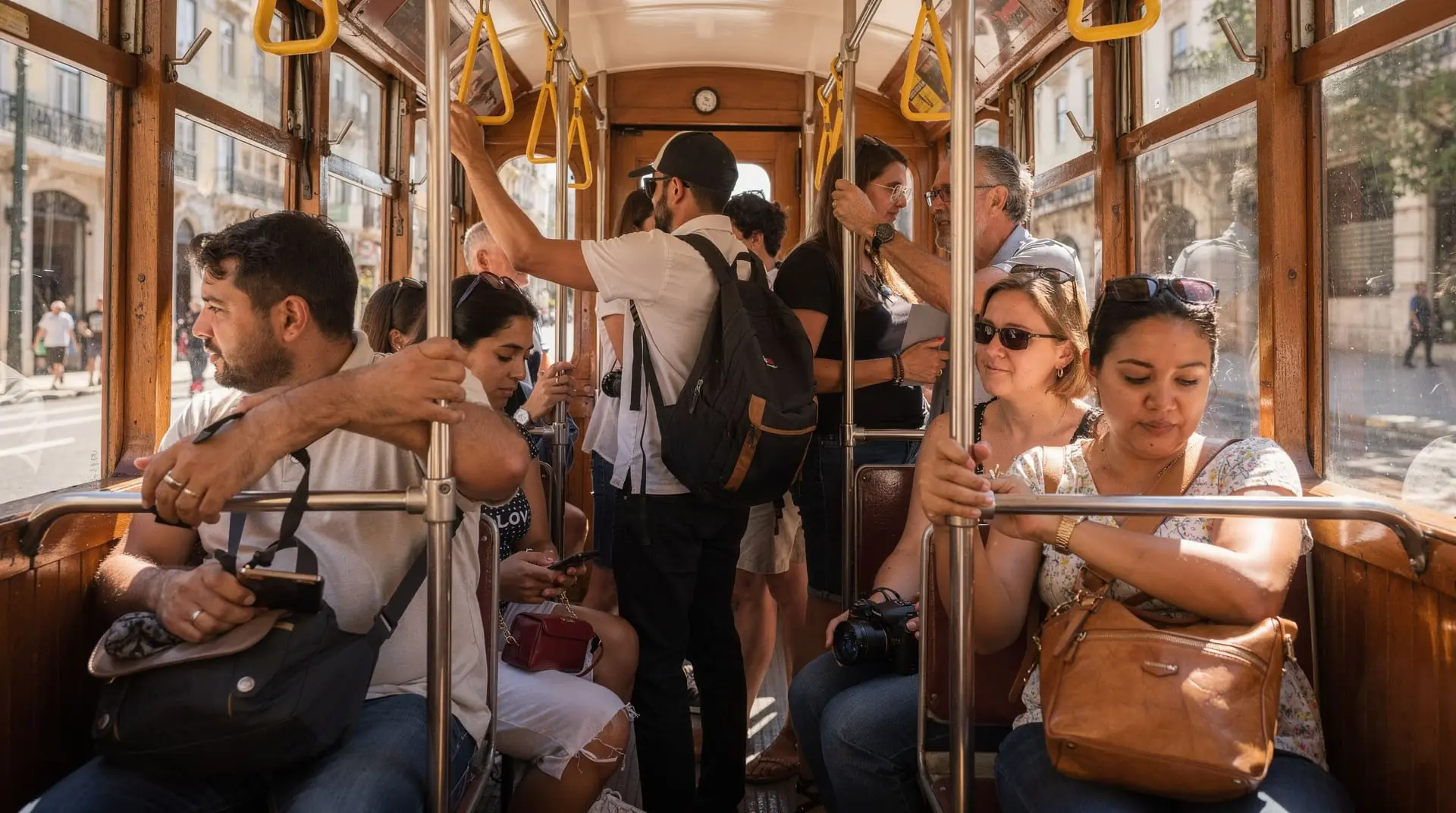
Tram 28 pickpockets: what actually happens and how to protect yourself
Last reviewed
Is tram 28 really dangerous for pickpockets in Lisbon?
Moderately, in specific conditions. The risk is highest between 10am and 4pm in summer, when the tram is packed so tightly that movement is impossible. The mechanics are jostling and distraction rather than anything violent. Board at Martim Moniz (the terminus), travel before 10am or after 4pm, keep your phone in a front pocket, and your risk drops to near zero.
| Where | Highest risk between Sé cathedral and Graça, especially at Portas do Sol |
| Risk level | moderate, concentrated 10am–4pm in summer; low outside that window |
| Time needed | full route 30–40 minutes |
| Getting there | board at Martim Moniz terminus, not a mid-route stop |
| Best time | before 10am or after 4pm for the lowest-risk ride |
The tram itself is not the problem
Tram 28 is a genuine piece of Lisbon’s working infrastructure — a 1930s electric tram that runs real routes that real residents used to ride to work. The tram company (Carris) runs it competently. The drivers are professional. The hardware is genuinely antique and genuinely charming.
The problem is specific: in peak tourist hours, the tram becomes one of the most crowded spaces in Lisbon — an enclosed, slow-moving vehicle where 80 people are packed into space designed for 40, tourists are distracted by photography and the view, and the crowd density is close to ideal for practiced theft.
This guide is about exactly how that works, not about telling you to avoid tram 28. You can ride it safely. The information here is what makes that possible.
How tram 28 pickpocketing actually happens
Understanding the mechanics removes most of the mystery and most of the risk.
The operating principle: Pickpocketing works on distraction plus crowd density. The tram provides both naturally. A tourist is standing, holding a phone to photograph the narrow alley, bag unzipped, while the tram jolts over cobblestones. Thieves exploit each element.
Method 1 — The bump: One person (sometimes posing as another tourist) stumbles into you at a tram jolt. In the confusion of catching themselves, they — or a partner positioned behind you — remove an item from a loose pocket or unzipped bag. The bump provides both opportunity and an alibi. The whole interaction takes under 3 seconds.
Method 2 — The hold and the fish: A thief positions behind you and, while you are focused forward (on the view, on your phone, on your companion), reaches into a bag that is hanging behind your body or into a back trouser pocket. This requires no contact and no excuse — it simply happens in a crowd dense enough that you cannot turn freely.
Method 3 — The photograph distraction: One person asks you to take their photo (or offers to take yours), which requires you to hand over or at least hold your phone at the ready. Their partner, positioned to your other side, works on pockets or bag clasps during the distraction.
Method 4 — Exit pressure: As the tram slows to a stop and passengers press toward the door, the jostling of exiting creates another distraction window. Items are taken in the final 30 seconds before you step off.
The high-risk zones on the route
The tram 28 route runs from Campo Ourique in the west to Martim Moniz in the east (and vice versa). The risk is not uniform.
Highest risk segment: Alfama — from Sé cathedral to Graça, particularly the narrow stretch through Escadinhas de São Cristóvão. This is where the route is most photographed, where tourists are most distracted, and where the carriage is most likely to be at full capacity.
High risk stops for boarding: If you board at Portas do Sol, Sé or Castelo (São Jorge Castle area) between 10am and 4pm, you are joining a full tram mid-route. There is no seating. You stand in a compressed crowd for the remainder of the journey.
Lower risk segments: The western stretch (Estrela, Largo do Rato, Chiado) carries more local commuter traffic proportionally and the tourist density is lower. The early morning runs (before 9am) are substantially different from midday runs in volume.
Who actually gets pickpocketed
Based on patterns documented by the Lisbon tourist police (PSP), victims share common characteristics:
Phone in back pocket: The single most reliable predictor. A smartphone in a back jeans pocket is accessible without the owner noticing, particularly when they are facing forward.
Bag worn on the back or side: A day-pack or crossbody worn behind the body is inaccessible to your own hands during the jostling. Unzipped pockets are trivially accessible to someone standing behind you.
Phone held for photography: Holding a phone at chest height to photograph the alley ahead means your hands and attention are occupied. A partner standing to your left does not register in your peripheral focus.
Early in the trip: Victims tend to be in their first 1-2 days in the city, when vigilance is lower and novelty is high.
The mitigation: what actually reduces risk
These are ranked by effectiveness:
1. Travel before 10am or after 4pm. This is the single most effective measure. The tram at 7am carries mainly construction workers and early-rising locals. The pickpocket window is a function of tourist density, and tourist density is a function of time.
2. Board at Martim Moniz terminus. The terminus is the eastern end of the route. Departures from here mean boarding an empty tram — you get a seat and the crowd builds gradually rather than you joining a full carriage. From the western terminus (Campo Ourique), the same logic applies.
3. Phone in front pocket. A front trouser pocket requires reaching across your body to access from outside — awkward in a moving crowd. This is the simplest physical intervention.
4. Bag in front. Wear your day-pack or crossbody on your front (chest or stomach) while on the tram. It looks slightly odd. It is effective. Your hands can rest on it without appearing paranoid.
5. Leave cash and cards in hotel. Travel with the day’s spending cash plus one card. If the worst happens, the loss is bounded. A money belt (worn under clothing) eliminates virtually all risk for wallets.
6. Seat rather than stand. If you board at the terminus and take a window seat, you are substantially safer — access to your pockets requires someone leaning over you, which is conspicuous.
The tram is still worth riding
None of the above should suggest you skip tram 28. The experience of riding it through Alfama and Graça — the tram grinding up steep cobblestone streets, the occasional contact with stone walls and building overhangs, the views opening suddenly at Miradouro das Portas do Sol — is genuinely one of the better things you can do in Lisbon.
The appropriate response to the risk is mitigation, not avoidance.
If the prospect of crowded public transport is particularly uncomfortable, the tuk-tuk tours that shadow the tram 28 route offer the same neighbourhoods in a private vehicle with a guide and no pickpocket risk. See our tram 28 vs tuk-tuk comparison.
Lisbon tram 28 ride with guided walking tour Lisbon city tour by private tuk-tuk — no crowd riskIf it happens: immediate steps
Step 1 — Freeze cards first. Call your bank immediately; have the international number saved somewhere other than the stolen phone. Most UK and US banks have freeze-from-app functionality — if you have a second device or can borrow one, freeze cards before they are used.
Step 2 — Check whether the item was simply dropped. In the confusion, items sometimes end up on the tram floor. Look before assuming theft.
Step 3 — File a police report. Required for travel insurance claims. The PSP (Polícia de Segurança Pública) has a tourist-oriented station at Rua Capelo 13, Chiado (Esquadra do Chiado), and the main city station at Rua Câmara Pestana. Take your passport. The report process takes 30-45 minutes.
Step 4 — Cancel documents. If your passport was stolen, contact your embassy immediately. The British Embassy is at Rua de São Bernardo 33; the US Embassy at Avenida das Forças Armadas.
Step 5 — File a travel insurance claim. You need the police report number plus receipts for any stolen items (or model/serial numbers). Most policies cover pickpocketing under “personal possessions.”
Frequently asked questions about tram 28 pickpockets
Do police patrol tram 28?
Occasionally. The PSP does targeted operations on tram 28 during peak season, and plainclothes officers are sometimes present. But the tram runs continuously and coverage is sporadic. Do not rely on police presence as your main protection.
Is tram 28 more dangerous than the Lisbon Metro?
Tram 28 has more documented pickpocketing incidents, partly because it carries more tourists per vehicle in more crowded conditions. The Metro is not risk-free — stations like Martim Moniz and Cais do Sodré are higher-risk — but tram 28’s peak-hour conditions are particularly dense.
Is it worse on weekends?
Yes, slightly — tourist volumes are higher on Saturdays in particular, and some locals who would commute on weekdays are absent. The July-August problem is more significant than the weekday/weekend variation.
What time does tram 28 start running?
The first departures are around 6:30-7am from both termini. The schedule is available on the Carris app and website. Note that the first few morning runs carry almost no tourists — entirely different from the 11am crowds.
Is an audio-guided tram experience safer?
The combined tram-and-walking-tour products (like the guided tram 28 experience via GYG) include a guide who stays with your group throughout the tram segment. A guide’s presence does not eliminate pickpocket risk but adds supervision — thieves tend to avoid groups with an obvious leader who is alert.
Should I use Uber instead of tram 28?
For pure transport (getting from point A to point B), Uber or Bolt is often faster and risk-free. For the experience of riding the tram itself, there is no substitute. The question is what you want from the journey.
How this compares to pickpocket risk elsewhere in Lisbon
Tram 28 gets outsized attention because it is so visibly touristic, but it is not the only crowded transport pinch point in the city. Metro interchange stations at peak commuting hours, the funiculars during summer queues, and packed miradouro viewpoints at sunset carry similar dynamics — dense crowds plus distracted visitors. The mitigations that work on tram 28 (front pockets, bags worn forward, awareness during the final moments before an exit or a stop) apply equally well anywhere else in the city that gets crowded. For the broader picture beyond this one tram line, see the Lisbon safety guide and the Lisbon tourist traps guide, which covers other situations where inflated risk perception or genuine scams intersect.
Travelling with children or a group on tram 28
Groups and families face a slightly different risk profile. A parent distracted by a child, or a group spread across a crowded tram with attention split between members, can create exactly the kind of momentary inattention pickpockets rely on. If travelling with children, designate one adult to watch bags and pockets specifically rather than assuming everyone is doing it collectively — diffused responsibility is a known failure mode. Groups of three or more are statistically lower risk than solo travellers or couples, simply because more eyes are on the surroundings, but only if everyone stays reasonably alert rather than all focused on the view at once.
Related guides
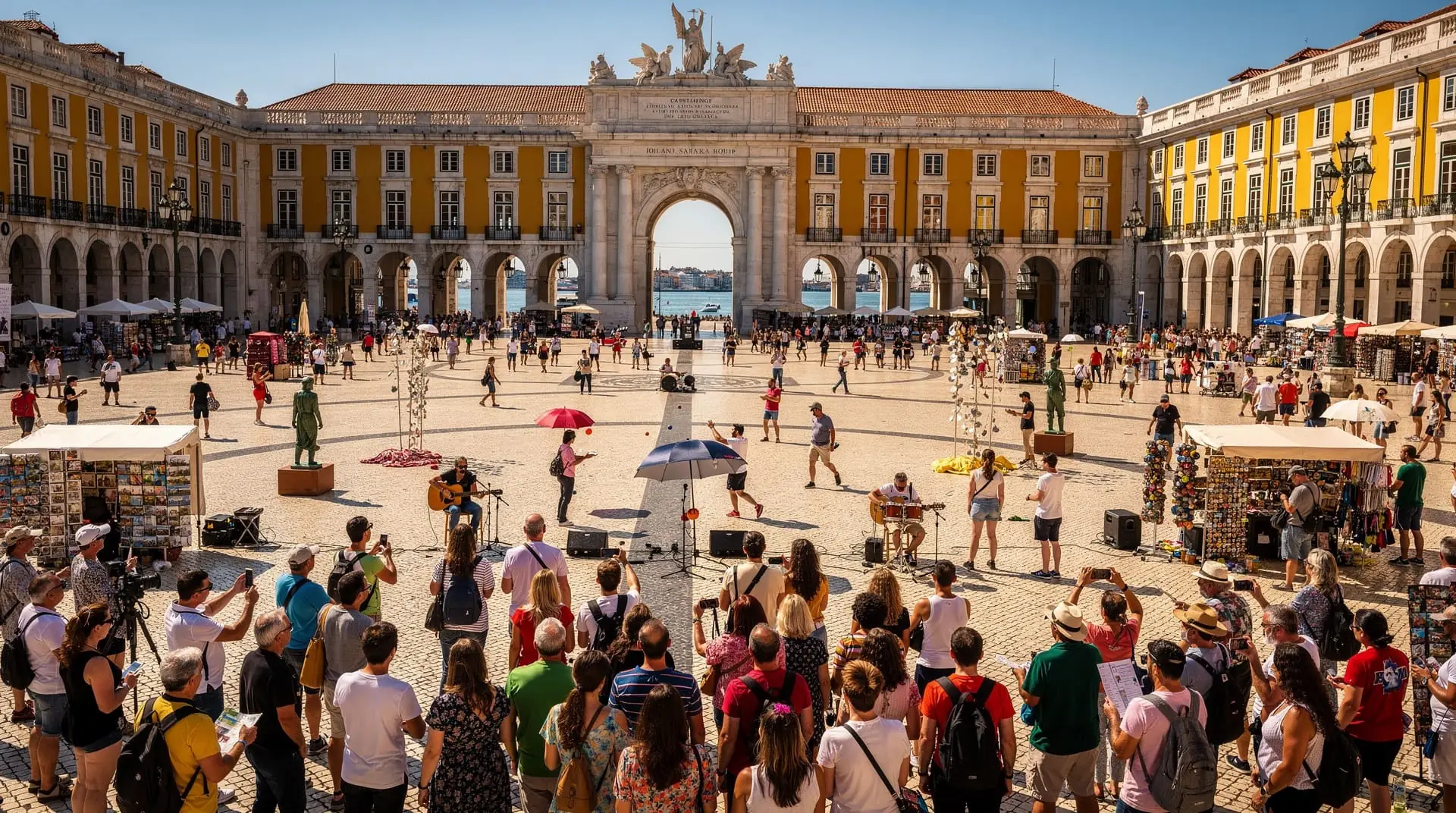
Lisbon tourist traps: the master list (and how to avoid each one)
The complete honest guide to Lisbon's tourist traps: couvert scam, fake fado, tram 28 pickpockets, airport taxis, Belém queues and more. Real advice.

Overrated attractions in Lisbon: honest skip-if-tight list
The Santa Justa lift, Elevador da Bica, tram 28 mid-day — honest takes on which Lisbon attractions disappoint relative to their effort and cost.

Lisbon airport taxi scams: what they are and how to avoid them
Lisbon airport taxi overcharging is real and preventable: broken meters, fixed flat fares, route padding. How to pay the right price.
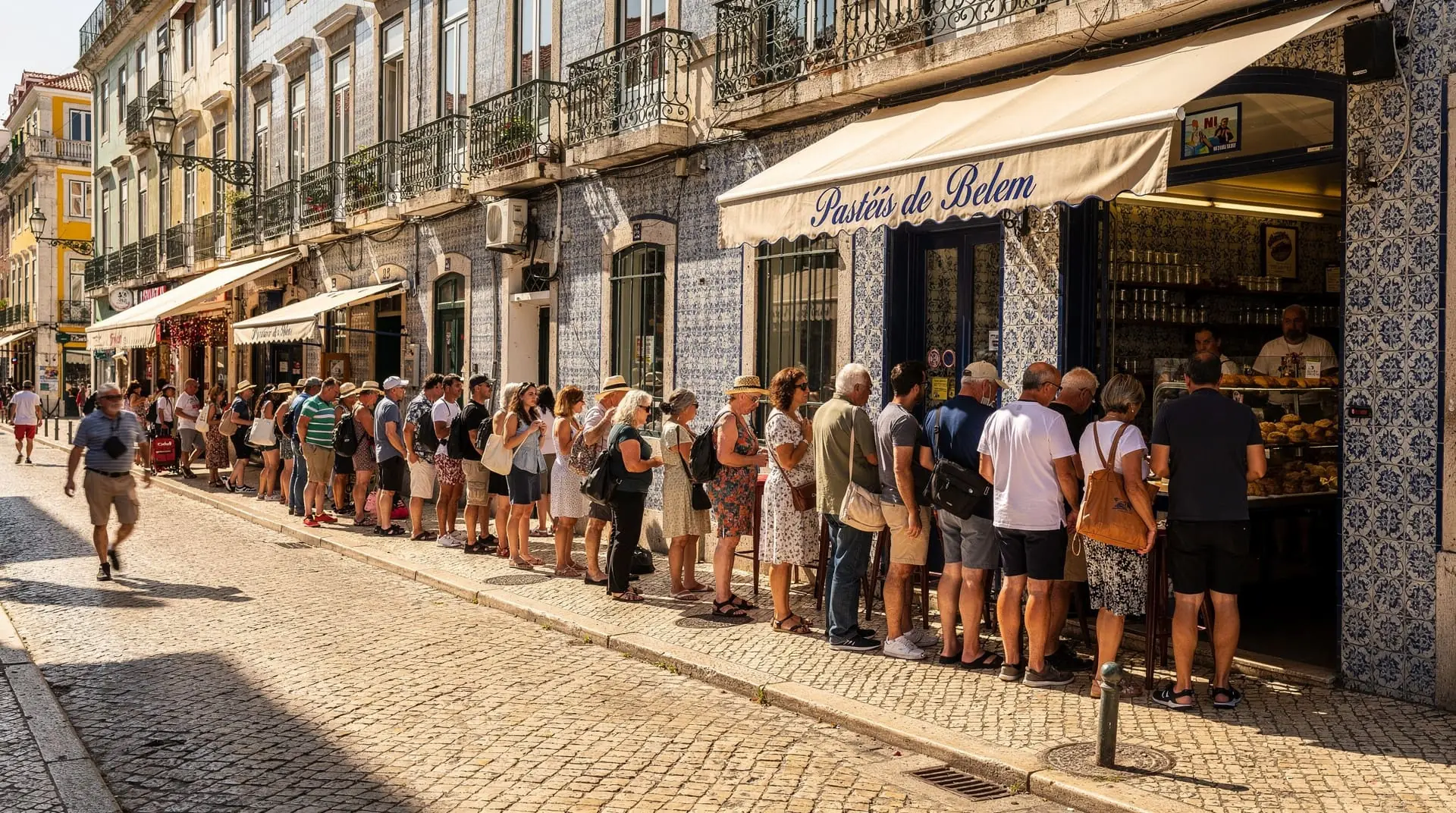
Pastéis de Belém queue: how to beat it and whether it's worth it
The real strategy for the famous Pastéis de Belém custard tart queue — which counter to use, when the wait is zero, and whether Manteigaria is actually better.
Ready to book? Top tours for this guide
We earn a small commission if you book through GetYourGuide — at no extra cost to you. Every tour is hand-picked and verified.

Lisbon: 48-Hour Hop-On-Hop-Off Bus Tour and Oceanarium Entry
Lisbon: MAAT Entry Ticket & Dolphin Watching Boat Tour
Lisbon: Alfama, Mouraria Walking Tour with Fado Night, Tapas
Lisbon: Hop-On Hop-Off Bus Tour
Lisbon: 1-or 2-Day Hop-On Hop-Off Bus Tour