Lisbon tourist traps: the master list (and how to avoid each one)
Last reviewed
What are the biggest tourist traps in Lisbon?
The couvert charge (bread and olives placed automatically at your table — not free, €3-8 each, you can refuse). Fake fado near Rossio and Restauradores. Tram 28 pickpockets in peak hours. Unmetered airport taxis. The Belém pastéis queue (avoidable with the right strategy). Drug touts near Praça do Comércio selling fake hash. Each is avoidable with basic knowledge.
What this guide is for
Lisbon is genuinely safer and more honest than most European tourist cities. The traps catalogued below are mostly opportunistic overcharging, not organised crime. Still, several thousand euros leave tourist wallets unnecessarily each week through the mechanisms described here. This guide documents each one specifically — not to alarm you, but to make sure your money goes to things you actually chose.
| Worst offender | Couvert charge and fake fado near Rossio |
| Typical extra cost | Around €10-70 per incident depending on the trap |
| Risk level | Financial nuisance, not personal danger |
| Fix | A few learned phrases and knowing where to walk |
| Read first | Lisbon safety for the broader picture |
Trap 1: The couvert charge
What it is: When you sit down at a Portuguese restaurant, the waiter will often place a small basket of bread, a dish of butter, and sometimes olives, cheeses, or tinned fish on the table. Nothing is said. These items are not free. Each item carries a separate charge — typically €1.50-4 per person for bread, €2-5 for olives, and more for tinned fish or cheese. A table of four who eat everything placed in front of them may find a €16-24 couvert charge on the bill before they ordered anything.
The scale: This is almost universal in Lisbon’s tourist-facing restaurants. It is not technically a scam — it is a legal practice in Portugal (called the couvert). But the lack of disclosure, the automatic placement, and the variable pricing make it function like a trap for visitors who do not know what they are looking at.
What to do: When the waiter places items on the table, say “Não, obrigado, não vamos pedir o couvert” (No, thank you, we are not ordering the couvert). They will remove everything and the charge disappears. This is your legal right and waiters are used to it — there is no awkwardness in experienced restaurants. If the waiter seems offended, it tells you something about the restaurant.
The full guide: Restaurant couvert scam — what it is and how to refuse
Trap 2: Fake fado near Rossio and Restauradores
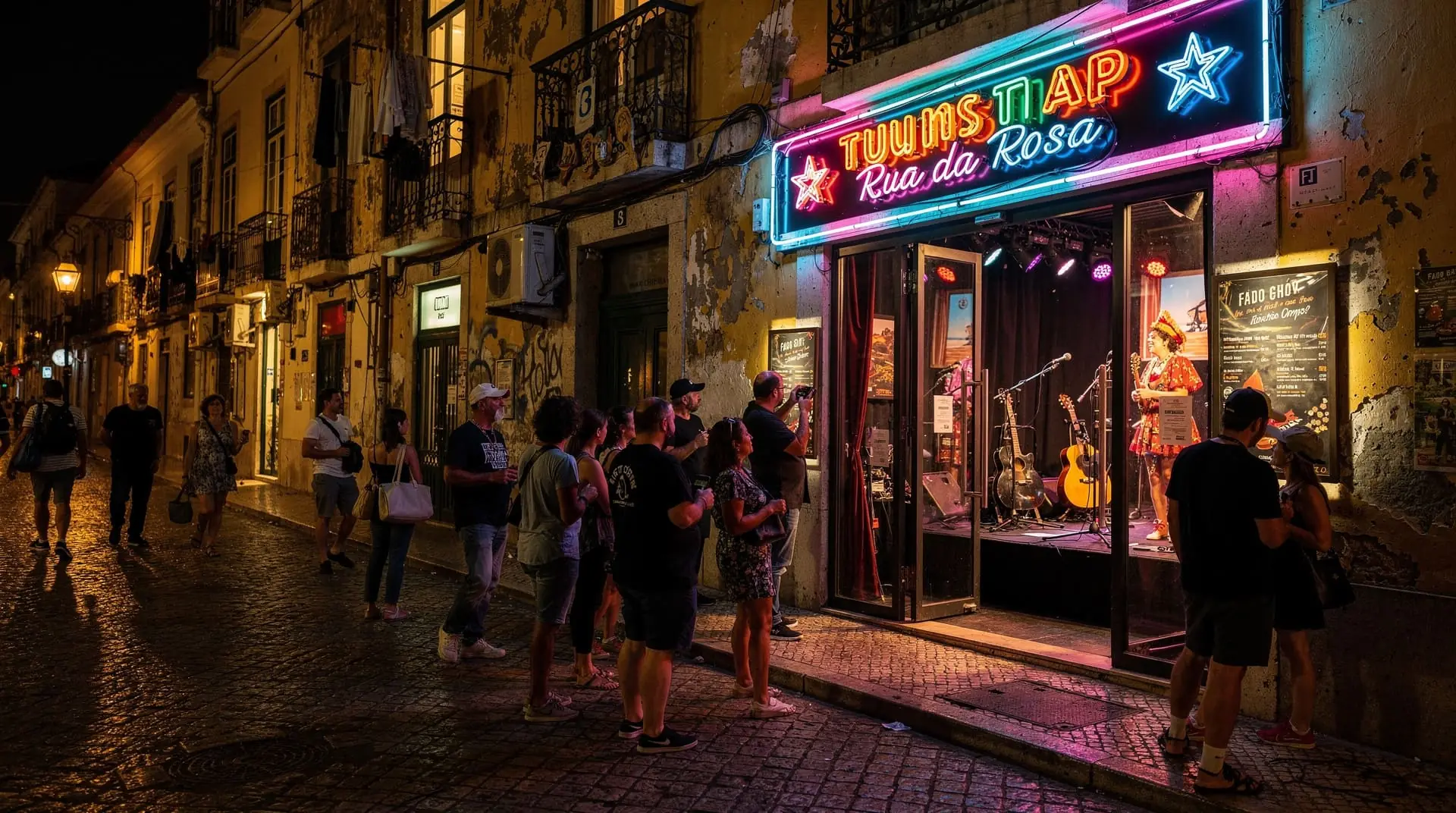
What it is: Near Rossio station, Praça dos Restauradores and Praça do Comércio, there are several “fado houses” with doormen who approach tourists on the pavement and offer “authentic fado dinner show” packages. The shows they run have the visual elements of fado — fadista, Portuguese guitar, dramatic lighting — but the music is performed by hired singers rather than genuine artists, the food is overpriced and mediocre, and the clientele is 100% tourists.
How to identify it: Real fado is in Alfama, Mouraria and Bairro Alto. It does not need street recruitment. Venues that approach you on the pavement with a laminated menu and a price list are not where real fado lives.
The scale: Some of these venues charge €70-90 per person for a dinner that would cost €25 without the fado label. The music is the tourist-show version — technically adequate, emotionally hollow.
What to do: Walk past without engaging. If you want fado, see our fado house comparison for the real venues, and our detailed fake fado warning for all the identifying signals.
Trap 3: Tram 28 pickpockets
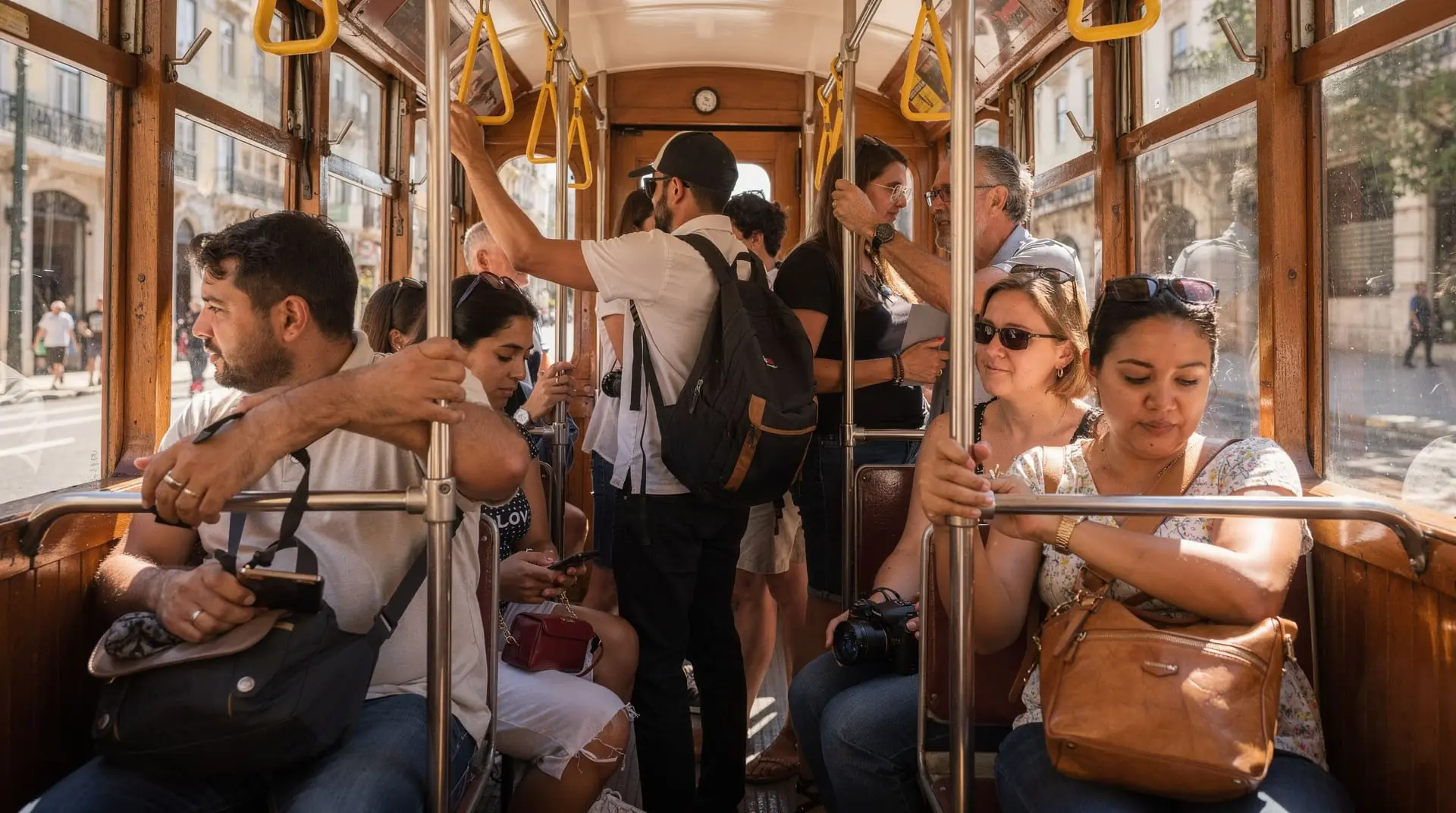
What it is: Tram 28, Lisbon’s iconic yellow hillside tram, is the single highest-risk location for pickpocketing in the city. The operating conditions (packed carriage, standing passengers, cobblestone jolts, tourists photographing with phones out) are ideal for deft-fingered theft. Methods include deliberate jostling, the “bump and grab,” and simple hand-in-bag theft while targets are distracted.
When the risk is highest: Between 10am and 4pm, and especially in July and August. Boarding at Alfama or mid-route (rather than at the Martim Moniz terminus) means standing in a full carriage. This is where most incidents occur.
The real risk level: Moderate-high at peak times; low if you board at the terminus before 10am. This is not violent crime — no one has been attacked on tram 28. Items taken are phones, wallets left in back pockets, cameras worn loosely.
What to do: Board at Martim Moniz (the eastern terminus), where you can board before the tram fills. Wear your bag on your front. Keep your phone in a front trouser pocket. Travel with only what you need for the day. See the full tram 28 pickpockets guide.
Trap 4: Airport taxis — broken meters and fixed fares
What it is: Upon exiting Humberto Delgado Airport, a subset of taxi drivers (not all — but enough to be a documented problem) either claim the meter is “broken” and quote a fixed fare, or add surcharges that do not legally exist. The legitimate metered fare from the airport to central Lisbon (Baixa, Chiado, Alfama) is €15-25 depending on traffic and exact destination.
The scam variants:
- Claiming the meter is “not working” and quoting a flat €40-50 fare
- Using the meter but routing through a longer path (adding 5-10 km and €8-15)
- Adding a “luggage supplement” that is real (€1.60 for bags in the boot) but multiplied fraudulently
- Charging “night rate” incorrectly during the day
What to do: Use Uber or Bolt from the airport (€10-15 to central Lisbon, fixed price visible before you book). If taking a traditional taxi, insist on the meter, confirm it starts at €0 when you board, and know your expected route in advance. The full guide: airport taxi scams in Lisbon.
Trap 5: Belém pastéis de nata queue
What it is: Pastéis de Belém (the original Lisbon custard tarts, baked since 1837) has two or three queues: one for eat-in tables (longest), one for the cashier (to order and then wait), and a right-side takeaway counter where pre-boxed pastéis are sold with almost no queue. Most tourists join the longest queue by default.
The actual situation: On a weekend in July, the eat-in queue at Pastéis de Belém can be 30-45 minutes. The takeaway counter on the right side of the entrance often has a 5-minute or zero queue. You get the same pasteis, slightly cooler, for eating on the Jerónimos Monastery lawn (which is not a worse experience).
The other option: Manteigaria, a pastelaria chain with branches in Chiado, Mercado da Ribeira and elsewhere, is tested by many visitors as equal to or better than Pastéis de Belém. No queue, same price (€1.30-1.50 each), served fresh.
What to do: Read our Belém pastéis queue strategy for the complete breakdown.
Trap 6: Drug touts near Praça do Comércio
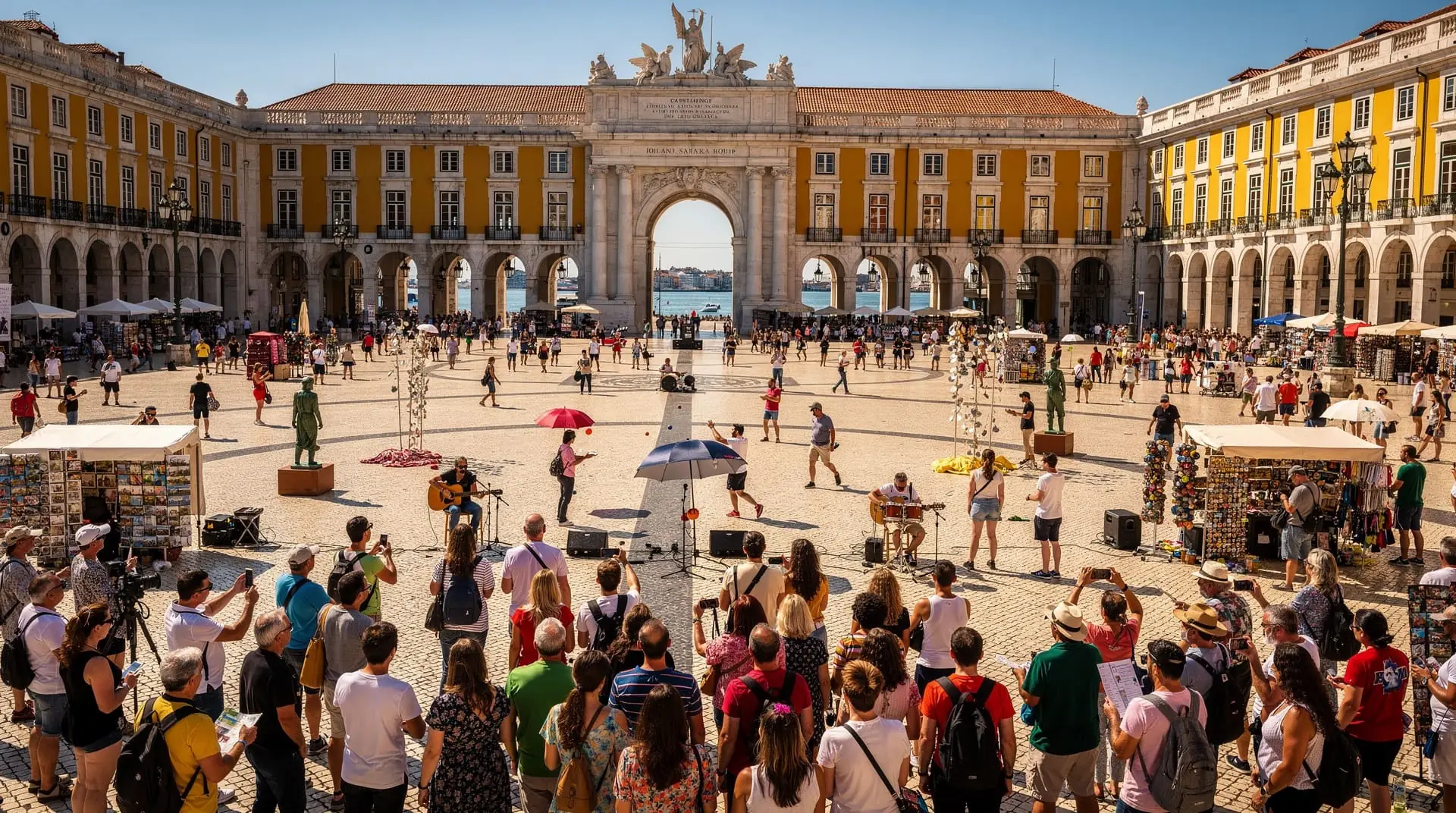
What it is: In the arcades and along the waterfront at Praça do Comércio, particularly in the late afternoon and evening, a small number of men approach tourists and quietly offer to sell hashish or other substances. The product is almost universally fake — small pieces of clay, compressed tea, or plastic, sold for €10-30 for what appears to be a small amount of cannabis resin.
The risk: Low but real. There is no documented violence associated with refusal. The risk is purely financial — you pay for something that is not what you were told. Possession of small amounts of controlled substances is decriminalised in Portugal (since 2001), but purchase still carries risk and fake product is common.
What to do: Ignore completely. Do not make eye contact, do not say “no,” do not engage. Walk past without acknowledging the approach. They will move on in 2-3 seconds.
Trap 7: Restaurant-near-monument markup
What it is: Any restaurant immediately adjacent to the Jerónimos Monastery, Belém Tower, São Jorge Castle or the Alfama tourist circuit charges a significant premium over the same food two streets away. The markup is typically 30-60% on mains and disproportionately high on local beers (€4-6 in tourist locations vs €2-3 locally) and water.
Specific examples:
- Coffee at a Praça do Comércio viewpoint café: €2.50-3.50
- Coffee at a neighbourhood café 3 streets away: €0.80-1.20
- Prato do dia (lunch special) near Jerónimos: €14-18
- Prato do dia in Mouraria or Intendente: €8-12
What to do: Walk one or two blocks from major monuments before sitting down. The Rua da Sé area near the cathedral and Largo das Portas do Sol are tourist-priced; the streets of Mouraria below São Jorge Castle are local. The cheap eats guide for Lisbon has specific recommendations.
Trap 8: Pushy Alfama souvenir sellers
What it is: In the narrower streets of Alfama, and around the tram 28 route, there are occasionally sellers offering small items (fridge magnets, miniature trams, cork products) who become persistent when you decline. This is a nuisance rather than a financial trap — the items themselves are reasonably priced — but the interaction can be uncomfortable.
What to do: A firm, polite “não, obrigado” (no, thank you) once is sufficient. Looking away and continuing to walk works faster than repeat refusals.
Trap 9: Turning up to Sintra without a plan
What it is: Sintra is not itself a scam, but arriving without pre-booked tickets or an early start is the single most common way visitors turn a great day trip into a miserable one. On summer weekends, walk-up queues for Pena Palace and Quinta da Regaleira routinely exceed an hour, and the parking situation in Sintra town is genuinely chaotic — cars circling for 30-40 minutes looking for a space that does not exist.
The scale: No direct financial cost, but a real cost in time and mood — visitors who lose their morning to queues often skip a site entirely or leave the trip feeling like a failure.
What to do: Book Pena Palace and Quinta da Regaleira tickets online a few days ahead (further in summer), take the train from Rossio rather than driving, and start before 09:00. See Sintra crowds and parking and Sintra without a car for the full strategy.
Trap 9b: The wrong tram, or paying tourist-tram prices
What it is: Alongside tram 28, several private “vintage tram” and open-top hop-on-hop-off operators sell tours at €25-40 that cover similar ground to a regular public tram or bus at a fraction of the cost. Some tourists assume tram 28 itself requires a special ticket beyond the normal transport card; it does not — a Viva Viagem card or contactless payment works exactly as it does on any city tram.
The scale: Not a scam exactly — the private tours are a legitimate paid product — but many buyers don’t realise a nearly identical route on public transport costs €2.35-3.50 rather than €25+. If your interest is genuinely the guided commentary and flexible stops, the hop-on-hop-off bus can be worth it for a first day; if you just want to see the route, take the tram 28 itself.
What to do: Decide what you actually want — commentary and flexibility (hop-on-hop-off), or the authentic tram experience at normal transport prices (tram 28, or the far less crowded bus 737 on the same route).
Trap 10: Overrated “must-see” attractions
What it is: Certain sights appear on every generic “top 10 Lisbon” list regardless of whether they justify the queue and price for most visitors — the Santa Justa lift queue is one example, covered in the FAQ below, but it’s not the only one. Some viewpoints and paid attractions promoted heavily to tour groups deliver less than a five-minute detour to a nearby, less-hyped alternative.
What to do: Cross-check any “essential” sight against our overrated attractions in Lisbon guide before committing significant queue time to it — several genuinely worthwhile alternatives are a short walk away.
What is NOT a trap in Lisbon
For balance: several things are sometimes labelled “traps” that are actually legitimate:
The tram 28 itself is not a scam — it is excellent if you ride it right (early, from the terminus, with a zapping card). The risk is pickpocketing, not the tram company.
The Lisboa Card is not a trap — it offers genuine value for museum-heavy itineraries. See our Lisboa Card vs paying separately breakdown.
Pastéis de Belém is legitimately the original, and in our testing, genuinely excellent. The queue is the only problem, not the product.
Uber and Bolt in Lisbon are largely legitimate and good value. Surge pricing exists but is transparent before you book.
Lisbon: free walking tour — tips-only, local guideThe hub: /guides/lisbon-tourist-traps/
All the guides linked from this page are part of our Honest Lisbon hub — a collection of practical, unvarnished planning content that covers the real logistics of visiting. Use it alongside the main destination and guide pages to plan a trip that is good rather than merely average.
For broader planning: first-time tips for Lisbon, Lisbon safety and how many days in Lisbon.
Frequently asked questions about Lisbon tourist traps
Has Lisbon got worse for tourists recently?
Lisbon became significantly more touristy between 2015 and 2020, then paused during the pandemic. Since 2022, visitor numbers have returned to and exceeded pre-pandemic levels. The tourist trap infrastructure has grown proportionally. The city is still far more honest than, say, Barcelona or Venice — but awareness is increasingly necessary.
Are there tourist traps in Alfama specifically?
Alfama has the highest concentration of tourist-facing restaurants with couvert charges and the tram 28 pickpocket risk. The neighbourhood itself is not a trap — it is the most atmospheric part of the city. The tourist restaurants on the main tram route are less good value than those one street away.
Is Uber safe in Lisbon?
Yes. Uber and Bolt are licensed, metered digitally, and generally reliable in Lisbon. Driver identities are verified, routes are tracked by app, and both companies have functioning customer service for complaints. They are significantly safer than negotiating with unregistered airport taxi touts.
Do Portuguese restaurants always charge a couvert?
No. Many restaurants — particularly in non-tourist neighbourhoods — do not practice the couvert, or bring items only if asked. The practice is concentrated in tourist-facing establishments near monuments. Asking before you sit down (“Há couvert?” — “Is there a couvert?”) takes 3 seconds and avoids ambiguity.
What is the best way to plan a Lisbon trip that avoids these problems?
Use public transport rather than hailing taxis. Eat at restaurants with physical Portuguese menus (not iPad-with-17-flags menus). Book fado in Alfama or Mouraria, not near Rossio. Ride tram 28 early. Carry only what you need. These five rules eliminate most of what this guide covers.
Related guides
Fake fado in Lisbon: how to spot it and where the real thing is
How to identify tourist-trap fado near Rossio and Restauradores — location, pushy doormen, set menus. Where authentic fado actually happens in Lisbon.
Tram 28 pickpockets: what actually happens and how to protect yourself
The honest guide to pickpocketing on Lisbon's tram 28: where it happens, how it works, realistic risk levels and exactly what to do to prevent it.

Overrated attractions in Lisbon: honest skip-if-tight list
The Santa Justa lift, Elevador da Bica, tram 28 mid-day — honest takes on which Lisbon attractions disappoint relative to their effort and cost.

The restaurant couvert charge in Lisbon: what it is and how to refuse it
The bread and olives placed on your table at Lisbon restaurants are not free. They are the couvert charge — €3-8 per person. Here is exactly how to refuse it.
Ready to book? Top tours for this guide
We earn a small commission if you book through GetYourGuide — at no extra cost to you. Every tour is hand-picked and verified.

Lisbon: 48-Hour Hop-On-Hop-Off Bus Tour and Oceanarium Entry
Lisbon: MAAT Entry Ticket & Dolphin Watching Boat Tour
Lisbon: Alfama, Mouraria Walking Tour with Fado Night, Tapas
Lisbon: Hop-On Hop-Off Bus Tour
Lisbon: 1-or 2-Day Hop-On Hop-Off Bus Tour