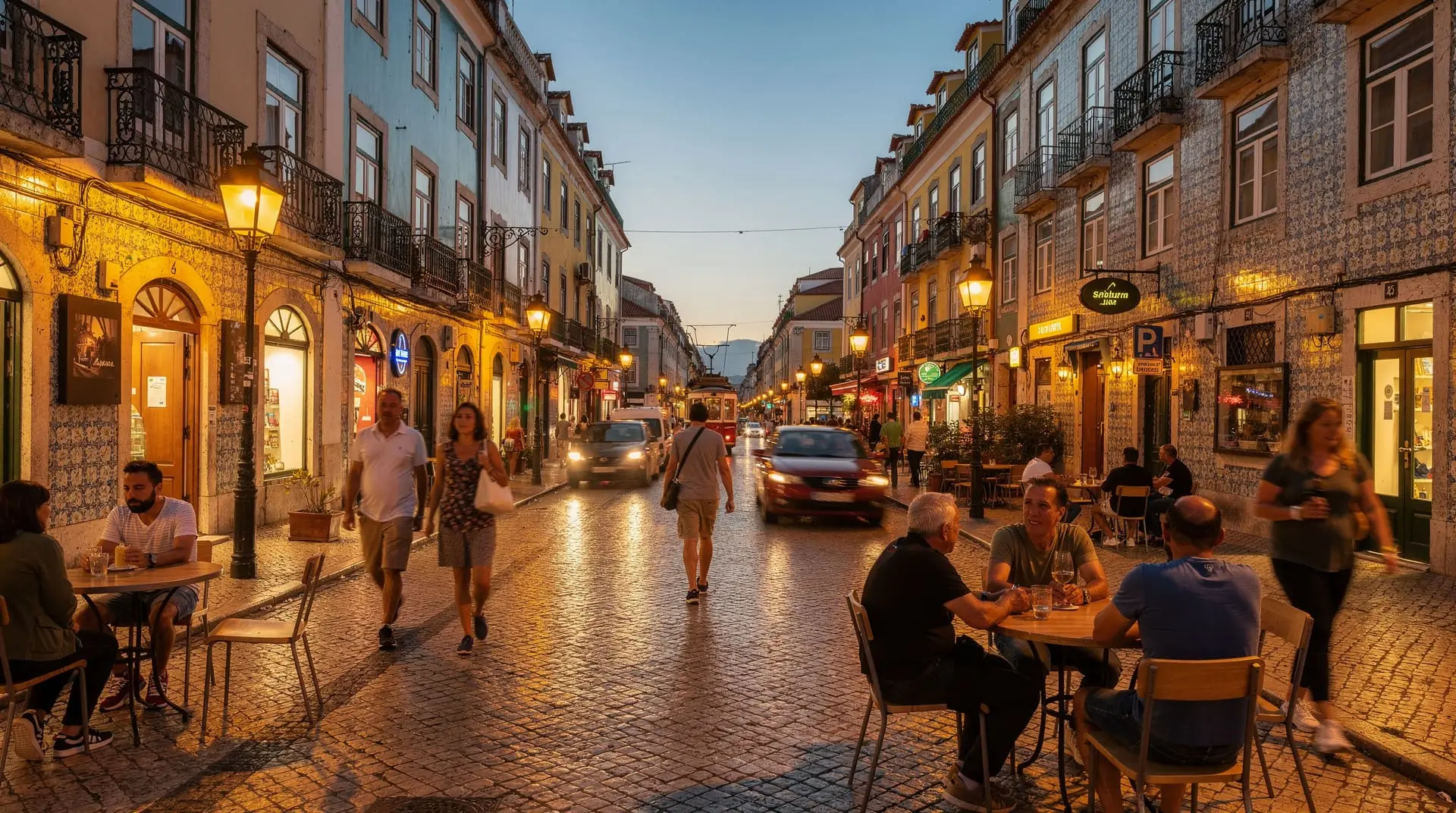
Is Lisbon safe? An honest safety guide for visitors
Last reviewed
Is Lisbon safe for tourists?
Lisbon is one of the safer European capitals for visitors. Violent crime affecting tourists is rare. The main risk is pickpocketing, concentrated on tram 28E (Alfama section), metro carriages during rush hour, and crowded markets like Time Out. Street drug dealers in Baixa are a nuisance but not a danger. Standard urban awareness prevents most problems.
Lisbon’s actual safety record
Lisbon consistently ranks among the safest European capitals in international safety indices. The 2025 Global Peace Index placed Portugal as the 6th most peaceful country in the world. For tourists, this translates into a city where violent crime is genuinely rare, where walking at night is normal and comfortable, and where the main concerns are opportunistic petty theft rather than any threat to personal safety.
That said, “safe” does not mean “nothing bad ever happens.” Lisbon has the pickpocket problem that affects all major European tourist cities, a persistent nuisance of street drug dealers in certain areas, and the standard risks of any city with a significant nightlife scene. This guide covers the real picture — not alarmist, not dismissive.
| Overall risk | Low — among the safer European capitals |
| Main risk | Pickpocketing (tram 28E, metro, crowded markets) |
| Emergency number | 112 |
| Tourism Police | 21 342 1623, Praça dos Restauradores, English spoken |
| Precaution level | Standard urban awareness, not heightened caution |
The main risk: pickpocketing
Pickpocketing in Lisbon is concentrated, not widespread. If you know where it happens and take basic precautions, your risk drops dramatically.
Tram 28E — the highest-risk location
Tram 28E is Lisbon’s most photographed icon and the most consistent pickpocketing location in the city. The tram is small, frequently overcrowded, and slow (which means the crowding lasts longer). The Alfama section — from Alfama through Mouraria to Martim Moniz — is where most incidents occur.
How it works: Two or three people work together. One creates a distraction (asking a question, apparently dropping something, blocking the door as people try to board). Another uses the confusion to extract a phone from a hand, a wallet from a jacket pocket, or to open an unzipped bag.
What to do:
- Phone should be in an inner zip pocket, not in your hand or a back pocket
- Bag should be in front of you, zipped, with the zip facing toward your body
- Be alert when the tram is very crowded and the doors are opening
- If your phone must be out for navigation, hold it with both hands against your body
For actual transport, bus 737 covers the same route, is less crowded, and has essentially no pickpocket risk. Read the tram 28 pickpocket guide for full detail.
Metro — lower risk, but real
The Baixa-Chiado interchange at rush hour (08:00-09:30 and 18:00-19:30) is the second most reported location. Techniques are similar — distraction on the platform or in the carriage.
Precaution: same as tram. At rush hour, keep your phone in your pocket. If listening to music, keep headphones plugged in — AirPods visible in ears attract attention.
Crowded tourist areas
Time Out Market (Mercado da Ribeira), the Belém waterfront area, the Alfama main miradouros (Portas do Sol, Santa Luzia), and Rossio square during peak hours all see pickpocketing incidents. These are the same profiles as any busy tourist area in any European city.
Bag security that works: A cross-body bag worn in front, with a zip, is significantly more secure than a backpack or a shoulder bag left dangling behind you. Neck pouches work well for passports and travel documents.
Street drug dealers — persistent but not dangerous
The area around Rossio, the streets south of Praça Dom Pedro IV, and certain streets in Baixa see low-level drug dealing. Dealers are usually men who approach tourists quietly offering hashish, cocaine, or other substances.
What to know:
- Portugal decriminalised personal drug use in 2001. Dealers operate in a semi-tolerated legal grey zone. Police are present but enforcement is inconsistent.
- Dealers are not threatening. A polite but firm “não obrigado” (no thank you) and continuing walking ends the interaction.
- Do not buy. Beyond the legal grey area, quality is completely unknown and the interaction can draw attention from opportunistic thieves in the area.
- The dealers in Baixa often approach specifically in tourist-facing areas. It is a nuisance, not a danger.
Bairro Alto at night — lively, not dangerous
Bairro Alto is Lisbon’s main nightlife district. On Friday and Saturday nights, crowds of 1,000+ people pack the narrow streets from about 22:00 until 02:00 or 03:00. This is overwhelmingly young people drinking, not a threatening situation — but a few things to know:
- Heavy drinking on both sides means the standard caution around alcohol applies: do not leave your drink unattended, be aware of your state, use rideshare rather than walking home alone if heavily intoxicated.
- Street drinking is tolerated. The atmosphere is social, not aggressive.
- Pickpocketing risk increases in very crowded bar areas — the same precautions as on tram 28E apply.
- If you are staying near Bairro Alto, expect significant noise until 02:00-03:00 on weekends. See where to stay in Lisbon for the neighbourhood context.
Taxi scams — the one genuine tourist trap
The airport taxi scam is the most financially significant scam targeting Lisbon tourists and is well-documented. Unlicensed drivers approach passengers in the arrivals terminal offering fixed-price rides that cost €50-80 for a journey worth €15-25.
The full detail is in the airport to city centre guide and the taxi airport scam guide. The short version: use the official taxi rank (cream taxis with green stripe), or book Uber/Bolt in the arrivals hall.
No similar scam applies to taxis in the city — metered licensed taxis are fine.
Fake fado — more expensive than dangerous
The “fado” restaurants near Rossio and around Praça do Comércio that advertise loudly and have touts outside often offer a diminished experience: recorded or semi-professional music, tourist-facing menus at inflated prices. This is not a safety issue but a value-for-money one. See the fake fado warning guide and the best fado houses guide for how to find authentic experiences.
Emergency numbers in Portugal
- Emergency (police, fire, ambulance): 112
- PSP (Metropolitan Police): 21 765 4242
- Tourism Police (COMETLIS): 21 342 1623 (specifically for tourist incidents, English spoken)
- Nearest hospital: Hospital de São José (central Lisbon), Hospital de Santa Maria (northern)
The Tourism Police have an office near Praça dos Restauradores and are specifically trained to assist tourists who have been robbed or scammed. If your passport is stolen, report to the nearest PSP station for a police report (needed for insurance claims and emergency documents).
Practical safety checklist
- Use a cross-body bag with zip, worn in front
- Keep phones in inner pockets on tram 28E and at busy metro interchanges
- Book Uber/Bolt rather than taking unlicensed taxis from the airport
- Decline drug offers with “não obrigado” and walk on
- Use the official taxi rank (cream car, green stripe) when taking taxis at the airport
- Keep a photocopy of your passport and a note of your travel insurance details separately
- Share your location with a contact when going out alone at night
For solo female travellers specifically, the solo travel in Lisbon guide covers the experience in detail.
Lisbon hidden gems guided tour — a small-group walk through the neighbourhoods with local insight, which also naturally helps first-timers get their bearings on which areas are which.
Safety by neighbourhood — a more granular picture
Baixa and Chiado — tourist-heavy but safe
Baixa is the tourist core. It is busy, pickpocket-aware, and the source of most tourist complaints — not because it is dangerous but because the high concentration of tourists creates a target-rich environment for the opportunistic theft minority. Keep your bag closed and in front. Do not use your phone while walking in the middle of a crowd. Otherwise, the area is very safe including at night.
Alfama — safe for visitors, busy with nuisance
Alfama at night (fado houses run until midnight or later) is populated and generally safe. The main issue is the uneven ground — the steep cobblestone streets are genuinely hazardous in the dark for people who are not used to them, particularly after a few glasses of wine. Wear flat, gripped shoes. Use a torch if your phone battery allows.
There is petty drug activity in some lower Alfama streets, particularly near Largo do Intendente. This is not directed at tourists and does not involve confrontation. Walking past quickly with purpose is all that is needed.
Mouraria — improving rapidly
Mouraria has a reputation from 20 years ago that no longer reflects its current reality. The neighbourhood is being renovated, has new restaurants and a creative community, and feels safe during the day and early evening. Very late at night (after 02:00), exercise the caution you would in any urban neighbourhood.
Cais do Sodré (Pink Street area)
The Rua Nova do Carvalho bar strip (Pink Street) is heavily policed on weekend nights, which keeps the atmosphere lively rather than threatening. The main risk is being in a very drunk crowd — standard awareness applies. Uber or Bolt from this area late at night is sensible.
Intendente and Arroios (north of Baixa)
These transitional neighbourhoods have improved significantly but are still more edgy than the historic tourist core. Daytime is fine. Late night, stick to the main streets. Some drug activity around Intendente square persists.
Avenida da Liberdade and Marquês de Pombal
Grand, well-lit, heavily used by both residents and tourists, and very safe at any hour.
Belém and Parque das Nações
Both are spacious, modern, well-lit areas popular with families and joggers, and register very few incidents of any kind. Belém’s museum queues attract the same opportunistic pickpocket risk as any crowded ticket line, but the waterfront promenade itself is relaxed even in the evening. See Belém half-day guide and Parque das Nações guide for what else is worth combining with a visit.
What to do if something goes wrong
If you are pickpocketed
- Do not confront the thief — they may work in groups and you will not recover your belongings this way.
- Check whether anything is actually gone (sometimes the attempt fails or you feel the touch in time).
- If your phone is gone: use Find My iPhone or Google Find My Device from another device to locate it. These are rarely recovered but the report helps.
- Report to the Tourism Police (Praça dos Restauradores, English spoken) or the nearest PSP station. Get a reference number for insurance.
- If your cards are gone: call your bank immediately from any phone (numbers are usually on the back of the card, so ideally you have these noted separately).
- If your passport is gone: contact your embassy or consulate. The British Embassy is on Rua de São Bernardo; the US Embassy is in Campo de Ourique. Both have emergency contact lines.
If you have a medical emergency
Dial 112. Hospital de São José (Rua José António Serrano) handles emergency medicine in central Lisbon and has English-speaking staff. Hospital CUF Descobertas (Parque das Nações) is a private hospital with very good facilities and is accustomed to treating tourists. For travel insurance purposes, keep your insurance card and the emergency phone number accessible.
If you are scammed
The Tourism Police (COMETLIS, Praça dos Restauradores) handle tourist-specific scam complaints. While recovery of money is unlikely, a police report helps if you need to dispute a credit card charge or make an insurance claim.
Health safety considerations
Food safety: Lisbon restaurants are generally well-regulated. Shellfish (amêijoas, percebes, camarão) should always be fresh and from a reputable source — if a menu is displaying ice-covered shellfish for extended periods without high turnover, skip them. Shellfish food poisoning, while uncommon, is more common in summer. Stick to busy restaurants with visible turnover.
Sun safety: Lisbon’s summer sun is strong — the UV index is high from May to September. The reflective calçada cobblestones amplify the radiation. Sunscreen (SPF 30+), hat, and shade in the 12:00-15:00 window is not overcautious. Heatstroke is a genuine risk on multi-hour hilltop walks in July and August.
Water: Lisbon tap water is safe to drink. Free drinking fountains exist throughout the city. Carry a refillable water bottle — dehydration on the hills in summer is a real issue. The €2.50 bottles of water sold at miradouro cafés are avoidable with a refillable bottle.
Pharmacies: Portuguese pharmacies (farmácia, green cross sign) are excellent first-response health services. Pharmacists speak English, are highly trained, and can handle common ailments (sunstroke, stomach issues, blisters, minor infections) without requiring a GP visit. Open typically 09:00-19:00 on weekdays, some Saturday mornings.
Cobblestones and falls: The calçada portuguesa paving that makes Lisbon photogenic is also genuinely slippery, especially on Alfama’s steep lanes and after rain. This is a more realistic injury risk for most visitors than crime — wear shoes with real grip, not smooth-soled sandals, and slow down on downhill stretches rather than hurrying to keep up with a tour group.
Comparing Lisbon’s safety to other European capitals
To calibrate expectations:
- Violent crime rate: Portugal’s homicide rate is among the lowest in Europe (comparable to Iceland, Finland). Far lower than France, Spain, or the UK. Tourist-directed violence is extremely rare.
- Pickpocketing rate: Similar to Barcelona, Rome, or Paris — cities with high tourist volumes and professional pickpocket networks. Lower than Paris’s peak tourist areas.
- Overall tourist experience: Visitors consistently rate Lisbon as feeling safe. The 2025 Travel + Leisure World’s Best Awards placed Lisbon in the top 5 European city destinations partly on the basis of visitor sentiment around safety and ease of travel.
The honest summary: Lisbon has the petty crime profile of a major European tourist city. It does not have the elevated concerns of some other Mediterranean capitals. Standard awareness is appropriate; anxiety is not.
For more context on specific tourist traps (distinct from safety issues but worth knowing), see the Lisbon tourist traps guide and the restaurant couvert scam explanation.
Safety on day trips: Sintra, Cascais, and the coast
Day trips outside Lisbon carry a slightly different risk profile than the city itself. Sintra’s train and its approach roads have occasional reports of pickpocketing at the busiest ticket queues, particularly around Pena Palace in peak season — the same bag-in-front precautions apply. Cascais and the beach towns are very low-risk; the main hazard there is the sea itself (rip currents at Guincho and other Atlantic-facing beaches, which are for experienced swimmers and surfers, not casual paddling). If you’re combining a coastal day with driving, see driving and parking in Lisbon for the practicalities of getting out of the city safely, since Portuguese motorway driving norms can catch out visitors used to different conventions.
Safety for first-time visitors
If this is your first trip to Lisbon, the first-time Lisbon tips guide covers the wider orientation picture beyond safety — but the safety-specific takeaway for a first visit is simple: the precautions that matter are almost entirely about bags and phones on the tram and metro, not about which streets to avoid. Lisbon rewards normal city awareness rather than defensive travel.
Related guides
How many days do you need in Lisbon? An honest answer
2, 3, 4, 5, or 7 days in Lisbon: what you can realistically see and do at each length. Honest advice without filler itineraries.
Accessibility in Lisbon — an honest assessment for disabled visitors
Honest accessibility in Lisbon: cobblestones and hills are brutal for wheelchairs, but several great museums, lifts, and adapted routes work.

Best time to visit Lisbon — month-by-month breakdown
When to visit Lisbon: April-June and September-October are ideal. Summer is hot and crowded. Winter is cheap and mild. Month-by-month guide with real data.
First-time Lisbon tips — 25 things worth knowing before you go
25 essential tips for first-time visitors to Lisbon: comfortable shoes for hills, booking Sintra in advance, the couvert rule, tram 28 realities, and more.
Ready to book? Top tours for this guide
We earn a small commission if you book through GetYourGuide — at no extra cost to you. Every tour is hand-picked and verified.
Lisbon: 48-Hour Hop-On-Hop-Off Bus Tour and Oceanarium Entry
Lisbon: MAAT Entry Ticket & Dolphin Watching Boat Tour
Lisbon: Alfama, Mouraria Walking Tour with Fado Night, Tapas
Lisbon: Hop-On Hop-Off Bus Tour
Lisbon: 1-or 2-Day Hop-On Hop-Off Bus Tour