Óbidos
Óbidos is Portugal's best-preserved medieval walled town — cobbled lanes, ginjinha in chocolate cups, a castle pousada, and 90 minutes from Lisbon.
Quick facts
Top tours and experiences
We earn a small commission if you book through GetYourGuide — at no extra cost to you. Every tour is hand-picked and verified.
From Lisbon: Budha Eden, Obidos & Nazaré Private Day Trip
From Lisbon: Nazaré, Batalha, Óbidos, and Peniche Day Trip
Óbidos: Medieval Tales & Secrets Spots Guided Walking Tour
Óbidos (Medieval Town): Half-Day Private Tour from Lisbon
Óbidos & Nazaré Private Tour
From Lisbon: Óbidos and Nazaré Private Half-Day Tour
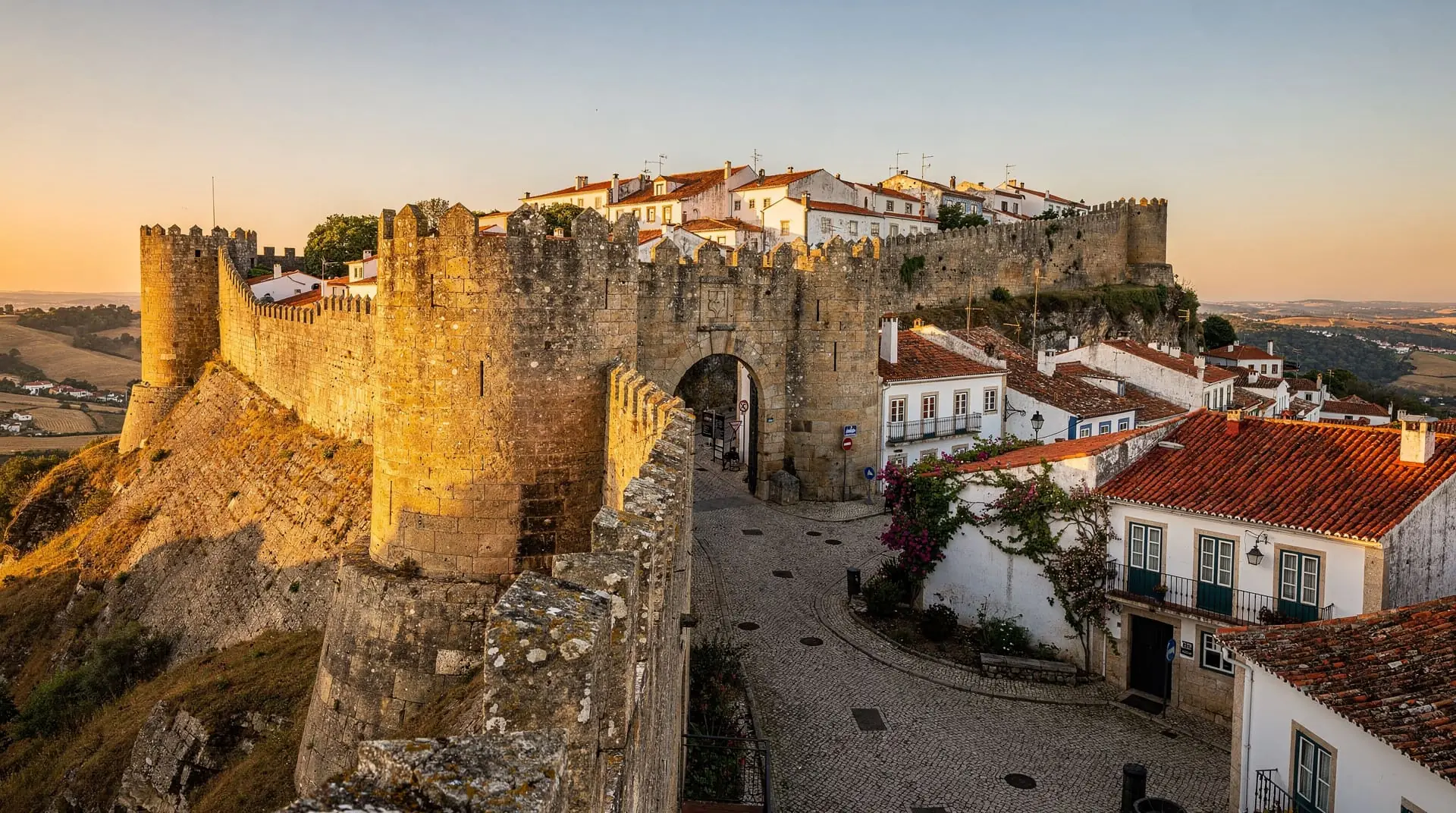
Óbidos sits inside a near-perfect ring of 12th-century walls on a ridge above the Lisbon–Porto corridor, and from a distance the whitewashed village with its castle at the north end looks like an illustration from a book of fairy tales. The difference from a fairy tale is that you can walk those walls — all 1.5 km of them — and drink ginjinha (sour-cherry liqueur) poured into an edible dark-chocolate cup while you do it.
The town measures roughly 600 metres from the main gate (Porta da Vila) to the castle. You can see all of it in three hours. That makes Óbidos a natural half-day addition to a longer Silver Coast itinerary, or a first stop on the Óbidos, Nazaré and Fátima day trip that most visitors do from Lisbon.
What makes Óbidos worth the trip
Medieval Portugal looked nothing like the sunny Algarve of the brochures. Óbidos gives you the other Portugal: thick limestone walls built on Roman foundations, narrow lanes where two people can’t pass comfortably, azulejo-tiled doorways, and window boxes overflowing with geraniums. The entire village is a national monument, which means no modern shop-fronts or signage clutter — what you see is a working town preserved largely by legislation.
The ginjinha tradition is the social glue. At least a dozen shops along Rua Direita sell the liqueur in chocolate cups for around €1.50–2 each. Buy one at the start of your walk, eat the cup at the end. Refill as needed.
The castle (now the Pousada de Óbidos, one of Portugal’s most atmospheric historic hotels) dates from the Moorish occupation and was expanded by Afonso Henriques after he took the town in 1148. He reportedly gave Óbidos to his wife Urraca as a wedding gift — a tradition the Portuguese queens maintained for centuries, giving the town its nickname “the wedding gift of Portuguese queens.” Whether you stay at the pousada or not, the castle keep is worth walking to.
Getting there from Lisbon
By bus (recommended): Rede Expressos operates coaches from Lisbon’s Sete Rios bus terminal several times daily. Journey time is approximately 1 hour 15 minutes. Tickets cost around €8 each way and are bookable online. Sete Rios connects directly to Jardim Zoológico metro station (blue line), so it’s straightforward from central Lisbon. The bus drops you at a stop just outside the walls, a 2-minute walk from Porta da Vila.
By car: Take the A8 motorway north from Lisbon, exit at Óbidos. Journey time 1 hour without traffic. Parking is available outside the walls (free on the western side, paid near the main gate). Do not try to drive inside the walls — the lanes are 2 metres wide.
By organised tour: Several day trips from Lisbon combine Óbidos with Nazaré and Fátima, handling transport logistics for you. There’s also a private World Heritage tour of the Óbidos medieval village if you’d rather focus on Óbidos alone with your own guide.
Walking tour of Óbidos: medieval secrets and hidden spotsWhat to see and do
Walk the walls
The circuit of the walls is Óbidos’s signature experience. Access is free, takes about 40 minutes at a leisurely pace, and gives views across the Lagoa de Óbidos wetlands to the west and the patchwork farmland to the east. The path is uneven and has no railings in several sections — not suitable for young children or anyone uncomfortable with heights. Wear shoes with grip.
Rua Direita: the main lane
The single cobbled street running from Porta da Vila to the castle is where most visitors spend their time. Potted geraniums, whitewashed walls with blue and yellow azulejo borders, craft shops, and the ginjinha sellers line it from end to end. The quality of craft shops varies — the best ones sell genuine hand-painted azulejo tiles, traditional blue-and-white pottery from Caldas da Rainha (the nearby ceramics town), and local honey.
Igreja de Santa Maria
The main church faces the central square and has an interior lined entirely in 17th-century blue azulejo panels — one of the most complete azulejo interiors in the country. The Renaissance portal is original. Free entry. It’s where King Afonso V married his 8-year-old cousin Isabel in 1444, which historical records mention without apparent self-consciousness.
The castle and pousada
The castle’s square keep and battlements are accessible whether or not you’re staying at the pousada. The hotel operates the bar and restaurant, which are open to non-guests. A coffee or glass of wine on the castle terrace with views over the village below is one of the better experiences Óbidos offers.
Festivals: Chocolate and literary
Óbidos hosts two festivals that attract large crowds: the Festival Internacional do Chocolate in March (the entire town smells of chocolate; stalls, workshops, competitions) and the Óbidos Vila Literária book fair in summer, when the town’s many second-hand bookshops — Óbidos is a recognised “book town” — overflow into the streets. Both are worth timing a visit around if you’re flexible.
Private half-day tour from Lisbon to Óbidos medieval villageWhere to eat
Petrarum Domus is the best restaurant inside the walls, occupying a 14th-century building near the castle. Expect grilled fish, traditional pork dishes, and Bairrada wines. Mains around €18–26. Book ahead on weekends.
A Casa on Rua Direita serves lighter lunches — soups, sandwiches, fresh pastries — at prices that won’t sting after paying for parking. Mains €10–14.
Tasca do Joel is a no-frills spot outside the walls where locals eat. Arroz de tamboril (monkfish rice) for two at €24–28.
Avoid the tourist restaurants right beside Porta da Vila — they charge €5 for a shared bread basket before you’ve ordered.
Where to stay
Pousada de Óbidos (inside the castle) is the obvious choice — doubles from €180 in low season, €280+ in summer — but you’re paying for the experience of sleeping in a medieval castle, not just a room. Book well ahead for the castle tower suites.
Casa das Senhoras Rainhas is a charming guesthouse inside the walls, with seven rooms decorated with antique furniture. Doubles from €110.
For more budget-friendly options, the town of Caldas da Rainha (10 km north, frequent local buses) has a wider range of hotels at €60–90 for a double.
How long to spend
Óbidos works perfectly as a half-day stop. Four hours is comfortable: 30 minutes walking the walls, 90 minutes exploring Rua Direita and the churches, lunch, and a coffee at the pousada before catching the bus back. If you’re combining with Nazaré (75 km north) or Fátima (55 km east), leave by early afternoon to reach the next stop before dark.
Honest tips
Crowds: July and August are busy — Rua Direita becomes a narrow bottleneck by 11am. Go early (gates open at 8am) or visit in spring/autumn. Weekday visits are significantly quieter than weekends year-round.
The walls in wet weather: When it rains, the stone walkways become slippery. The municipality is aware of this and posts warning signs, but the lack of railings on the outer edge is a genuine risk in wet conditions.
Chocolate festival timing: The festival (usually late February–March) turns Óbidos from a quiet village into a weekend scrum. Accommodation books out months ahead and buses run full. If that’s not your scene, avoid those dates.
Ginjinha pricing: The €1.50–2 chocolate cup version is the standard tourist price. Locals buy the same liqueur bottled from the same shops for €8–12 per 500ml to take home — much better value.
How Óbidos fits an itinerary
Óbidos slots naturally into a Silver Coast day trip or as the first stop on a classic Fátima, Nazaré and Óbidos tour. From Lisbon, the A8 reaches Óbidos in under an hour, then continues north to Nazaré (another 30 minutes) and the road east reaches Fátima in 55 km.
In a 5-day Lisbon itinerary, Óbidos works best on the same day as Nazaré — leave Lisbon at 8:30am, spend the morning in Óbidos, have lunch, then drive or take a local bus the 43 km to Nazaré for the afternoon and return by bus or organised transfer. The day-trip matcher tool can help you combine these correctly based on your transport options.
Day trip from Lisbon: Nazaré and Óbidos combinedFrequently asked questions about Óbidos
Is Óbidos worth visiting as a day trip from Lisbon?
Yes — it’s one of the most distinctive day trips in central Portugal. The medieval walled town is genuinely well-preserved, entry is free, and the ginjinha-in-chocolate-cups tradition is unique to Óbidos. Four to five hours is enough to see everything without rushing.
How do I get from Lisbon to Óbidos by public transport?
Take Rede Expressos from Sete Rios bus terminal (connected to Jardim Zoológico metro, blue line). Buses run several times daily; journey time is approximately 1 hour 15 minutes and tickets cost around €8 each way. Book online at rede-expressos.pt.
Can I drive inside the walls of Óbidos?
No. The lanes inside the walls are too narrow for cars. Park outside the walls — there’s free parking on the western side — and enter on foot through Porta da Vila.
When is the best time to visit Óbidos?
April, May, and October offer the best combination of mild weather and manageable crowds. July and August are the busiest months; Rua Direita becomes very congested by mid-morning. The Chocolate Festival in March is a special occasion but brings large weekend crowds.
What is ginjinha and where should I try it in Óbidos?
Ginjinha is a Portuguese sour-cherry liqueur, traditionally served in a small shot glass or, in Óbidos, in an edible dark-chocolate cup. Any of the shops on Rua Direita sell the chocolate-cup version for €1.50–2. There’s no single “best” shop — quality is similar across all of them.
Can I combine Óbidos with Nazaré and Fátima in one day?
Yes, and this is one of the most popular Silver Coast tour routes. Several organised day tours from Lisbon cover all three. By car, the triangle works in a long day: Óbidos (morning), Nazaré (lunch and early afternoon), Fátima (late afternoon). By public transport it requires careful scheduling — an organised tour is easier.