Monserrate Palace and Park: Sintra's quietest grand estate
Last reviewed
How do you get to Monserrate Palace from Sintra?
Bus 435 departs from Sintra station and Sintra-Vila, stopping at Monserrate en route to Colares. The journey from the station takes about 15 minutes. Alternatively, tuk-tuks from Sintra-Vila charge €12–18 per vehicle. The palace is 3.5 km west of Sintra-Vila on a winding road — not walkable for most visitors.
| Where | 3.5 km west of Sintra-Vila |
| Cost | Around €10 for park and palace |
| Time needed | 2.5–3 hours for palace and park |
| Getting there | Bus 435 (~15 min) or tuk-tuk (€12–18) |
| Best time | March–June for the gardens; weekday mornings for quiet |
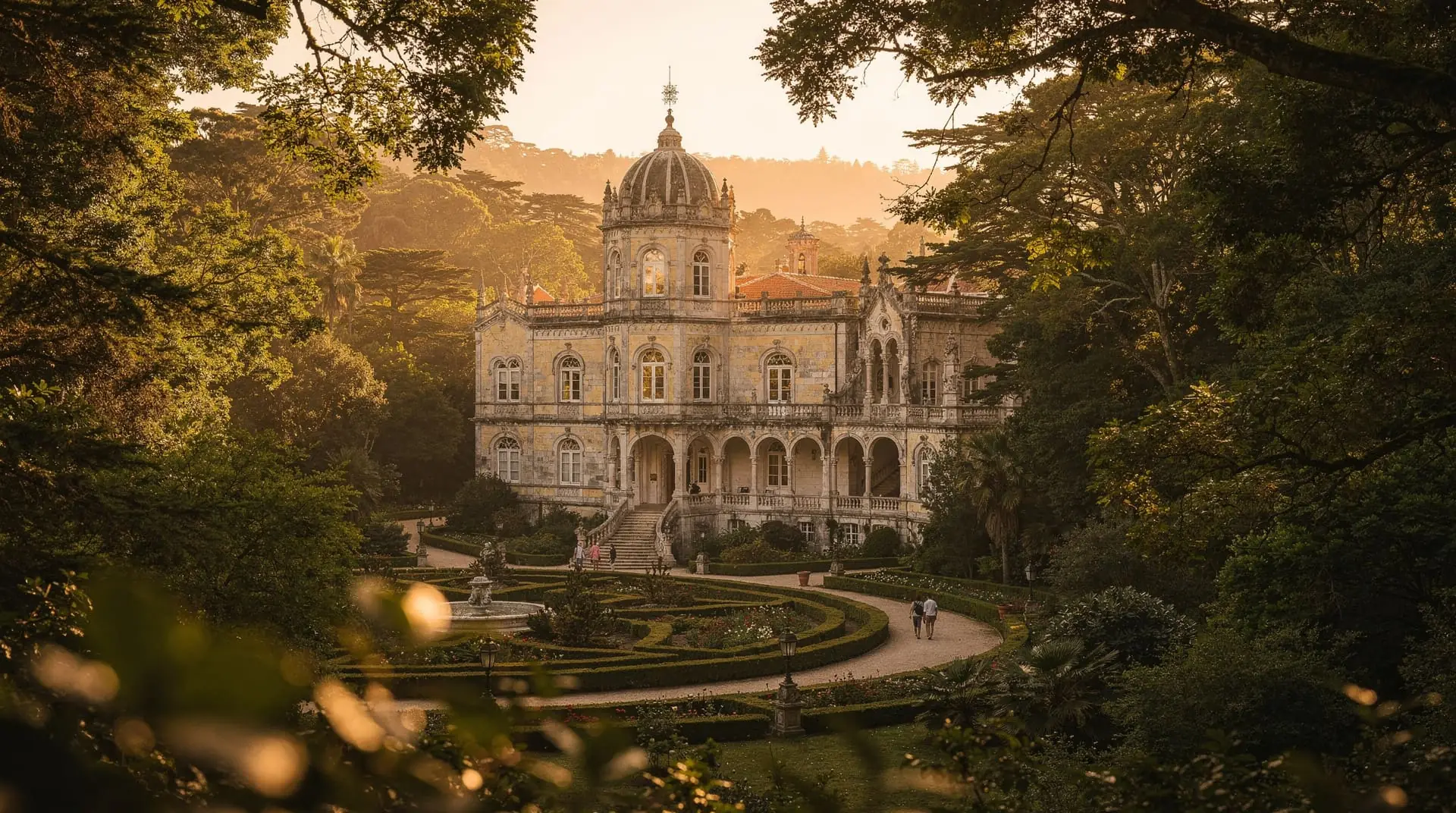
Monserrate is Sintra’s least crowded major monument and arguably its most elegant. While Pena Palace receives 1.5 million visitors a year and Quinta da Regaleira has become a fixture on everyone’s itinerary, Monserrate remains genuinely off the main tourist trail. On a weekday morning in September, you might walk through the botanical park for an hour and encounter twenty people.
The palace itself — a confection of Romantic-Gothic and Mughal-Indian design, with horseshoe arches, carved sandstone tracery, and three distinctive domed towers — was built in the 1860s for Sir William Beckford’s successor, Sir Francis Cook, who employed the English architect James Knowles Jr. The result is one of the most distinctive buildings in Portugal: part Sintra Romantic palace, part Rajput summer pavilion, utterly unlike anything else in the country.
The palace and its history
The site has a longer history than the current building suggests. A neo-Gothic chapel stood here in the late 18th century, built by William Beckford — the eccentric English millionaire who also built Fonthill Abbey in Wiltshire — who rented the property in the 1790s. George Gordon, Lord Byron, visited in 1809 and described the garden in Childe Harold’s Pilgrimage. The Romantic literary pedigree of the site is exceptional.
Sir Francis Cook purchased the property in 1856 and commissioned a total redesign. The current palace was built in two phases between 1858 and 1885, and the 30-hectare park was planted by William Stockdale with species from Australia, Mexico, Brazil, Japan, India and South Africa — a living catalogue of the Victorian-era botanical obsession.
The Cook family held the estate until the 1940s. It fell into disrepair under the Salazar-era state management and was not systematically restored until the 1990s. The restoration of the palace interior is ongoing — some rooms remain scaffolded, while others have been returned to their original opulence. This work-in-progress quality is part of what gives Monserrate a different atmosphere to the immaculately presented Pena Palace.
Tickets and entry
Ticket price (2026): €10 per adult for park and palace. €5 for children 6–17, free under 6. EU students €5.
Monserrate Park and Palace e-ticket with audio guideThe audio guide is particularly useful at Monserrate because the interpretation panels inside the palace are sparse. The e-ticket with audio covers both the palace rooms and the botanical park.
Walk-up tickets are available at the gate almost year-round — Monserrate does not sell out, even in high season. Online booking provides a timed-entry window and skips the short ticket queue, but is not essential here in the way it is at Pena or Regaleira.
Monserrate Palace and Park ticketLisboa Card: covers entry to Monserrate Palace.
Getting there
By bus 435
Bus 435 departs from Sintra station (Avenida Dr. Miguel Bombarda, stop outside the station) and from Sintra-Vila. It runs west along the Sintra-Colares road, stopping at Monserrate gate (approximately 15 minutes from the station). The bus is less frequent than the 434 — typically every 45–60 minutes — so check the schedule at the station before setting out. The return schedule is equally important: missing the last afternoon bus means a 45-minute walk back to Sintra-Vila.
Timetable note: in winter (October–May), bus 435 runs fewer daily services. Check the Scotturb website or the posted timetable at the station. The 434 (which serves Pena and Moorish Castle) is not the same route.
By tuk-tuk
Tuk-tuks from Sintra-Vila to Monserrate charge €12–18 per vehicle. This is a legitimate option if you have missed the bus or are travelling with a group where the per-person cost becomes reasonable. Ask the driver to confirm the return pick-up or arrange a scheduled pickup if you do not want to rely on the bus schedule.
By taxi or Uber
A taxi from Sintra station to Monserrate costs approximately €8–12. Uber availability in Sintra is inconsistent — the town is not well-covered. It is not reliable for the return journey.
On foot from Sintra-Vila
The walk from Sintra-Vila to Monserrate is 3.5 km on a winding road through the serra. It is pleasant in cooler weather and on the route you pass a series of remarkable quintas (private estates) behind walls. Allow 45–55 minutes. Not recommended in high summer heat (July–August). The walk downhill is easier and many visitors walk down from Monserrate to Sintra-Vila after their visit.
What to see: the palace
The palace interior has three distinct architectural zones:
The music room (Sala da Música): the grandest surviving interior room. The ceiling is a honeycomb of interlocking plaster niches — one of the most elaborate Moorish-revival ceilings in Portugal. Restored to a high standard.
The dining room: still undergoing restoration but interesting for the layered archaeology of wallpapers, plasterwork and tile visible behind the scaffolding.
The Indian room: horseshoe arches and carved stone screens modelled directly on Rajput palace architecture. James Knowles Jr. had access to contemporary architectural publications on Indian palace design and copied specific details with unusual accuracy.
The dome rooms: the three exterior domes correspond to separate interior spaces. Access to the upper dome platforms is occasionally open to visitors — ask staff.
Allow 45–60 minutes for the palace interior.
What to see: the park
The 30-hectare park is the reason to spend more than 90 minutes at Monserrate. The botanical collection is extraordinary: Australian tree ferns (Dicksonia antarctica) creating a prehistoric-forest atmosphere in the lower garden, a Mexican section with cacti and agaves, a Japanese-inspired planting zone, Indian laurels, bamboo groves and a collection of cycads that is among the finest in Europe.
The park paths are well maintained but not always obvious — the estate map (available at the entrance) is worth using. Key areas:
The ruined chapel: the remains of an 18th-century chapel in the lower garden, deliberately left as a Romantic ruin. The tree ferns growing alongside it create an extraordinary visual.
The Victorian cascade: a reconstructed waterfall feature. In spring and early summer, the surrounding planting of camellias, rhododendrons and tree heathers is exceptional.
The rose garden: above the palace on the upper terrace. In May–June the flowering is outstanding.
The valley path: descends steeply into the ravine below the palace, with the most exotic tree fern specimens. Worth the descent even though the climb back is steep.
Allow a minimum of 90 minutes for the park, 2.5–3 hours total for a thorough visit of palace and grounds.
Combining Monserrate with a Sintra day
Monserrate’s distance from the Pena/Regaleira cluster and its bus-schedule constraints make it difficult to combine with both Pena and Regaleira on the same day without a car or private tour. The realistic options:
Monserrate-only morning: 09:30 opening (or first bus, check), 2.5–3 hours at Monserrate, bus back to Sintra-Vila by 12:30, lunch, afternoon at Regaleira or National Palace.
With a private tour: the only practical way to combine Monserrate, Pena and Regaleira in one day without a car. A guide with a vehicle covers the distances efficiently. If Regaleira matters more to you than the Moorish Castle or Cabo da Roca, the Pena Palace, Regaleira and Monserrate combined tour covers that specific trio instead.
Lisbon: Pena Palace, Moorish Castle, Monserrate and Cabo da Roca tourFor Sintra without a car, the priority decision is whether you want depth at fewer monuments (Monserrate + Regaleira) or breadth across more (Pena + Moorish Castle + Regaleira). Monserrate is the right choice if you prefer quiet and botanical gardens over hilltop panoramas and crowds.
The botanical park in detail: what to look for
The Monserrate park is far more than a backdrop for the palace. William Stockdale’s 1858–1890s planting design drew on Victorian-era botanical expeditions to create a living encyclopaedia of the global flora available through 19th-century plant hunters.
The Australian section: the most dramatically atmospheric part of the park. Dicksonia antarctica tree ferns — a species that dates from the Jurassic period, 200 million years ago — have grown to 4–5 m here in the moist Atlantic climate. Walking among them on a misty morning, with the soft green light filtering through the fronds, is one of the most unusual landscape experiences within two hours of Lisbon. The ruined Gothic chapel in this section, draped in moss and surrounded by ferns, was deliberately left in its romantic decay state.
The Japanese section: camellia varieties dominate in winter and spring, flowering from November to March. Japanese maple varieties provide autumn colour. A stone lantern and bamboo grove complete the orientalist composition — Knowles Jr. and Stockdale drew on the same Victorian enthusiasm for Japanese aesthetics that influenced Impressionist painters and Arts and Crafts designers.
The Mexican section: agaves, aloes and a collection of cacti that includes some specimens introduced in the 1860s. These survive because the Sintra climate is mild enough in winter — it rarely falls below 5°C — but humid enough in summer to prevent the desiccation that kills succulents in hotter, drier climates.
The formal rose garden: on the upper terrace above the palace. At its peak in May–June, it contains old cultivars and heritage English roses chosen for their fragrance over show-variety uniformity. This is an unusually unfashionable choice for a contemporary formal garden, which makes it more interesting.
The cascade and lake: the Victorian cascade system runs water through the lower garden, creating a series of pools and rills. The black swan lake (swans were introduced in the 1860s) is visible from the upper palace terrace — a deliberately picturesque touch in keeping with the Romantic landscape tradition.
| Season | What’s flowering | Crowd level |
|---|---|---|
| Nov–Feb | Camellias in the Japanese section | Low; misty tree fern valley |
| Mar–Apr | Early rhododendrons, azaleas | Low–moderate |
| May–Jun | Rose garden at its peak | Moderate |
| Jul–Aug | Dry, green foliage rather than flowers | Moderate; hot |
| Sep–Oct | Autumn colour on Japanese maples | Low |
The literary history of Monserrate
The site attracted a literary history before the current palace was built. William Beckford — who rented the earlier property in the 1790s — was the author of Vathek (1786), one of the founding texts of Gothic fiction and an orientalist fantasy that anticipated the architectural aesthetics of the current building by 70 years. Beckford’s time in Sintra was productive and happy; he described Monserrate in his journals as one of the most beautiful places he had ever seen.
Lord Byron visited in 1809, during the same tour of the Iberian peninsula that produced the Childe Harold stanzas on Sintra. He walked through the gardens, which were then in a state of romantic semi-abandonment. The combination of exotic plants growing wild around the ruins of an English Gothic chapel was precisely the kind of scene that fuelled the Romantic movement’s aesthetics.
The Cook family — the Victorian merchants who built the current palace — left a more practical legacy: they catalogued the plants systematically, introduced irrigation systems to the dry-season management, and maintained the collection through the late 19th century. The estate they created was recognised as a UNESCO World Heritage Site as part of the Cultural Landscape of Sintra in 1995, the same year as Pena, Regaleira and the other Sintra monuments.
Who should prioritise Monserrate
Repeat visitors to Sintra who have already done Pena and Regaleira get the most out of Monserrate — it offers something genuinely different rather than more of the same. Garden and plant enthusiasts will find the botanical collection unmatched anywhere else in the Sintra circuit; few other Portuguese gardens combine Australian tree ferns, Mexican cacti and Japanese camellias in one estate. Photographers benefit from the quieter paths, which allow for considered composition without crowds intruding on every frame. Families with young children, by contrast, may find the distance and bus logistics more friction than the payoff justifies — Pena’s coloured towers and the Quinta da Regaleira initiation well are more immediately engaging for kids. Visitors on a first, single-day Sintra trip with limited time should generally prioritise Pena and Regaleira and treat Monserrate as a second-visit reward.
Photographing Monserrate
The music room ceiling rewards patience: shoot from the centre of the room with a wide-angle lens to capture the full honeycomb pattern, and come on an overcast day when the light through the windows is even rather than harshly directional. Outdoors, the tree fern valley photographs best in the soft, diffused light of an overcast or misty morning — direct sun creates harsh contrast between the canopy and the shaded understory. The palace exterior, with its three domes, is most striking from the lower lawn looking up, particularly in late afternoon when the sandstone takes on a warm tone. Avoid midday in summer, when the light is flat and the heat makes a slow, considered walk through the park less comfortable.
Practical information
Opening hours: 09:30–20:00 (summer); 09:30–18:00 (winter). Check seasonally — winter hours can vary. Open daily except 25 December.
Photography: allowed throughout. The palace interior, particularly the music room ceiling, is best photographed with a wide-angle lens. The tree fern valley requires patience with the light.
Accessibility: the palace ground floor is largely accessible. The park paths vary from accessible (main paths) to steep and rough (valley path). Wheelchairs can navigate the main terrace garden.
What to wear: comfortable walking shoes. The park paths include some steep sections with loose gravel. Light clothing in summer; a layer for the tree fern valley, which stays cool.
Food: no café or restaurant on site. Bring water and a snack. The nearest food options are back in Sintra-Vila (35–50 minutes by bus or foot).
If you are planning a full Sintra day around Monserrate, the Sintra in one day guide and the Sintra National Palace guide cover how to sequence the other monuments realistically.
Frequently asked questions about Monserrate Palace
Why is Monserrate less crowded than the other Sintra palaces?
Mainly because it is off the bus 434 route (the main tourist circuit) and requires bus 435 or a separate taxi/tuk-tuk. Tour groups almost universally go to Pena and Regaleira, which are faster to reach. Monserrate requires deliberate effort to visit, which naturally filters the crowd.
Is Monserrate Palace worth visiting?
Yes, particularly if you have been to Pena on a previous trip or prefer botanic gardens and architectural detail to spectacular hilltop views and crowds. It is a genuinely beautiful, underappreciated estate.
Can I walk from Pena Palace to Monserrate?
Not easily. They are on opposite sides of the Serra da Sintra. From Pena, you would need to descend to Sintra-Vila (bus 434 or walking) and then continue west by bus 435 to Monserrate. The total journey takes about 45 minutes. Not practical to combine both on foot.
Is Monserrate included in the Lisboa Card?
Yes. The Lisboa Card includes entry to Monserrate Palace (and most other major Sintra monuments). Transport by bus 435 is also included.
What makes the Monserrate architecture unusual?
The combination of Romantic Gothic (the pointed arches of the ground floor arcade), Moorish-Andalucian (horseshoe arches, geometric plasterwork) and Indian Mughal (the carved sandstone screens, the domed towers) elements under one roof is unique in Portugal and rare in Europe. The architect James Knowles Jr. was unusually well-informed about Indian palace design for his time.
When are the gardens at their best?
March–June for the rose garden, camellias and rhododendrons. The Australian tree ferns are dramatic year-round but particularly beautiful in the mist of October–February. July–August is fine but very dry.
Related guides

Pena Palace: tickets, queues and how to make the most of your visit
How to visit Pena Palace in Sintra — timed entry tickets, bus 434, park-only vs palace+park options, and what to expect inside the Romantic hilltop castle.
Moorish Castle Sintra: ramparts, views and how to get there
Complete guide to Sintra's Moorish Castle — 10th-century ramparts, the walk from town or bus 434, combined visits with Pena Palace, and honest tips.
Quinta da Regaleira: the Initiation Wells and esoteric gardens
Visit guide for Quinta da Regaleira in Sintra — the Initiation Wells, timed-entry tickets, dawn tip, and how to combine it with Pena Palace and the town.

Sintra National Palace: the conical chimneys and royal rooms
Guide to Sintra National Palace — the two giant conical kitchen chimneys, Mudéjar tile rooms, tickets, and how to combine it with Quinta da Regaleira.
Ready to book? Top tours for this guide
We earn a small commission if you book through GetYourGuide — at no extra cost to you. Every tour is hand-picked and verified.

Pena Palace and Park Entrance Ticket
From Lisbon: Sintra Half-Day Tour with Pena Palace Tickets
Sintra: Pena Palace & Coastal Wonders Day Tour with Tickets
Sintra: Pena Park and Palace Skip-the-line Ticket
Sintra: Pena Palace Guided Tour