
Moorish Castle Sintra: ramparts, views and how to get there
Last reviewed
Is the Moorish Castle in Sintra worth visiting?
Yes, if you like walking along medieval ramparts with panoramic views. The castle is a genuine 10th-century Moorish fortification with intact curtain walls you can walk along for about 1 km. Views extend to the Atlantic and across the Serra da Sintra. It is smaller than Pena Palace but less crowded and has authentic medieval atmosphere.
| Where | Serra da Sintra ridge, above Sintra-Vila |
| Cost | Around €10 for adults |
| Time needed | 60–90 minutes |
| Getting there | Bus 434 or a 45–60 min forest walk from Sintra-Vila |
| Best time | Clear mornings for Atlantic views; bring a layer year-round |
The Castelo dos Mouros sits on a rocky ridge of the Serra da Sintra, 412 metres above sea level, looking — from a distance — like a natural extension of the granite outcrops. The castle is a genuine medieval fortification, not a 19th-century reconstruction: the curtain walls and towers you walk along were built by Moorish forces in the 8th–9th centuries and subsequently extended after the Christian reconquest. Archaeological finds inside the walls include Islamic ceramics, Visigothic artefacts and even Roman-era materials — this ridge has been defended by successive civilisations for over two thousand years.
Unlike Pena Palace directly above it, the Moorish Castle is raw, weather-exposed and atmospheric. There is no furnished interior to visit — you are walking the walls themselves. That is either its appeal or its limitation, depending on what you come for.
What you actually do at the Moorish Castle
The visit centres on walking the curtain walls. The main rampart walk is approximately 1 km from the lower gateway to the Royal Tower (Torre Real), the highest point of the fortification at 450 m elevation. The path along the wall is wide enough for two people abreast in most sections, narrows at some tower passages, and involves significant stair-climbing at each tower.
From the Royal Tower, on a clear day, you can see:
- The Atlantic Ocean, 10 km to the west
- Cabo da Roca on the horizon (the westernmost point of continental Europe)
- Pena Palace, above and to the east, with its coloured towers
- Cascais and the Tagus estuary to the south
- Lisbon’s urban spread on the far horizon on the clearest days
The walk is not technically difficult but it is physically demanding. The stairways at each tower section involve steep steps, and the wind at the top can be strong. Plan 45–60 minutes for the full rampart circuit at a comfortable pace.
Beyond the walls, the castle interior enclosure contains archaeological excavations (ongoing — visible through protective covers), the ruins of a small Romanesque church (Igreja de Santa Maria do Castelo), and the remains of water cisterns. A small exhibition space near the entrance provides historical context.
Tickets and entry
Adult ticket (2026): €10. Children 6–17: €5. Free under 6. Lisboa Card included.
Moorish Castle skip-the-line ticket with audio guideThe audio guide is particularly useful here because there is limited on-site interpretation. The castle’s history — through Moorish, Visigothic, Roman and even pre-Roman layers — is complex and the audio guide navigates it well.
Walk-up tickets are available at the gate. The Moorish Castle rarely sells out, even in peak season (it receives fewer visitors than Pena). However, the bus 434 schedule is the real constraint — see below.
Getting there: bus 434 and walk options
By bus 434 (recommended)
Bus 434 runs the circuit: Sintra station → Sintra-Vila → Moorish Castle → Pena Palace → back. The Moorish Castle stop is below the entrance gate, with a 200 m uphill walk to the castle entrance.
A skip-the-line ticket for the Moorish Castle saves the short box-office queue and confirms your timed entry window:
Moorish Castle Sintra e-ticket and audio guideKey bus 434 facts:
- Day ticket: €4.10 (hop-on hop-off for the full day)
- Frequency: every 15–20 minutes in peak season; every 30–40 minutes off-season
- The 434 runs until approximately 19:00–19:30 (check the last bus time at the station when you arrive — critical for your return)
- In peak season, buses fill up quickly at the Pena Palace stop — if you plan to visit Pena first and then take the 434 downhill to the Moorish Castle, you may need to wait for a bus with space
Walking from Sintra-Vila to the Moorish Castle
A forest path connects Sintra-Vila to the Moorish Castle, climbing through the Sintra Natural Park. Distance: approximately 2.5 km from Sintra-Vila centre. Elevation gain: about 300 m. Time: 45–60 minutes uphill.
The path is well-maintained and shaded. Most hikers walk up and take the bus down — good footwear required. The forest is Atlantic-humid and often misty, giving an atmospheric approach particularly in winter and spring.
Walking from Pena Palace to the Moorish Castle
This is the most popular walking combination. From the Pena Palace park, a forest path descends to the Moorish Castle — about 1.5 km downhill, taking 20–30 minutes. The path is well-marked within the park. This is the optimal order: arrive by bus 434 at Pena (morning, shorter queue), visit Pena, walk down through the forest to the Moorish Castle, then take bus 434 back to Sintra-Vila from the Moorish Castle stop.
The optimal combined itinerary
Pena Palace + Moorish Castle in one morning
08:30–09:00: Train from Lisbon Rossio to Sintra (40 min) 09:10: Bus 434 from Sintra station (first or second service of the day) 09:45: Arrive Pena Palace; pre-booked timed entry for opening 10:00–12:00: Pena Palace visit (palace + park) 12:00: Walk forest path down to Moorish Castle (20–30 min) 12:30–13:30: Moorish Castle rampart walk 13:45: Bus 434 from Moorish Castle stop to Sintra-Vila 14:00: Lunch in Sintra-Vila 15:00–17:00: Quinta da Regaleira or National Palace 17:30: Train back to Lisbon
This schedule requires pre-booked tickets for Pena Palace. The Moorish Castle does not need pre-booking. For full logistics, see the Sintra in one day guide.
The history in brief
The castle was built by Moorish forces most likely in the 8th–9th centuries, during the Islamic period of Iberian history (711–1249 AD in Portugal). Sintra (then called Shintara or Cynthia) was a strategic position dominating the routes between the Atlantic coast and Lisbon.
The Portuguese under Afonso Henriques captured the castle in 1147, during the same campaign that took Lisbon. Unlike Lisbon’s São Jorge Castle, which was subsequently developed into a royal palace, the Moorish Castle was maintained as a military post and then gradually abandoned after the 1755 earthquake damaged its walls.
King Ferdinand II — the same “artist king” who built Pena Palace above — partially restored the walls in the 19th century as part of his programme of Romantic heritage conservation on the Serra. It was listed as a UNESCO World Heritage Site as part of the Cultural Landscape of Sintra in 1995.
Weather and the Sintra microclimate
Sintra’s position on the Serra traps Atlantic moisture, giving the castle a higher rainfall than anywhere else within 50 km of Lisbon. Even on days when Lisbon is clear and sunny, the Serra da Sintra can be in cloud. The Moorish Castle, on the exposed ridge, is the most weather-exposed monument in the region.
This is not a problem — the mist gives the castle a genuinely medieval atmosphere that clear days cannot replicate. But be prepared:
- Bring a layer even in summer (the ridge is significantly cooler than Lisbon)
- The stone walls are slippery when wet — good footwear is more important here than at any other Sintra monument
- Visibility varies dramatically; the Atlantic views are only available on clear days
The view from the Moorish Castle: what you actually see
The castle’s position on the Serra da Sintra ridge offers a genuinely different perspective from Pena Palace above it. Where Pena’s views are dominated by the Atlantic to the west and the deep serra forest below, the Moorish Castle’s rampart walk gives you a dynamic relationship with the landscape as you move along the walls: the view changes at each tower, and the relationship between the castle and Pena Palace above (visible above the tree line) is most legible from here.
From the Royal Tower:
- West: the Atlantic coast at Cabo da Roca on clear days, approximately 10 km. The coastline at Cascais is visible as a faint strip.
- North: the serra continues into forested ridges, with the tower of the Convento dos Capuchos (a 16th-century ascetic monastery) occasionally visible among the trees.
- East: Sintra-Vila below, with the conical chimneys of the Sintra National Palace easily identified. The Tagus estuary and, on exceptional days, Lisbon’s waterfront 25 km away.
- Above: Pena Palace’s coloured towers, 150 m above the Moorish Castle walls, looking down. The visual relationship between the two monuments is one of the most arresting architectural contrasts in Portugal.
On misty days — which are frequent given the Serra’s Atlantic microclimate — the views close in and the castle takes on a different atmosphere: the walls emerging from cloud, the forest silent below, the sound of wind through the towers. Some visitors prefer this to the clarity of a sunny day.
What the Moors built and why it matters
The castle was built by Moorish forces in the 8th–9th centuries as part of a network of hilltop fortifications across the Iberian peninsula. The construction technique uses irregular local granite bonded with lime mortar — “opus incertum” — which gives the walls their rough visual texture. The towers were originally taller and roofed; the square profiles you walk are the remaining bases.
Inside the walls, large cisterns provided the water supply that made a siege possible to withstand. The Sintra castle held against Christian attack for years and was only captured in 1147 when Afonso Henriques’s forces took Lisbon simultaneously, leaving the Sintra garrison isolated. A castle that could hold water could hold out — and the cisterns were the strategic key.
The walls contain material from multiple periods: the original 8th–9th century construction at the core, repairs from the Christian period, and the 19th-century restoration by Ferdinand II (who also built Pena Palace) which stabilised and partly rebuilt the most damaged sections. Walking the circuit, you can see variations in stone quality and mortar type that correspond to these different building campaigns.
The Sintra Natural Park context
The Moorish Castle sits within the Sintra-Cascais Natural Park (Parque Natural de Sintra-Cascais), a 145 km² protected area that runs from the Serra da Sintra to the Atlantic coast. The park encompasses the castle grounds, the Pena Park (200 hectares of planted forest around the palace), the Convento dos Capuchos, and the coastal cliffs around Cabo da Roca.
The Atlantic Laurissilva forest — a relic ecosystem of laurel, tree heaths and Atlantic oak, similar to the forests of Macaronesia — covers much of the serra. This is why the serra is almost always green even in August, when the Alentejo and Algarve are brown and dry: the Atlantic fog provides moisture even when it does not rain.
Walking in the park is excellent, and the trails between the castle, Pena and the Convento dos Capuchos can be done without bus transport if you have 4–5 hours and proper footwear. The Sintra without car guide has the walking routes mapped.
Practical information
Opening hours: 09:45–20:00 (summer); 10:00–18:00 (winter). Open daily.
Time needed: 60–90 minutes for the full rampart walk and interior area.
Accessibility: the rampart walk involves steps and rough stone surfaces. Not wheelchair accessible. The lower entry courtyard is accessible.
Food and drink: no café on site. Bring water — the climb in summer heat is demanding. Nearest food: Sintra-Vila (bus 434 or 30-minute downhill walk).
Photography: excellent throughout. The rampart walk provides changing views as you ascend. Golden hour from the Royal Tower is exceptional but requires careful bus schedule management.
Avoiding the crowds at the Moorish Castle
Even in peak season, the Moorish Castle receives noticeably fewer visitors than Pena Palace, largely because tour groups on tight schedules skip it. To avoid the modest crowds it does get, arrive either with the first bus 434 departures (before 09:30) or walk down from Pena in the early afternoon once the morning wave of Pena visitors has thinned. Weekday visits, particularly Tuesday to Thursday outside school holidays, are consistently quieter than weekends. Because there is no timed-entry system here, the constraint is the bus 434 schedule rather than ticket availability — build slack into your plan rather than cutting it fine.
Moorish Castle vs Pena Palace: which first?
| Moorish Castle | Pena Palace | |
|---|---|---|
| Style | Raw 8th–9th century ramparts | Ornate 19th-century Romantic palace |
| Crowds | Lower | Higher, needs timed entry |
| Interior | None — walls only | Furnished rooms |
| Time needed | 60–90 min | 2–3 hours (palace + park) |
| Best order | Visit second, walking down from Pena | Visit first for the shorter queue |
Doing Pena first and walking down through the forest to the Moorish Castle (20–30 minutes) is the most efficient sequence — see the combined itinerary above and the Sintra in one day guide for the full day plan.
Frequently asked questions about the Moorish Castle
How long does it take to visit the Moorish Castle?
The full rampart walk takes 45–60 minutes at a comfortable pace. Including the interior archaeological area and the small exhibition space, allow 90 minutes total.
Is the Moorish Castle better than Pena Palace?
They offer different experiences. Pena is more visually spectacular (exterior colours, interior rooms, wider views from higher elevation) but busier. The Moorish Castle is less crowded, more authentic as a historical site, and better for the walking-the-walls experience. Many visitors find the Moorish Castle atmosphere more satisfying precisely because it is less manufactured.
Can I walk between the Moorish Castle and Pena Palace?
Yes — a 1.5 km forest path connects them through the Pena Park. From Pena, it is mostly downhill to the Moorish Castle (20–30 minutes). From the Moorish Castle up to Pena, the same path takes 35–45 minutes with a steep final section.
Do I need to book tickets in advance?
The Moorish Castle rarely sells out. Walk-up tickets are usually available. Online booking is still recommended for the skip-the-queue benefit, but it is not as critical as for Pena Palace.
What footwear should I wear?
Trainers with good grip are the minimum. Hiking shoes or trail shoes are ideal, particularly if the walls are wet. Flip-flops and sandals are genuinely dangerous on wet stone steps.
Is the Moorish Castle child-friendly?
Older children (8+) who are comfortable with heights and steep steps will love it. The walls have no railings in some exposed sections, which can be alarming for parents of young children. There is nothing inherently unsafe for confident children who follow instructions. Under-5s may find the walking difficult and the steps too steep.
What is the best viewpoint at the Moorish Castle?
The Royal Tower (Torre Real) at the highest point of the rampart walk. Alternatively, the Guard’s Tower on the south rampart has a clear view toward Lisbon and the Tagus. On a clear morning before midday haze, both are outstanding.
Related guides

Pena Palace: tickets, queues and how to make the most of your visit
How to visit Pena Palace in Sintra — timed entry tickets, bus 434, park-only vs palace+park options, and what to expect inside the Romantic hilltop castle.

São Jorge Castle: visiting Lisbon's Moorish hilltop fortress
Complete guide to São Jorge Castle — tickets, queues, the panoramic views, the peacocks, and the best ways to walk up from Alfama or arrive by tram.

Monserrate Palace and Park: Sintra's quietest grand estate
Guide to Monserrate Palace in Sintra — Romantic-Mughal architecture, exotic park, bus 435 logistics, and why it is far quieter than Pena Palace.
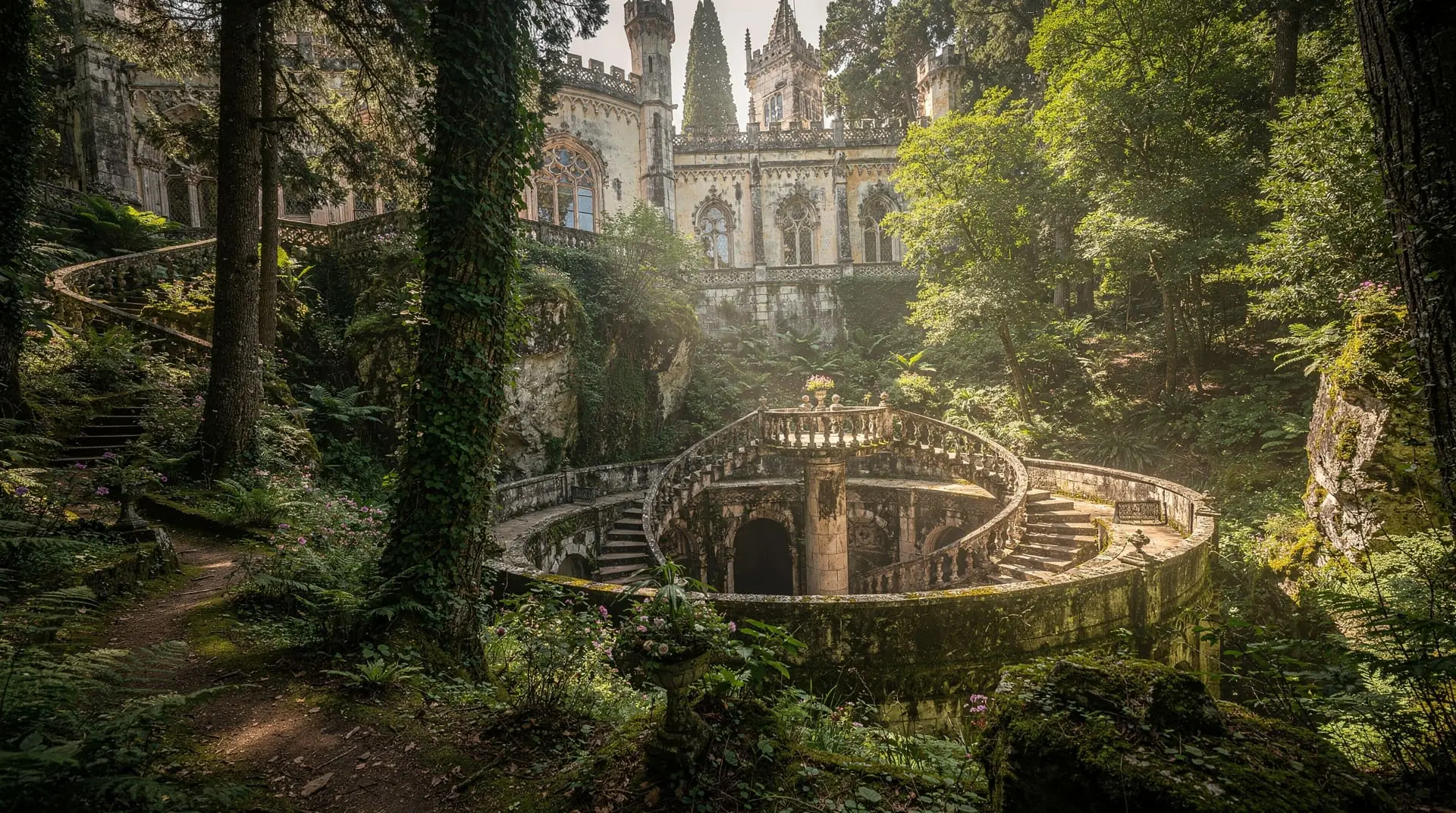
Quinta da Regaleira: the Initiation Wells and esoteric gardens
Visit guide for Quinta da Regaleira in Sintra — the Initiation Wells, timed-entry tickets, dawn tip, and how to combine it with Pena Palace and the town.
Ready to book? Top tours for this guide
We earn a small commission if you book through GetYourGuide — at no extra cost to you. Every tour is hand-picked and verified.

Pena Palace and Park Entrance Ticket
From Lisbon: Sintra Half-Day Tour with Pena Palace Tickets
Sintra: Pena Palace & Coastal Wonders Day Tour with Tickets
Sintra: Pena Park and Palace Skip-the-line Ticket
Sintra: Pena Palace Guided Tour