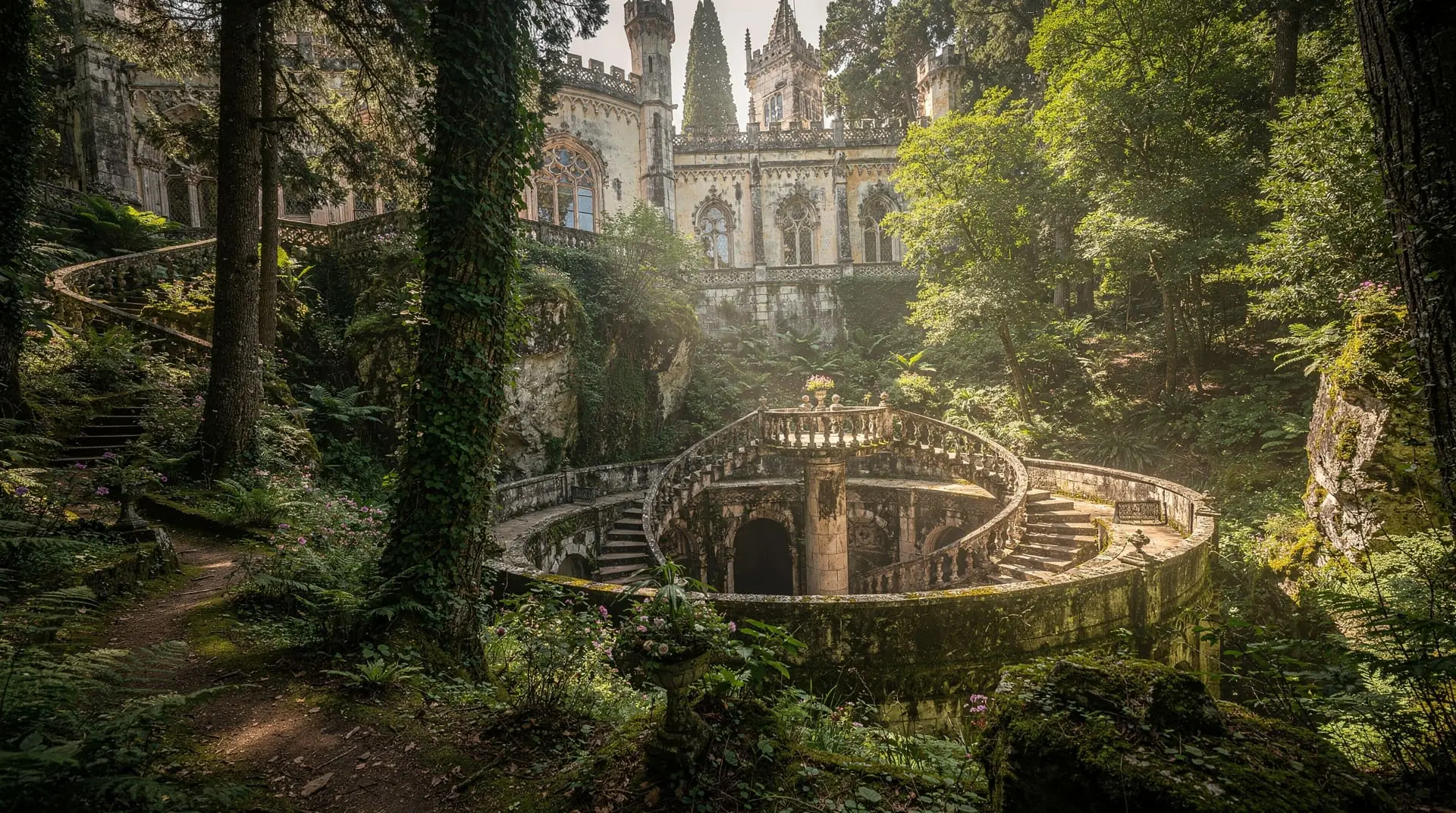
Quinta da Regaleira: the Initiation Wells and esoteric gardens
Last reviewed
What is the Quinta da Regaleira Initiation Well?
It is a 27-metre deep spiral stone staircase built into the ground, used for initiatory rituals by the estate's owner António Carvalho Monteiro in the early 1900s. Templar and Rosicrucian symbols are carved throughout. You descend the 9-storey staircase, pass through a tunnel, and emerge into the estate gardens — a theatrical and atmospheric experience unlike any other in Portugal.
Quinta da Regaleira is a 4-hectare estate on the outskirts of Sintra-Vila, and it is unlike anywhere else in Portugal. The palace is Manueline-Romantic in style, the gardens are English-landscape in structure, and the philosophical programme underlying the whole estate draws on Freemasonry, Rosicrucianism, alchemy and Templar symbolism. António Augusto Carvalho Monteiro, the wealthy butterfly collector and bibliophile who commissioned the estate between 1904 and 1910, intended it as a physical embodiment of esoteric initiation rites.
Most visitors come for the Initiation Wells — the poço iniciático — and leave having had one of the most memorable architectural experiences in Portugal. The wells are genuinely extraordinary. But the gardens, grottoes, tunnels, chapels and the main palace reward extended exploration beyond the Instagram stop.
| Where | Sintra-Vila, walkable from the historic centre |
| Cost | around €15 adult, €7.50 children 6–17 |
| Time needed | 2–3 hours |
| Getting there | 10–12 min walk from Sintra National Palace |
| Best time | 09:30 opening, especially April–June |
The estate and its history
Carvalho Monteiro, known as “Monteiro the Millionaire” for his fortune inherited from Brazilian coffee trading, bought the Regaleira estate in 1892 and hired the Italian architect Luigi Manini — better known as a theatrical set designer — to create something between a palace, a garden folly and an initiatory landscape. The result, completed around 1910, was classified as a UNESCO World Heritage Site as part of the Cultural Landscape of Sintra in 1995.
Manini designed the estate around initiatory themes: the descent into the earth (the wells), the underground passages connecting different points of the garden, the towers and platforms representing stages of elevation, and the symbols carved on almost every surface — Templar crosses, pentacles, the moon, compass-and-square Masonic motifs, alchemical signs.
Whether Monteiro was an actual Freemason or simply fascinated by esoteric symbolism is debated by historians. The estate was never used for any documented ritual purposes. It was, more plausibly, an elaborate expression of one man’s extraordinarily well-funded obsession with hidden knowledge.
The Initiation Wells (Poços Iniciáticos)
There are two wells — the main Initiation Well and the smaller, less-visited Unfinished Well.
The main Initiation Well
This is not a water well. It is a 27-metre deep circular shaft, lined with carefully dressed stone, descending through nine landings (representing the nine circles of the Commedia dell’Arte — or the nine spheres of the Kabbalah, depending on your preferred interpretation). A spiral staircase, protected by stone balustrades carved with esoteric symbols, winds down to the bottom.
At the bottom of the well, a Templar cross is set into the stone floor. Tunnels radiate outward in four directions, connecting to different parts of the estate garden — you emerge from a grotto into daylight at unexpected locations. The experience of descending the spiral staircase and then navigating the dark tunnels (lit by fixed electric lamps) is genuinely theatrical.
The well is 100% worth the visit. Queues to descend can build up during peak hours — this is one of the reasons to arrive early.
The Unfinished Well
A shorter, less elaborate structure in a different part of the estate. Fewer visitors reach it. Worth finding — the state of partial completion reveals the construction process.
Tickets and booking
Standard entry ticket: €15 per adult, €7.50 for children 6–17, free under 6. Includes full estate access.
Timed-entry booking: the estate operates a timed-entry system. Online tickets are available through the official website (regaleira.pt) and authorised resellers. Walk-up tickets are available at the gate but slots sell out on peak-season mornings by 11:00.
Quinta da Regaleira skip-the-line ticket with audio guideA guided tour adds 90 minutes and significantly enriches the esoteric symbolism — the estate is beautiful but opaque without context. Guides explain the Masonic and Rosicrucian references that casual visitors miss.
Quinta da Regaleira guided tour with entryGetting there from Sintra town
Quinta da Regaleira is the only major Sintra monument within easy walking distance of Sintra-Vila (the historic centre). From the Sintra National Palace, it is approximately 600 m on Rua Barbosa du Bocage — a slightly uphill walk through pleasant residential streets, taking 10–12 minutes.
Bus 434 does not stop at Regaleira. Tuk-tuks from Sintra station can drop you at the gate (€8–12 per vehicle). If you are already at Pena Palace or the Moorish Castle, bus 434 brings you to Sintra-Vila, then walk.
The dawn tip: is it worth it?
The estate opens at 09:30. Arriving at opening, particularly in April–June when dawn light filters through the forest before 10:00, gives you the wells and tunnels largely to yourself. The experience of descending the Initiation Well in empty silence — with the forest above and the stone below — is different in kind from the midday visit when groups queue at the top.
In July–August, even the 09:30 opening has a crowd by 10:00 due to tour groups. Book the earliest available timed slot online.
A walk through the estate
Most visitors follow a similar circuit (there is a map at the entrance):
Palace exterior: the Manueline-Romantic facade with its turrets and carvings. Do not try to rush through the exterior — the carved details reward attention.
Chapel of the Trinity: small, atmospheric, with Masonic floor-tile patterns visible to anyone who knows what to look for. Unusual for a Catholic chapel.
Initiation Well (main): descend slowly. At the bottom, choose your tunnel exit — the emerging-into-light experience in the garden is a set piece Manini designed carefully.
Grottoes and cascade: a series of artificial grottoes running water, stalactite formations and strategically placed romantic views. More English landscape garden than Portuguese formal garden.
Tower of Regaleira: climb for views over the estate and towards Sintra-Vila.
Unfinished Well: find it by following the estate map to the eastern section. Often missed by visitors who do not look for it.
Upper terrace garden: formal planting, azulejos on garden walls, views toward the Serra.
Allow 2 hours minimum. Three hours lets you explore thoroughly without rushing.
Combining Regaleira with other Sintra monuments
Regaleira and the Sintra National Palace are the two monuments in Sintra-Vila itself — the historic centre. They can be combined in a morning or afternoon without transport.
Half-day in Sintra-Vila: 09:30 Regaleira (opening), 12:00 lunch on Rua das Padarias, 13:30 Sintra National Palace (pre-book), 15:30 done. Bus back to Lisbon or continue to Pena.
Full Sintra day: see the Sintra in one day guide for a schedule that includes Pena Palace in the morning, Regaleira in the afternoon, and dinner in Sintra before the evening train back.
From Lisbon: Sintra, Pena Palace and Quinta da Regaleira tourWhat the estate looks like in different seasons
Spring (March–May): the gardens are in bloom, wisteria and camellias visible, light is green and fresh. The best season for photography.
Summer (June–August): full foliage, deep shade in the tunnels, hot above ground. Crowded but beautiful.
Autumn (September–November): foliage turning, fewer visitors, dramatic misty conditions on the Serra frequent by October.
Winter (December–February): the estate can be genuinely atmospheric with low cloud and empty. Some sections may be damp underfoot.
The esoteric symbolism: a brief decoding guide
Visitors who know nothing of Freemasonry, Rosicrucianism or Templar symbolism can still enjoy Regaleira purely as a beautiful garden with unusual architecture. But the estate makes considerably more sense with a brief orienting primer.
The Knights Templar: a medieval military order founded in Jerusalem in 1119, dissolved by Pope Clement V in 1312. Their connection to Portugal was particularly strong — they were refounded here as the Order of Christ. The Templar cross appears throughout the estate. Monteiro, the estate’s creator, was either a Freemason or deeply influenced by Masonic symbolism; Freemasonry had partly descended from (or at least claimed descent from) Templar traditions.
The nine landings of the Initiation Well: the number nine appears throughout Masonic and Rosicrucian symbolism. The nine floors of the well correspond variously to the nine spheres of Dante’s cosmology (the nine circles of paradise), the nine ranks of angels in Christian tradition, or the nine degrees of an initiatory order. The specific meaning Monteiro intended is ambiguous — possibly deliberately so.
The Chapel of the Trinity: a chapel dedicated to the Trinity in an estate that foregrounds Masonic and Rosicrucian symbolism is not necessarily contradictory. Both Freemasonry and Rosicrucianism historically maintained a relationship with Christian symbolism while incorporating elements from other esoteric traditions. The Masonic floor pattern (compass and set-square geometry visible in the floor tiles) is the key to reading the chapel.
The pentacle: a five-pointed star appears in the lower garden, laid out in stone. The pentacle is a symbol common to Pythagoreanism, Freemasonry and Rosicrucianism — it represents mathematical harmony, the five elements, or human proportions depending on the tradition.
You do not need to accept any of this as historically or philosophically serious to appreciate the estate. Monteiro may have been a committed initiate or may have been an extremely wealthy aesthete who found these symbols beautiful and portentous. The result is the same either way.
Honest tips for a better visit
Book the earliest slot: the 09:30 opening is genuinely different in quality from a 12:00 visit. The well is silent, the tunnels uncrowded, the light in the upper garden is softer.
Use the estate map: the gardens are not intuitively navigable without it. Pick one up at the entrance. The Unfinished Well is in the northeast corner — many visitors miss it entirely.
Bring a phone with a good low-light camera: the tunnels are lit but not brightly. A dedicated flash camera is counterproductive (kills the atmosphere); a modern phone camera manages the low-light conditions well.
Do not expect obvious explanations: the estate was not built to be decoded — it was built to be experienced. Resist the urge to find a single coherent “meaning.” The plurality of symbols from different traditions is the point.
Combine with the National Palace in the afternoon: the contrast between the National Palace’s courtly medieval history and Regaleira’s fin-de-siècle esoteric excess is itself interesting. Together they show two completely different sides of Sintra’s character.
Practical information
Opening hours: 09:30–20:00 (summer); 09:30–18:00 (winter). Open daily.
Photography: allowed throughout, including in the wells and tunnels (bring a phone with a good low-light camera — flash is unhelpful in the tunnels).
Accessibility: the wells and underground tunnels are not accessible to wheelchairs. The garden level and palace exterior are mostly accessible. Call ahead for current information.
What to wear: comfortable shoes with grip. The tunnel floors can be damp and slippery, the garden paths are uneven cobblestones. A light jacket for the tunnels, which are cool even in summer.
Food: no food service on the estate. Sintra-Vila has numerous cafés and restaurants within 10 minutes’ walk.
Frequently asked questions about Quinta da Regaleira
How long does it take to visit Quinta da Regaleira?
Two hours is the minimum for a proper visit that includes the wells, tunnels, grottoes and palace exterior. Allow three hours if you want to explore the full estate at a relaxed pace or take a guided tour.
Is Quinta da Regaleira suitable for children?
Yes, with some caveats. Children enjoy the tunnels and the well descent enormously. The staircase is narrow and the tunnels are dark (but lit) — fine for confident children. Very young children (under 4) may find the staircase descent difficult. The garden is open and child-friendly.
What do I need to know about the Initiation Well?
It is 27 metres deep with 9 landings connected by a tight spiral staircase. The bottom is lit. Tunnels lead out from the base. It is not recommended for anyone with severe claustrophobia, as the tunnel sections are narrow. The ascent uses a different staircase — you do not climb back up the same way you came down.
Can I visit Quinta da Regaleira without booking?
Walk-up tickets are available at the gate when slots remain. From June to September, morning slots often sell out by 11:00. To guarantee entry at your preferred time, book online — the Quinta da Regaleira skip-the-booth e-ticket with audio guide lets you buy ahead and walk straight past the ticket counter. Off-season (November–March), walk-up is usually fine.
Is Quinta da Regaleira walkable from Sintra station?
It is 1.5 km from Sintra station — about 20 minutes’ walk via Sintra-Vila, uphill in sections. Most visitors take a tuk-tuk for the uphill portion (€8–12) or walk from Sintra-Vila (which is itself 1.2 km from the station, reachable by bus 434 or a 15-minute walk).
How does Regaleira compare to Pena Palace?
They are very different experiences. Pena is an extraordinary exterior — colourful, hilltop, panoramic views — with a furnished royal interior. Regaleira is smaller, darker, and focused on the underground: wells, tunnels, grottoes. Both are excellent; most Sintra visitors do both. See the Pena Palace guide for comparison.
Is there a restaurant or café at Quinta da Regaleira?
There is no on-site café or restaurant. Bring water. For food, Sintra-Vila (10 minutes’ walk) has Piriquita (for famous travesseiros pastries), Tasca do Pestana for petiscos, and several sit-down restaurants. Avoid the tourist-trap restaurants directly on the main square that charge premium prices for mediocre food.
Accessibility in more detail
The estate’s main draw — the wells and their connecting tunnels — is genuinely inaccessible to wheelchair users and anyone with significant mobility limitations: the spiral staircase is narrow, uneven in places, and has no lift or ramp alternative. The palace exterior, the upper terraces and the main garden paths are more manageable, though still uneven cobblestone rather than flat paving, and some sections involve moderate gradients. If mobility is a concern for anyone in your group, it’s worth calling ahead (the estate’s contact details are on regaleira.pt) to confirm which sections are currently passable, since maintenance work occasionally closes parts of the garden circuit. Strollers can manage the main garden paths but not the well staircase — one adult should be free to carry a child through the tunnel section while another minds the stroller at the entrance.
What to skip if you’re short on time
If you only have 90 minutes rather than the recommended two to three hours, prioritise in this order: the main Initiation Well and its tunnels first (this is the reason most people come), then the grottoes and cascade immediately afterward since they’re on the same walking loop, then the palace exterior on your way out. The Unfinished Well, the Tower of Regaleira, and the upper terrace garden are the first things to cut if time is tight — worthwhile, but not essential to understanding the estate’s character. Skipping the guided tour in favour of reading the symbolism section of this guide beforehand is a reasonable time-saving trade-off if your schedule is genuinely constrained.
Crowds and light by time of day
| Time | Conditions |
|---|---|
| 09:30 opening | Quietest, best light through the forest, wells largely empty |
| 10:00–12:00 | Tour groups arrive, queues build at the well entrance |
| 12:00–15:00 | Busiest window, especially July–August |
| 15:00–17:00 | Crowds thin, softer afternoon light in the garden |
| Last 90 min before close | Very quiet, atmospheric, but rushed if you want the full circuit |
Photography and the wells
The Initiation Well is one of the most photographed spots in Sintra, and it is worth planning your shots rather than just snapping quickly at the top. The classic shot — looking straight down the spiral staircase from the rim — needs a gap in the queue, which is easiest right at 09:30 opening or in the last hour before close. Inside the tunnels, a modern phone’s low-light mode outperforms most compact cameras; a tripod is impractical given the narrow passages and other visitors. If you want the well genuinely empty for photography rather than just quiet, book a guided tour slot in the first hour — guides move groups through efficiently, leaving brief windows where the staircase is clear.
Related guides
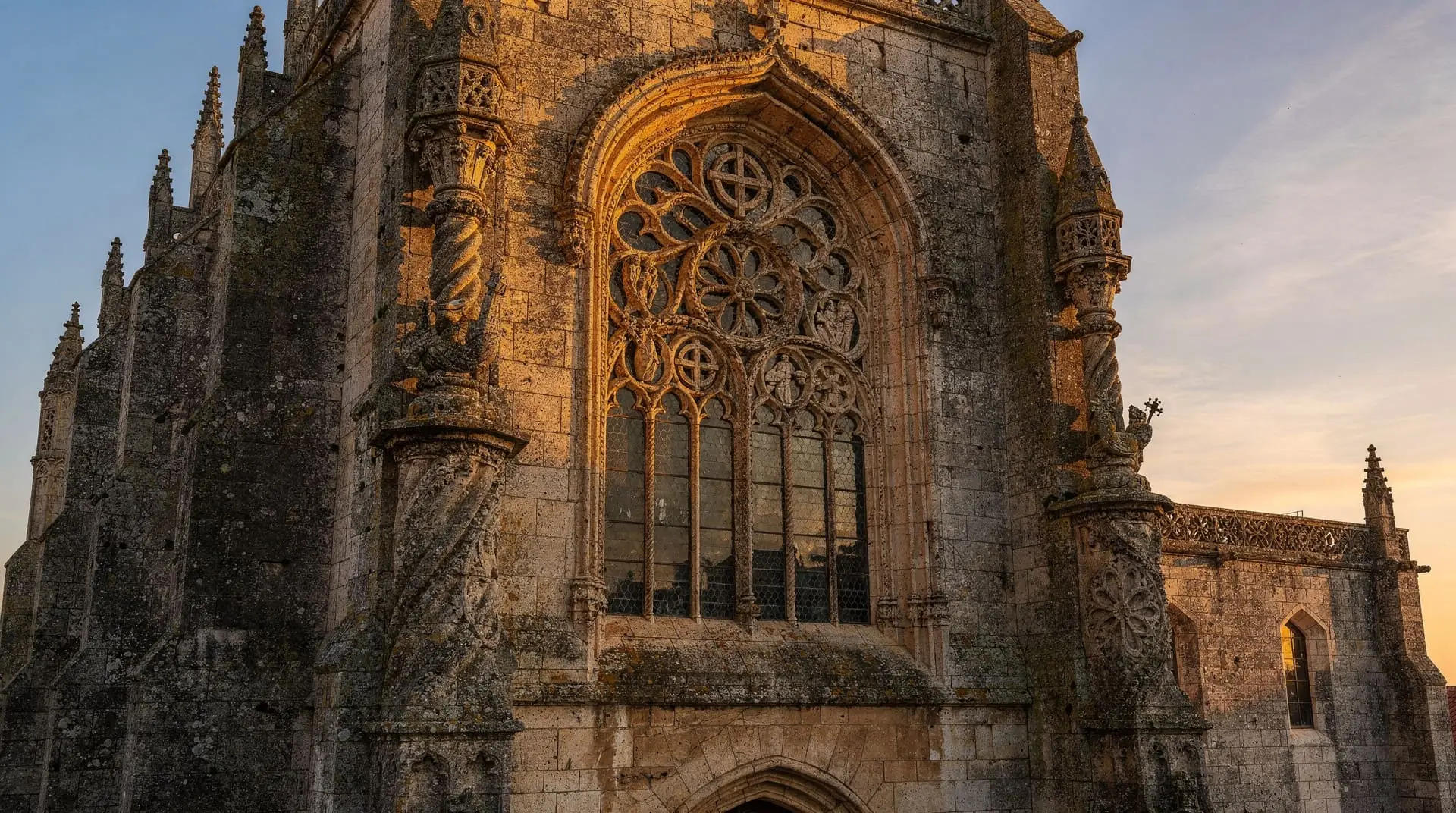
Convent of Christ in Tomar: the Templar headquarters and Manueline window
Visit guide for the Convent of Christ in Tomar — Templar castle, circular Charola, the most complex Manueline window in Portugal, and day trip logistics.

Pena Palace: tickets, queues and how to make the most of your visit
How to visit Pena Palace in Sintra — timed entry tickets, bus 434, park-only vs palace+park options, and what to expect inside the Romantic hilltop castle.

Monserrate Palace and Park: Sintra's quietest grand estate
Guide to Monserrate Palace in Sintra — Romantic-Mughal architecture, exotic park, bus 435 logistics, and why it is far quieter than Pena Palace.
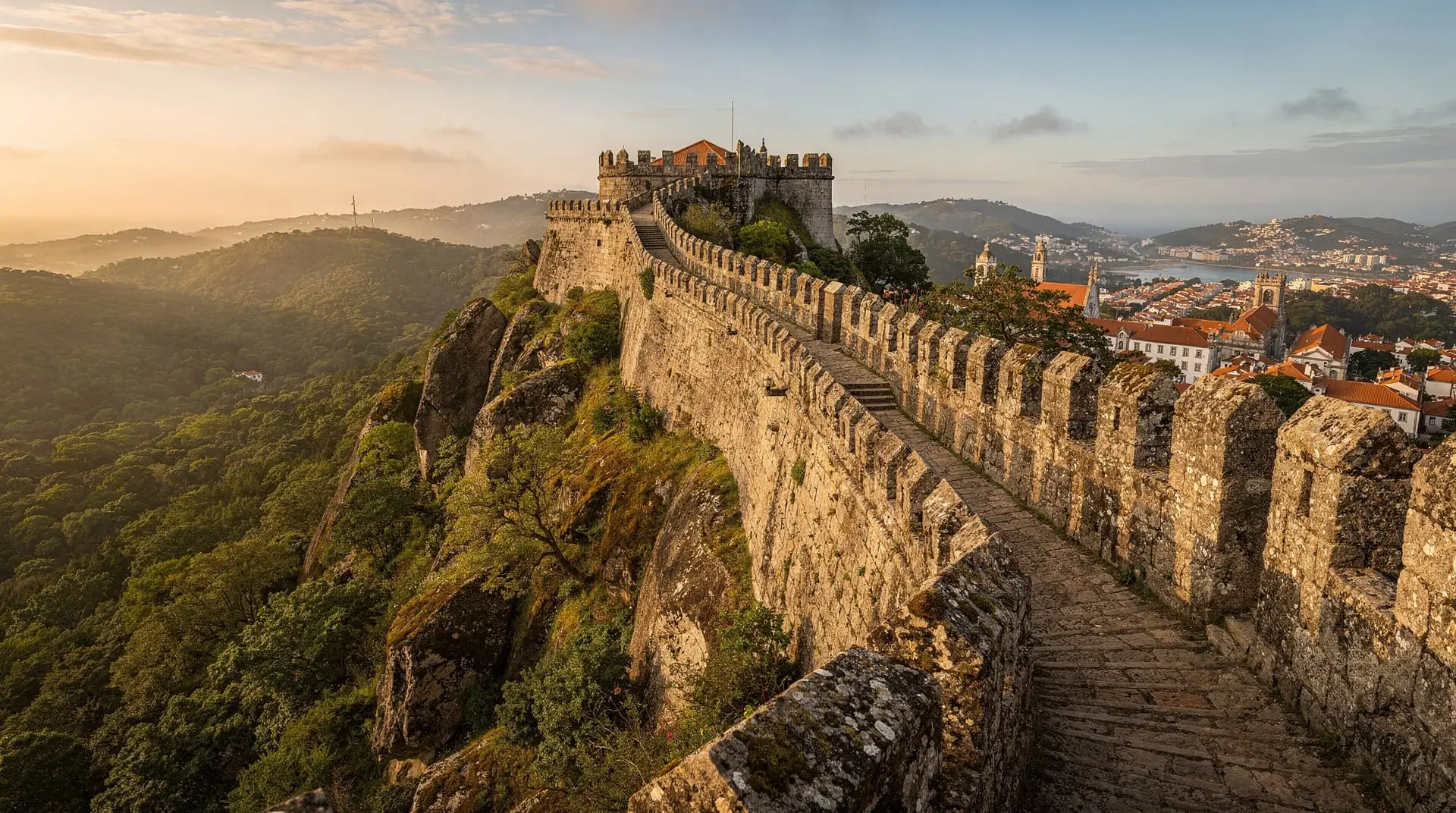
Moorish Castle Sintra: ramparts, views and how to get there
Complete guide to Sintra's Moorish Castle — 10th-century ramparts, the walk from town or bus 434, combined visits with Pena Palace, and honest tips.
Ready to book? Top tours for this guide
We earn a small commission if you book through GetYourGuide — at no extra cost to you. Every tour is hand-picked and verified.

Pena Palace and Park Entrance Ticket
From Lisbon: Sintra Half-Day Tour with Pena Palace Tickets
Sintra: Pena Palace & Coastal Wonders Day Tour with Tickets
Sintra: Pena Park and Palace Skip-the-line Ticket
Sintra: Pena Palace Guided Tour