
Sintra National Palace: the conical chimneys and royal rooms
Last reviewed
What are the two white conical towers at Sintra National Palace?
They are the kitchen chimneys, built in the 15th century to ventilate the palace kitchens during large royal banquets. Each cone is 33 metres tall. They are the most distinctive silhouette in Sintra-Vila and the symbol of the palace — visible from many points around the town and even from the Pena Palace ramparts.
The Palácio Nacional de Sintra is the only major Sintra monument that requires no bus, no tuk-tuk and no uphill walk. It stands at the centre of Sintra-Vila, in the main square (Praça da República), with those famous conical chimneys rising directly above the roofline of the town. After Pena Palace, it is the most architecturally significant building in Sintra — and because it sits in the town rather than on a hilltop, it is often overlooked by visitors who ride the bus straight to Pena and Regaleira without stopping.
That is their loss. The interior of the National Palace is one of the finest collections of Mudéjar and Gothic-Mudéjar azulejo tilework in Portugal, the royal apartments are extensively furnished, and the Swan Room ceiling — 27 painted swans, one for each of the ladies-in-waiting at the 15th-century Portuguese court — is exceptional.
| Where | Praça da República, Sintra-Vila (town centre) |
| Cost | Around €12 adult, €6 reduced, under 6 free |
| Time needed | 60–90 minutes |
| Getting there | Walk from Sintra station (15 min) or bus 434 |
| Best time | Afternoon, after the 11am–1pm tour-group window |
What you are visiting
The National Palace of Sintra was the primary royal summer residence from the 13th century until the early 20th century. Its construction spans several royal periods: the medieval Islamic foundation (vestiges visible in some structural elements), the Gothic additions of King Dinis (1261–1325), the extensive Manueline renovation under Manuel I (1495–1521), and the later Baroque and classicist modifications.
The result is a stratified building that tells six centuries of Portuguese royal history in its rooms. Unlike the purpose-built 19th-century romanticism of Pena Palace, the National Palace is a working palace — a place that was genuinely lived in, modified by each generation, and adapted for practical royal use including government functions.
The two conical chimneys date from the reign of João I (1385–1433). They are, despite their peculiar appearance, entirely functional — built at massive scale to vent the cooking of banquets that fed hundreds at a time.
Tickets and entry
Adult ticket (2026): €12. Children 6–17: €6. EU citizens under 25 or over 65: €6. Under 6: free.
Sintra National Palace e-ticket and audio guideThe audio guide is worthwhile — the palace’s layered history and the azulejo iconography require explanation that the physical panels do not fully provide.
Sintra National Palace skip-the-line ticketWalk-up tickets are usually available. The National Palace does not attract the same volume of tour groups as Pena, so queues rarely exceed 15–20 minutes even in peak season. The exception is summer Saturdays and any day when cruises are in Lisbon (cruise passengers are often bused to Sintra in the morning).
Lisboa Card: included.
Getting there
The palace is at the centre of Sintra-Vila, the historic centre. From Sintra train station:
Bus 434: alight at the Sintra-Vila stop (the second stop, before continuing to Moorish Castle and Pena). About 8 minutes from the station.
Walking: 1.2 km from the station, about 15 minutes on a mostly flat road (Avenida Dr. Miguel Bombarda then Rua do Paço). Pleasant walk through the town’s approach.
The palace entrance is on Praça da República — impossible to miss given the chimneys.
The rooms: what to see
The magpie room (Sala das Pegas)
The ceiling is painted with magpies holding a rose in their beak and a scroll reading “Por bem” (For good). Legend holds that King João I was caught kissing a lady-in-waiting by his queen, and painted one magpie for each lady-in-waiting (27) as a preemptive declaration of honour. A charming story of uncertain historical basis but excellent as a memory aid for the painting.
The swan room (Sala dos Cisnes)
The largest room in the palace, used for receptions and state occasions. The ceiling is painted with 27 swans — one for each of the ladies-in-waiting of the court of Afonso V (1432–1481). The swans are gilded and each is slightly different. The room also has Mudéjar tileWork at dado height — among the oldest preserved ceramic tile decoration in any Portuguese building.
The coat of arms room (Sala dos Brasões)
The most ornately decorated room. The dome ceiling features 72 coats of arms of the Portuguese nobility, arranged by rank around a central armorial display. Below, the azulejo dado panels (18th century) depict hunting scenes, with extraordinary detail in the borders. This room alone is worth the entry price.
The kitchen
The kitchen is directly below the conical chimneys, and entering it gives you an immediate sense of why the chimneys needed to be that large. The roasting spits, the storage vaults, the fireplace scale — it is the most visceral illustration of medieval royal catering in Portugal.
The Moorish bath and the private apartments
The remains of a 12th–13th century Islamic bath (hammam) are accessible in the basement. Above, the private royal apartments of the later period are furnished with Portuguese and Chinese export furniture and Arraiolos carpets.
Allow 90 minutes for a thorough visit.
Combining with Quinta da Regaleira
The Quinta da Regaleira is 600 m from the National Palace — a 10-minute walk uphill. These two monuments are the natural pairing for a Sintra-Vila half-day:
09:30: Regaleira opens — be there at opening (book in advance). 12:00: Walk down to Sintra-Vila for lunch (A Piriquita for travesseiros, or Tasca do Pestana for petiscos). 13:30: National Palace (book in advance, or walk-up if slots available). 15:30: Browse the village, get pastéis de Sintra from Piriquita to take on the train, then bus or walk to station. 16:00–17:00: Train back to Lisbon.
This is an achievable half-day from Lisbon without rushing. Combine it with a 2-day Lisbon itinerary that puts Sintra on Day 2.
For a guided day trip from Lisbon that combines these monuments with transport arranged:
Sintra guided tour: Pena Palace, Quinta da Regaleira and CascaisThe Manueline details to look for
Manuel I’s renovations of the palace in the early 16th century added Manueline decorative elements that link the building to the same cultural moment as Jerónimos Monastery and Belém Tower. Look for:
- The armillary sphere (Manuel’s personal emblem) appearing on the exterior windows and portal frames
- Twisted rope column detailing similar to Belém Tower
- Marine motifs (anchor, coral) on some interior carved brackets
The Manueline additions at the National Palace are less extensive than at Belém or Jerónimos but are more easily viewed at close range without the crowds.
What the National Palace is not
It is not a viewpoint palace. Unlike Pena or the Moorish Castle, the National Palace has no panoramic terrace. Views from the exterior terrace are limited to the Sintra-Vila streetscape.
It is not a garden palace. The grounds are a courtyard rather than an extensive park.
It is primarily an interior palace — a sequence of rooms with exceptional tilework, painted ceilings, and furnishings. Visitors who prefer views and landscape will find more at Pena; visitors who prefer architectural detail and art history will find Sintra National Palace particularly rewarding.
The azulejo collection in context
Sintra National Palace holds some of the oldest preserved azulejo panels in Portugal — a detail that gets insufficient attention in most visit guides. The term azulejo derives from the Arabic “al-zulayj” (polished stone) and the style was brought to Iberia by the Moors. The earliest panels in the palace (15th–16th century) predate the Portuguese tradition of narrative blue-and-white tiles by over a century and show the Mudéjar geometric tradition at its most refined.
The panels in the Sala dos Cisnes (Swan Room) and the kitchen area are particularly significant. They were made using a method called “cuerda seca” (dry cord) or the related “cuenca” technique — pressing the clay to create relief borders that prevent glaze colours from bleeding together. This produces the characteristic sharp outlines of early azulejo work. The 18th-century panels in the Sala dos Brasões use a different, later technique — brush-painted polychrome on a tin-glazed ground — producing the softer narrative style.
If the azulejo tradition interests you beyond the palace, the National Tile Museum in Lisbon (Museu Nacional do Azulejo) holds a comprehensive collection that traces the full evolution from Mudéjar origins to contemporary art. Visitors who do both in the same trip often notice the same geometric motifs recur — a useful thread if you’re travelling with anyone who finds “just more old tiles” a hard sell; framing it as a single evolving craft across six centuries tends to land better than framing each stop as a separate museum visit.
Sintra-Vila: the town around the palace
Sintra-Vila — the historic centre around the National Palace — deserves an hour of street-level exploration beyond the palace ticket. The town was built to service the royal summer court and retains an unusual density of 19th-century quintas, Romantic villas and formal gardens behind walls.
Rua das Padarias: the main commercial street, running north from Praça da República. A Piriquita at number 1 is the most famous pastry shop in Sintra — their travesseiros (almond-and-egg-cream parcels in flaky pastry) and queijadas (cheese tarts) are genuine regional specialities, not tourist approximations. Queue at the counter rather than waiting for table service.
Rua Visconde de Monserrate: a quieter side street with less touristy shops — stationery, wine, local pottery. The Bazaar do Pão bakery at the far end produces excellent bread.
The Moorish fountain (Fonte Mourisca): in a small square off Rua das Padarias, a 19th-century orientalist fountain decorated with azulejos. A typical Romantic-era Sintra feature that most visitors walk past without stopping.
Sintra’s tourist traps: the restaurants immediately on Praça da República facing the palace charge premium prices for average food. Walk two streets back from the square and prices drop significantly. Look for restaurants where Lisbonites on day trips are eating rather than restaurants that have trilingual menus in the window.
The history of Sintra as a royal summer retreat
The Serra da Sintra’s Atlantic microclimate — cool, moist, frequently misty — made it attractive to the Moorish and then the Portuguese royal court as a relief from Lisbon’s summer heat. The town’s identity as a royal resort is ancient: the Moors called it Shintara, and the Portuguese court was present here through much of the medieval period.
It was Lord Byron who gave Sintra its international reputation. In Childe Harold’s Pilgrimage (1812), he described it as “this glorious Eden” and “perhaps the most delightful in Europe, uniting the beauties of every kind, wood, rock, sea, and mountains.” The poem sparked a Romantic fascination with Sintra among the European aristocracy and bourgeoisie that persists in different form today.
The UNESCO inscription of Sintra as a Cultural Landscape in 1995 recognised the ensemble: not just the individual monuments but the relationship between the palace-dotted hilltops, the coastal cliffs, the Atlantic forest and the Romantic town below. This distinction is worth remembering when you visit — the individual monuments are extraordinary, but the whole landscape is the point.
Practical information
Opening hours: 09:30–18:30 (last entry 18:00) in summer; 09:30–17:30 (last entry 17:00) in winter. Closed 25 December.
Photography: permitted throughout, no tripods in busy rooms. The Swan Room and Coat of Arms Room are the principal photographic highlights — good natural light from clerestory windows in the afternoon. Flash is discouraged near the older azulejo panels, where glaze can show glare.
Accessibility: the ground floor is largely accessible. Upper rooms involve a staircase. Lift access available — ask staff.
What to wear: standard. No specific requirements.
Crowds: worst at 11:00–13:00 when tour groups are typically present. Visit in the afternoon for a quieter experience.
With children: the kitchen and the two giant chimneys are a genuine hit with kids — the scale is easy to grasp and the “why is it shaped like that” question answers itself once you’re standing under one. The Magpie Room story (King João I and the 27 painted birds) is the kind of palace legend that keeps children engaged through a room that would otherwise be just another painted ceiling. There is no rampart or steep terrace here, which makes it one of the lower-risk Sintra sites for families with younger children — see Sintra with kids for how it fits a family day.
Toilets and rest: available inside near the entrance. There is no café within the palace itself, but Praça da República has several options immediately outside, and Rua das Padarias (with A Piriquita) is a two-minute walk.
Who should prioritise this palace
If your Sintra day is built around Pena Palace and Quinta da Regaleira, as most first-time visits are (see the full Sintra day trip plan and the Sintra in one day guide for choosing between combinations), the National Palace is easy to leave out simply because it sits at ground level rather than on a hilltop with a queue. That’s a mistake for anyone who cares more about art history and interior detail than dramatic scenery — put simply, if you enjoyed the tilework at Jerónimos Monastery or the azulejo panels at Belém Tower, this palace rewards the same attention on a smaller, quieter scale. If your time is genuinely limited to one site beyond Pena, choose Regaleira for spectacle and this palace for substance — they serve different appetites, not competing ones.
Travellers doing Sintra without a car benefit particularly from this palace’s location: no bus queue, no uphill walk, just a flat stroll from the station, which makes it a sensible first or last stop of the day depending on your train times.
Frequently asked questions about Sintra National Palace
Is Sintra National Palace the most visited palace in Sintra?
No — that is Pena Palace. The National Palace is the second or third most visited, after Regaleira. Its in-town location means many visitors walk past the exterior without going in, which is a missed opportunity given the quality of the interior.
How long does a visit take?
90 minutes for a thorough visit of all accessible rooms with the audio guide. 60 minutes if you move at a moderate pace through the highlights. 30 minutes if you only want the chimneys and the Swan Room (the two most photographed elements).
Can I see the conical chimneys from inside?
The chimneys are viewed best from the kitchen below them (from the interior) and from the palace courtyard and Praça da República (from the exterior). You cannot climb them.
What is the best monument to combine with the National Palace?
Quinta da Regaleira, which is a 10-minute walk uphill and opens at 09:30. Do Regaleira first (2 hours), then lunch in the village, then the National Palace in the afternoon. See the logistics notes above.
Is Sintra National Palace included in the Lisboa Card?
Yes.
What is the Mudéjar style visible in the azulejos?
Mudéjar refers to the style created by Muslim craftsmen working under Christian patronage in Iberia after the Reconquista. At Sintra National Palace, the geometric azulejo patterns — interlocking star shapes, arabesque borders — follow Islamic geometric principles applied in glazed ceramic tile. These panels from the 15th and 16th centuries are among the oldest surviving tilework in the country.
How does the National Palace differ from the other Sintra palaces?
It is older, lower, and more historically layered than Pena (which is a purpose-built 19th-century Romantic creation). Unlike Regaleira (esoteric gardens, underground wells) or Monserrate (exotic botanical park), the National Palace is primarily an architectural and interior-arts experience. It is the best of the four for understanding the actual history of the Portuguese monarchy.
Related guides

Pena Palace: tickets, queues and how to make the most of your visit
How to visit Pena Palace in Sintra — timed entry tickets, bus 434, park-only vs palace+park options, and what to expect inside the Romantic hilltop castle.
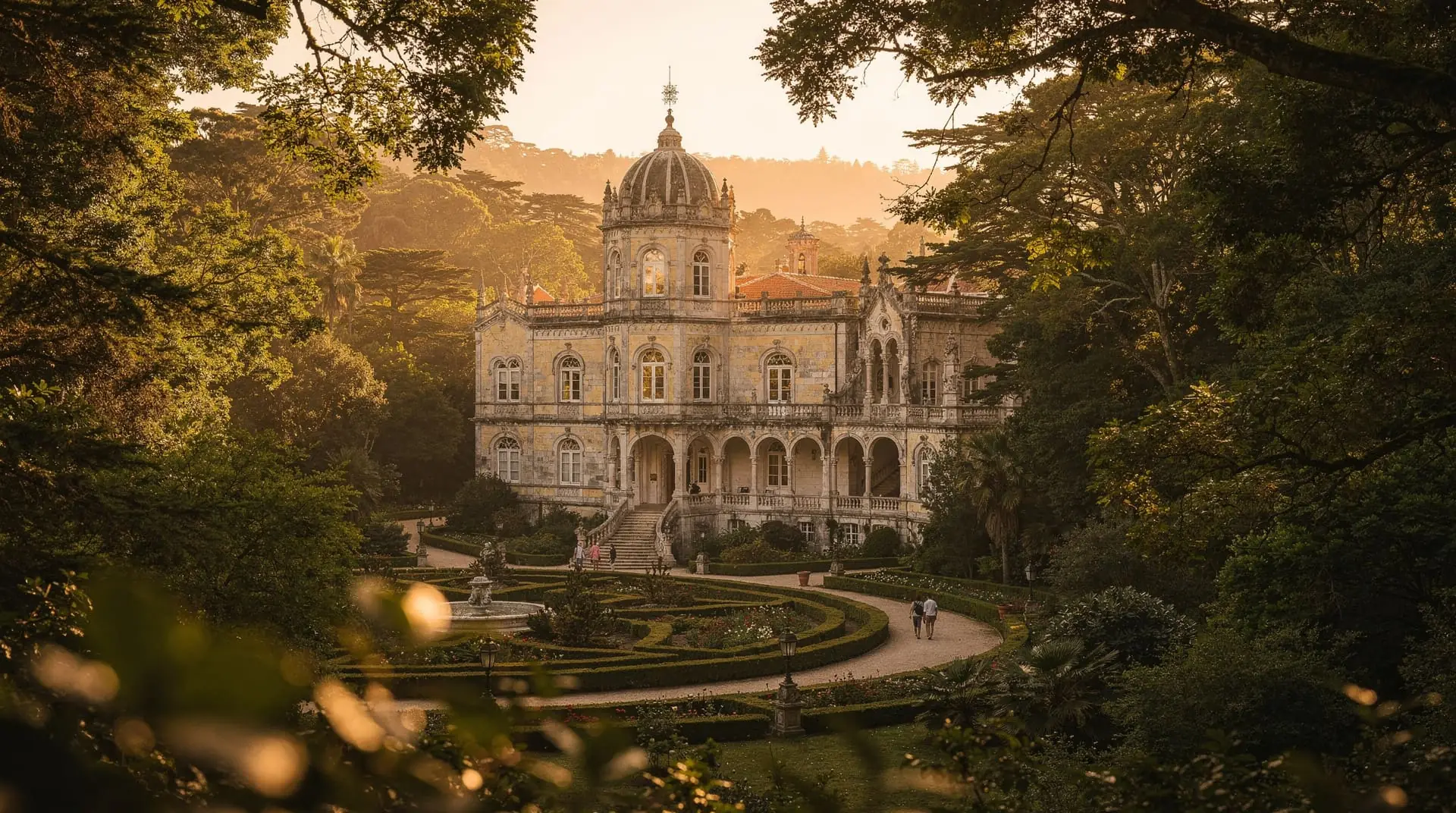
Monserrate Palace and Park: Sintra's quietest grand estate
Guide to Monserrate Palace in Sintra — Romantic-Mughal architecture, exotic park, bus 435 logistics, and why it is far quieter than Pena Palace.
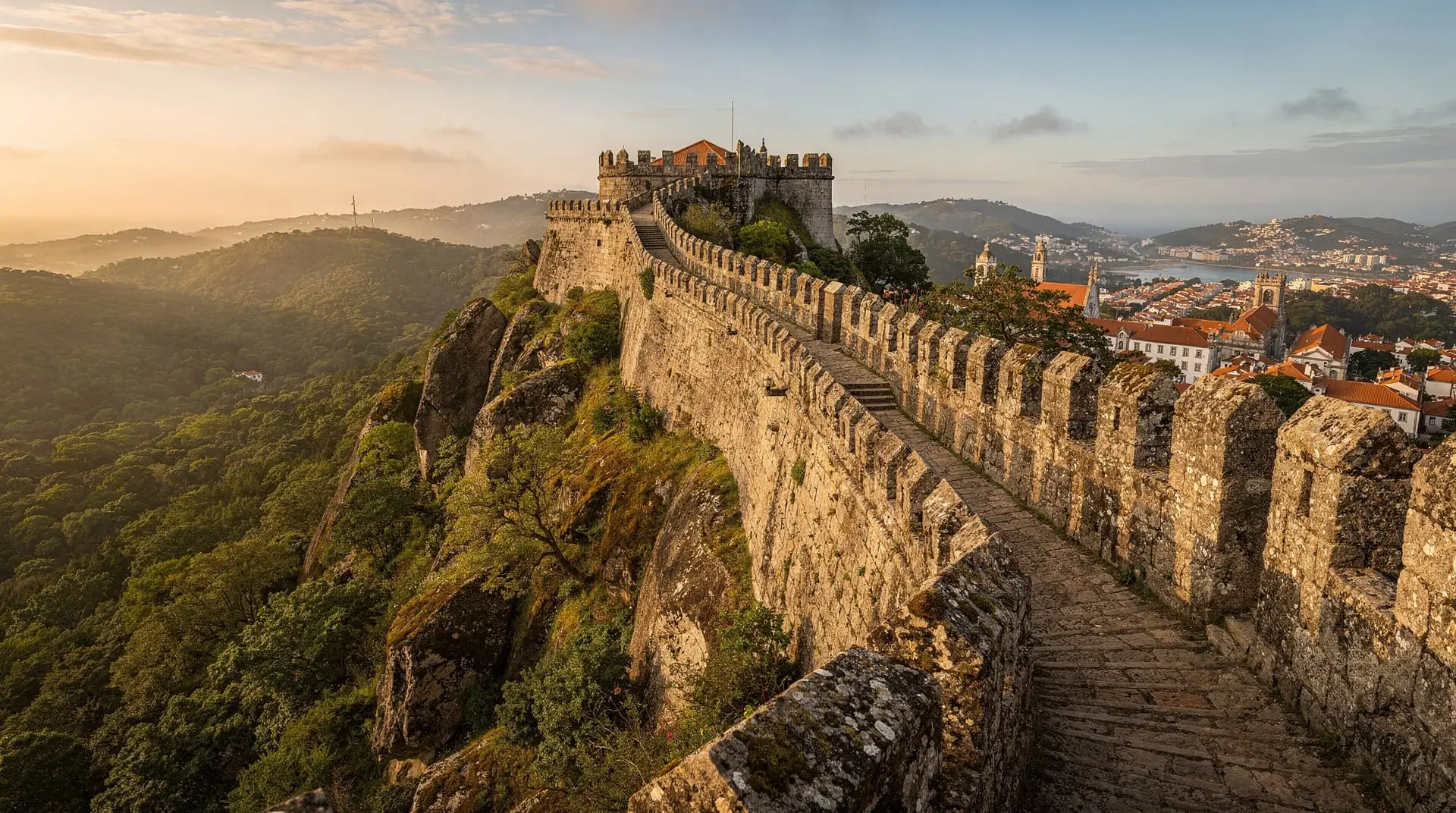
Moorish Castle Sintra: ramparts, views and how to get there
Complete guide to Sintra's Moorish Castle — 10th-century ramparts, the walk from town or bus 434, combined visits with Pena Palace, and honest tips.
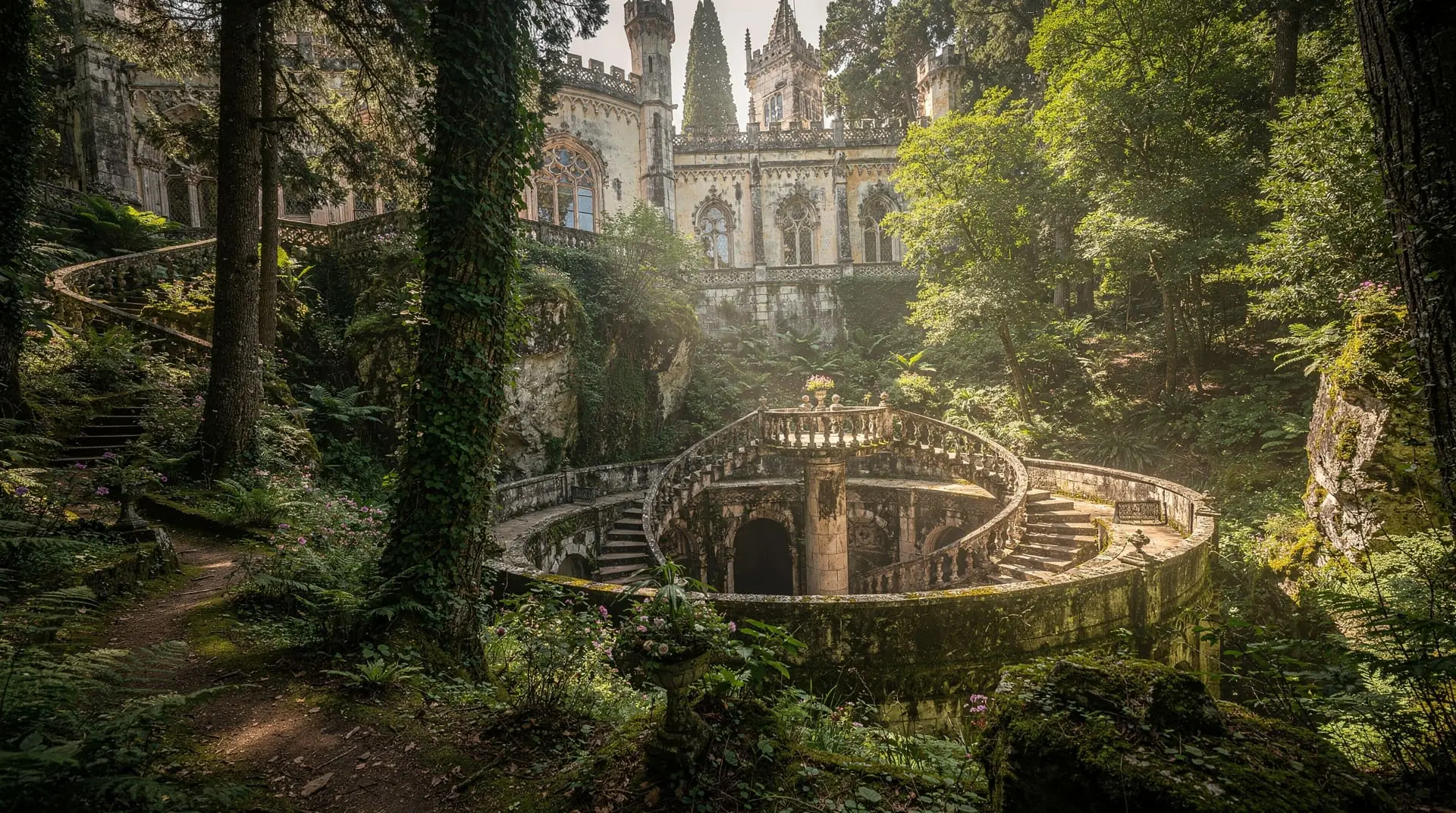
Quinta da Regaleira: the Initiation Wells and esoteric gardens
Visit guide for Quinta da Regaleira in Sintra — the Initiation Wells, timed-entry tickets, dawn tip, and how to combine it with Pena Palace and the town.
Ready to book? Top tours for this guide
We earn a small commission if you book through GetYourGuide — at no extra cost to you. Every tour is hand-picked and verified.

Pena Palace and Park Entrance Ticket
From Lisbon: Sintra Half-Day Tour with Pena Palace Tickets
Sintra: Pena Palace & Coastal Wonders Day Tour with Tickets
Sintra: Pena Park and Palace Skip-the-line Ticket
Sintra: Pena Palace Guided Tour