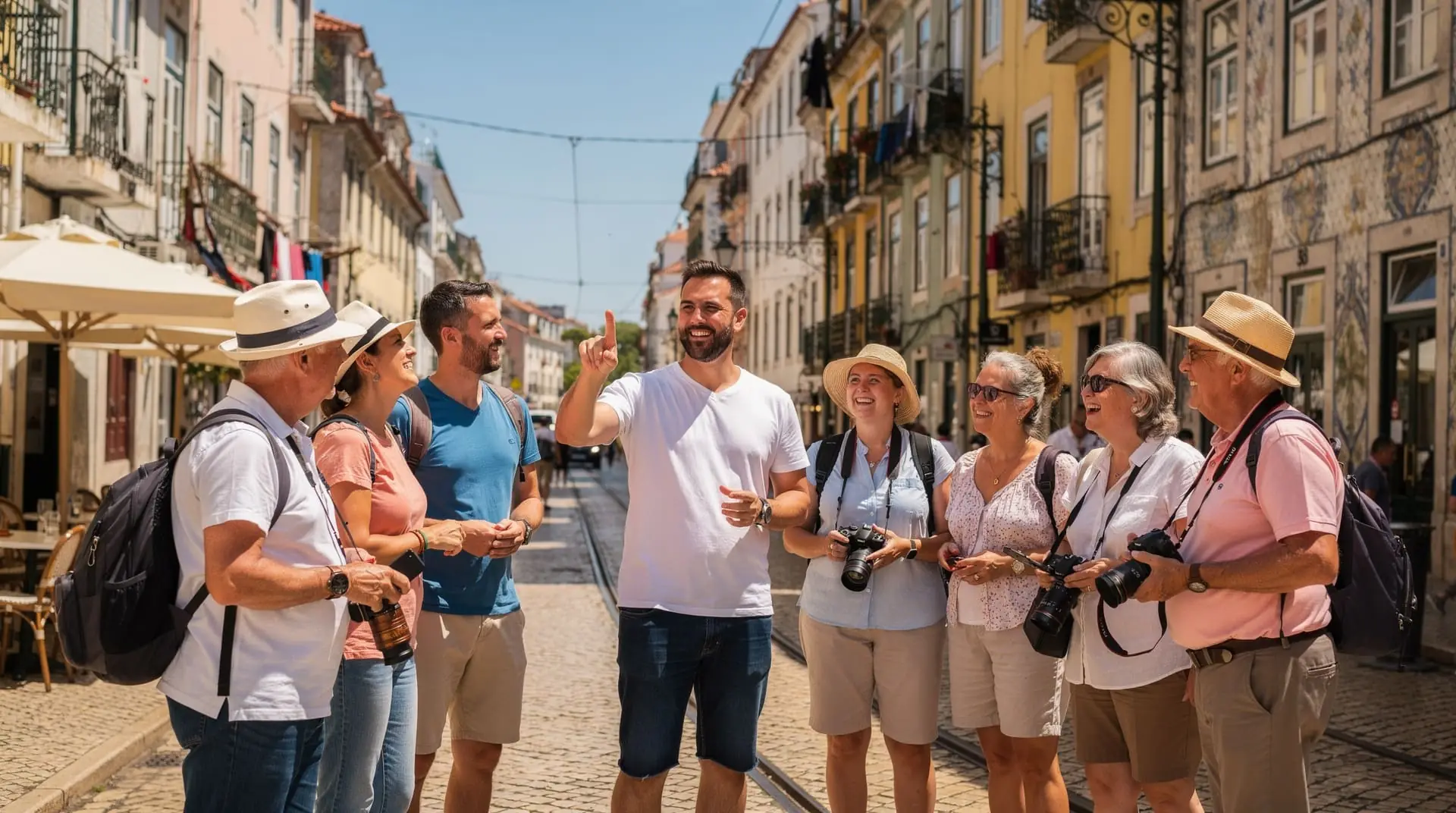
Best walking tours in Lisbon — themed, paid, and what to look for
Last reviewed
What are the best walking tours in Lisbon?
For the historic centre, the Alfama and Baixa-Chiado guided walks from established operators (Devour Tours, SANDEMANs, Inside Lisbon) deliver well. Food-focused walks through Mouraria and the Mercado da Ribeira are the best value for 3-4 hours. Jewish heritage and fado history tours are more specialist but excellent for visitors with those interests. Expect to pay €20-35 per person for a quality 2-3 hour tour.
Lisbon rewards a guide more than most European capitals, because so much of what makes the historic centre interesting — the layered history of Alfama, the earthquake-driven planning of Baixa, the multicultural texture of Mouraria — is invisible to a first-time visitor walking past it alone. This guide sorts the paid walking tour market by theme, tells you what a good operator looks like, and flags what to check before you book.
| Where | Alfama, Baixa-Chiado, Mouraria, Bairro Alto |
| Cost | Around €20-35 for a standard 2-3 hour walk; €50-80 for food tours |
| Time needed | 2-3 hours (standard), 3-4 hours (food), up to full day |
| Booking | 2-3 days ahead off-peak; a week ahead in July-August |
| Best time | Morning (cooler, fewer crowds) or the dedicated night tours for atmosphere |
What a good walking tour does in Lisbon
Lisbon’s historic centre is compact — the distance from Praça do Comércio to the São Jorge Castle is less than a kilometre as the crow flies — but it is also layered in a way that rewards knowledge. The Alfama is a medieval Islamic neighbourhood overlaid with Portuguese history, then fado, then a 21st-century renovation wave that has brought both gentrification and cultural investment. Baixa is a grid of 18th-century rationalist planning built over the earthquake rubble of old Lisbon. Mouraria is one of the most genuinely diverse neighbourhoods in western Europe.
None of this is immediately legible on a first visit. A good walking tour is not sightseeing — it is interpretation. The physical sites (the Sé cathedral, the miradouro, the fado bar) are visible whether you have a guide or not. What the guide provides is the framework that makes the sites mean something.
This guide covers the main tour themes available, the operators worth considering, and the practical information for booking.
Historic centre and Alfama walks
The largest category. Most operators in Lisbon offer a variation on the “historic Alfama and Baixa” circuit: starting at Praça do Comércio, moving through the Baixa grid, climbing to Alfama via the Sé cathedral, visiting one or two miradouros, and descending through the fado neighbourhood.
What makes a good operator in this category:
- Maximum group size of 10-15 people (more becomes a crowd management exercise)
- Guide who actually lives in or has personal connection to the neighbourhood
- Stops that go beyond the main tourist points to include a local café, a courtyard, or a workshop
- Duration of at least 2.5 hours (the short 1.5-hour versions feel rushed)
Operators to consider:
Inside Lisbon: One of the oldest walking tour operators in the city, with guides who have been running the same routes for 10+ years. The Alfama tour is particularly strong on neighbourhood history and fado context. Small groups (10 max). About €25 per person.
Devour Tours: Food-focused with some general walks. The Alfama walk often includes stops at a local adega (wine shop) and a tasca. Tour quality varies by guide but the better ones are excellent. About €25-30.
Lisbon Chill-Out: Primarily known for free tours but also runs paid specialist walks. The Jewish quarter walk and the Alfama walk are both well-regarded.
Food and wine walking tours
The food tour market in Lisbon is competitive and the quality range is wide. A good food tour covers: pastéis de nata at a real bakery (not the touristy Belém queue), a proper local tasca for petiscos, the Mercado da Ribeira or a neighbourhood market, ginjinha at a traditional bar, and perhaps an azulejo-adorned wine bar for a glass of Portuguese wine.
What to look for:
- The number of food stops and whether they are included in the price (some tours charge the tour fee plus food separately)
- Whether the restaurants are genuinely local or tourist-facing (check Google Maps reviews of the stops, not just the tour)
- Duration — a proper food tour needs 3-4 hours to cover the ground without rushing
Themes: The Mouraria food walk (multicultural food scene — African, South Asian, and traditional Portuguese) is different from the Baixa-Chiado walk (refined restaurants and wine bars) or the Alfama walk (traditional tascas and fado-adjacent cafés). Decide which neighbourhood character interests you more.
Price: Expect €50-80 per person for a quality food tour including tastings. This seems high but accounts for the food cost built into the price.
Full detail on food tour options: Lisbon food tours guide.
Jewish heritage walks
Lisbon has one of the most significant and under-visited Jewish heritage sites in western Europe. The Jewish community (Mouraria and adjacent areas) was expelled or forced to convert in 1497, but the physical traces remain in street names, architectural details, and several preserved sites.
The Centro Histórico de Lisboa has a mapped Jewish Heritage Route. Walking it independently with a map is possible. Walking it with a specialist guide who can explain the inquisition history, the crypto-Jewish community, and the connection to Sephardic Jewish communities in Amsterdam and beyond is a qualitatively different experience.
Tour content typically includes: The Mouraria neighbourhood (original Jewish quarter before the 1497 expulsion), Alfama streets where conversos (converted Jews) settled, the Church of São Domingos (site of anti-Jewish riots in 1506), the area around Rua da Judiaria, and context about the expulsion edict and the Portuguese Inquisition.
Booking: Several operators offer this tour but it is a specialist product. Check that the guide has genuine expertise rather than a general Lisbon background. Expect around €20-30 per person.
Fado and music history tours
Fado originated in Lisbon’s waterfront and Alfama neighbourhood in the early 19th century, with roots in the earlier modinha and lundum musical forms brought from Brazil. A fado history walk connects the physical geography of the music’s development with its social and cultural context.
Good content for a fado history tour: the Museu do Fado (worth visiting before or after the walk), the streets of Alfama where the early fadistas (fado singers) performed, the role of the guitarra portuguesa (Portuguese guitar), the fado house tradition and how it developed from improvised street performance to formal restaurant shows, and the trajectory of fado from 20th-century Salazar-regime association to UNESCO Intangible Cultural Heritage status in 2011.
The walk works best as a prelude to an evening at a proper fado house — the context makes the music significantly more meaningful. See the best fado houses guide for evening options.
Tour duration: Usually 2-2.5 hours plus fado dinner if combined. Combined fado walk and dinner packages run around €50-70 per person.
Alternative Lisbon tours
This category covers tours that deliberately go beyond the usual circuit: street art in Mouraria and the Intendente area, architecture tours (modernist Lisbon is genuinely interesting — the Almada Negreiros murals at Gare do Oriente, the Siza Vieira-designed Faculty of Architecture), tile workshop visits, craft producers in the Bairro Alto, and rooftop bar routes.
Lisbon hidden gems guided tourStreet art: Lisbon has one of the most significant street art scenes in Europe, concentrated in Mouraria, Intendente, and parts of Bairro Alto. The best-known artist is Vhils (Alexandre Farto), who carves portraits into building facades. Tours covering the street art context and the cultural moment that produced it run about 2 hours and cost €15-25.
Architecture and urban planning: The Marquês de Pombal planning of Baixa after the 1755 earthquake is a fascinating story of Enlightenment urban design under pressure. The pombaline buildings have a specific structural system (the “gaiola pombalina”) that made them earthquake-resistant — understanding this changes how you look at the Baixa grid entirely.
Practical information for booking walking tours
Group size: Tours under 12 people are generally better than tours of 20+. Check the maximum group size in the tour description.
Language: All major operators offer English-language tours daily. Some offer French, German, and Spanish on specific days — check availability.
Cancellation: Most walking tours cancel in heavy rain. Check the cancellation policy — reputable operators offer full refunds or rescheduling for weather cancellations.
Meeting points: Usually at a landmark (Praça do Comércio, the Sé, Martim Moniz square). Arrive 5 minutes early — tours with guides who have another group at a different time will leave on schedule.
Tipping: For paid tours, tipping is not expected but appreciated. €2-5 per person for a good guide is appropriate.
Booking: Direct from operator websites, GetYourGuide, or Viator. GetYourGuide often has the most competitive prices and a reliable cancellation policy.
Walking tour vs self-guided visit
Walking tours are not the only way to explore Lisbon’s neighbourhoods. If you are a competent navigator and enjoy independent exploration, a self-guided walk with a good map and some research can be equally rewarding and considerably cheaper.
The advantage of a guided tour is not access to sites — most of the places a guide takes you are publicly accessible. It is interpretation and context. If you have read about Lisbon’s history before arriving, have some Portuguese, and are comfortable getting slightly lost, self-guided walking in Alfama is genuinely one of the best things to do in the city.
If you prefer structure, have limited time, or are in Lisbon for the first time without prior research, a paid guided walk is well worth the €20-30 investment. The alternatives — the hop-on hop-off bus, the tuk-tuk without a knowledgeable driver — provide less insight at higher cost.
Night walking tours
A distinct category. Night tours (departing 7-9pm) cover different ground and different atmosphere from the daytime circuit:
- The Alfama at night when fado sounds emerge from doorways
- The Bairro Alto before and during nightlife
- Illuminated monuments — Belém Tower lit from below, the Sé cathedral floodlit, São Jorge Castle above the city
- The Cais do Sodré and Pink Street area for a glimpse of Lisbon nightlife without committing to a pub crawl
Night tours run approximately 2-2.5 hours and cost €15-25 per person. Several operators combine the walking tour with a fado tasting — 45-60 minutes at an intimate fado house, followed by or preceded by a walk through the neighbourhood where fado originated. See the best fado houses guide for which venues participate in these combinations.
Photography walking tours
Lisbon is one of the most photographed cities in Europe and has developed a specific walking tour format catering to photographers — amateur and serious alike.
These tours cover the city’s photogenic streets and viewpoints (Alfama roofscape, São Jorge Castle, Portas do Sol, Graça miradouro, the tram 28 corridor) with a guide who is also an experienced photographer. The guide covers compositional advice, golden hour timing, and the specific streets and angles that produce the strongest images.
Duration: typically sunrise or sunset sessions (1.5-2 hours) or blue hour night photography sessions. These tours are small — 4-8 people maximum — because larger groups compete for the same angles and make managing the session impractical.
Price: €25-40 per person, sometimes including a review session. A model release from the guide may be required for using images commercially.
Longer tours: half-day and full-day options
Beyond the standard 2.5-3 hour walking tour, several operators offer extended half-day (4-5 hours) and full-day (7-8 hours) guided experiences.
Half-day: Typically covers two distinct neighbourhoods in depth — Alfama plus Baixa-Chiado, for instance, or Belém plus Alcântara. At this duration you get monument entries included (some half-day tours include Jerónimos or São Jorge Castle entry). Price €35-60 per person. A Lisbon city half-day private guided tour of the iconic attractions follows this same format with a guide dedicated to your party alone.
Full-day: Effectively a private or small-group guided day that crosses most of the major city areas. Useful for visitors with only one or two days in Lisbon who want maximum coverage with explanation. These include breaks, lunch at a recommended restaurant, and both major monument sites and neighbourhood exploration. Price €80-150 per person (private); €40-70 (small group, 8-10 max).
Private vs group: Private tours (one guide, your party only) allow full flexibility — you go at your pace, ask any questions, and the guide adapts the itinerary. Genuinely worth the premium for any group of 4 or more people, where the per-person cost of a private tour approaches the group tour price.
Booking tips and what to look for
Check the guide’s profile: Most booking platforms allow guides to create profiles with background information. A guide who has lived in Lisbon for 20+ years, who has specific expertise in one of the tour themes, and who has a response rate to reviews demonstrating engagement with their clients — this is the profile that predicts quality.
Read recent reviews: Reviews older than 6 months may describe a different guide (staff turnover is real in the tour industry). Recent reviews in the same language you will tour in are the most relevant data.
Cancellation policy: European weather is rarely catastrophic enough to cancel a walking tour, but if you have concerns, choose operators with free cancellation up to 24 hours before. Most reputable operators offer this.
What to wear: Lisbon’s streets are predominantly cobblestone (calçada portuguesa). Flat, sturdy shoes are not optional — heels will be painful within 20 minutes in Alfama. Comfortable walking shoes or trainers are the correct choice.
Accessibility: Most standard city walking tours are not suitable for visitors with significant mobility limitations, due to the steep hills and uneven paving. Ask operators specifically about accessibility before booking. Some offer adapted routes using funiculars and trams for the hill sections.
The difference between a tour and an experience
A good walking tour guide understands that the physical sights are secondary to the story. The 1755 earthquake and its aftermath is not just an event in a guidebook — it reshaped the city’s entire spatial organisation, killed perhaps a third of the population, triggered the Age of Enlightenment in Portugal, and produced the pombaline urban planning grid that still defines the Baixa today. Understanding this while standing at Praça do Comércio (built on the ruins of the old Ribeira Palace, destroyed in the earthquake) makes the square something other than a large parking area with nice river views.
The best walking tour guides are storytellers who happen to use the city as their stage. They know which wall to stand at to catch the light on the azulejo tiles at the right moment, which corner a famous fado singer lived on, and which café has been making the same coffee recipe since 1905. This knowledge cannot be reproduced by audio guides or GPS apps — it comes from years of walking the same streets with genuinely curious groups.
What shoes and what to bring
Lisbon’s streets are predominantly calçada portuguesa — small stone tiles set in patterns. They are beautiful and highly slippery when wet. On a dry day they are manageable in flat-soled comfortable shoes. On a rainy day they become a genuine hazard for anyone in hard soles or heels.
Walking tour advice: wear the most comfortable flat shoes you own. Trainers or walking shoes with rubber soles. Your feet will thank you at the end of a 3-hour circuit that involves 4-6km of calçada.
What to bring: Water (dehydration in summer Lisbon is fast), sun protection if you are going in the morning (June-September), a small crossbody bag worn in front for phones and valuables (particularly in the Alfama section), and €15 in small notes for the tip at the end if it is a free tour.
What not to bring: Large backpacks that make narrow-street navigation awkward, heavy cameras on tripods (slows the group), or unrealistic expectations about the pace — walking tours in Alfama are slow because the streets demand it.
See also: free walking tours in Lisbon, Alfama guide, Lisbon food tours, first-time Lisbon tips, best fado houses.
Choosing between tour themes at a glance
| Theme | Duration | Typical price | Best for |
|---|---|---|---|
| Historic Alfama/Baixa | 2.5-3 hrs | €20-30 | First-time visitors, orientation |
| Food and wine | 3-4 hrs | €50-80 | Anyone who wants a meal built in |
| Jewish heritage | 2-2.5 hrs | €20-30 | Specialist history interest |
| Fado and music history | 2-2.5 hrs | €20-30 (more with dinner) | Pairing with an evening fado house |
| Alternative/street art | 2 hrs | €15-25 | Repeat visitors, design/art interest |
| Night walking | 2-2.5 hrs | €15-25 | Atmosphere, illuminated monuments |
| Photography | 1.5-2 hrs | €25-40 | Photographers, sunrise/sunset sessions |
Free tour vs paid tour: an honest comparison
Lisbon has a well-established free walking tour scene (tip-based, typically the historic Alfama-Baixa route) alongside the paid market covered above. The free tours are a legitimate way to get oriented on a tight budget, and guides are often just as knowledgeable — their income depends entirely on the tip, which incentivises a good performance. What you lose versus a paid small-group tour: guaranteed group size (free tours can swell to 25-30 people in peak season), guaranteed themes beyond the generic historic circuit, and the flexibility to ask detailed questions without holding up a large group. See the free walking tours guide for the specific operators and meeting points.
A reasonable approach for a longer stay: do a free tour on day one for orientation, then book a paid specialist tour (food, Jewish heritage, or night walking) later in the trip once you know which theme interests you most.
Related guides

Tram 28 guide — route, stops, timing, and the pickpocket reality
Everything about Lisbon's tram 28: the full Martim Moniz to Campo Ourique route, best boarding times, pickpocket risks, and the tram 12E alternative.

Free walking tours in Lisbon — how they work, what they cost, and the best operators
Lisbon free walking tours: tip-based economics, expect €10-15 per person, best operators (Sandeman's, Chill-Out), and themes available.

Tuk-tuk tours in Lisbon — where they're useful, what they cost, and scams to avoid
Honest guide to Lisbon tuk-tuks: Alfama hills access, pricing €20-40 per hour, licensed operators, and how to avoid overcharging and unlicensed drivers.

Is hop-on hop-off worth it in Lisbon? An honest assessment
Honest verdict on Lisbon hop-on hop-off buses: routes, prices €25-35, when it makes sense and when the metro plus walking beats it every time.
Ready to book? Top tours for this guide
We earn a small commission if you book through GetYourGuide — at no extra cost to you. Every tour is hand-picked and verified.

Lisbon: 48-Hour Hop-On-Hop-Off Bus Tour and Oceanarium Entry
Lisbon: MAAT Entry Ticket & Dolphin Watching Boat Tour
Lisbon: Alfama, Mouraria Walking Tour with Fado Night, Tapas
Lisbon: Hop-On Hop-Off Bus Tour
Lisbon: 1-or 2-Day Hop-On Hop-Off Bus Tour