
Lisbon or Porto: an honest take after visiting both
Published
I want to start with the declaration that every comparison piece should make and almost none do: there is no correct answer. If someone tells you Lisbon is definitively better than Porto or vice versa, they are telling you about themselves, not about the cities.
| Lisbon population | ~550,000 city, 2.8M metro |
| Porto population | ~240,000 city, 1.7M metro |
| Lisbon wins on | Day trips, beaches, fado, food scene breadth |
| Porto wins on | Traditional atmosphere, wine tourism, lower prices |
| First-time visitor, limited time | Lisbon |
That said, the cities are genuinely different, the differences are specific and describable, and most travellers will have a better time in one than the other based on what they actually want from a city trip. Here is my attempt at an honest accounting.
Scale and pace
Lisbon has a population of about 550,000 in the city proper, 2.8 million in the metropolitan area. It is a capital city — it has the infrastructure, the international connectivity, the range of hotels, restaurants, and cultural institutions that implies. The vibe in the Chiado/Baixa area on a weekend afternoon is cosmopolitan and busy.
Porto has a population of about 240,000 in the city, 1.7 million in the metro area. It is smaller, denser, and — this is a common observation that happens to be accurate — feels more like a working Portuguese city in the way that Lisbon increasingly doesn’t. There are more Portuguese restaurants that haven’t adjusted their prices for tourism, more neighbourhood bars where the clientele is local, more of the slightly rough-edged vitality of a place that hasn’t fully completed its gentrification arc.
I find Porto slightly more interesting to walk around for this reason. Lisbon is a more comfortable visit.
The day trips question
This is where Lisbon wins unambiguously. Within 90 minutes of Lisbon you can reach:
- Sintra (40 minutes by train), with its extraordinary palace concentration and UNESCO status
- Cascais (40 minutes by train), a beach town with its own character
- Arrábida and Setúbal (1 hour by car/bus), with some of Europe’s best coastal scenery
- Évora (1:40 by train), a UNESCO city with Roman temples and megalithic monuments
- Nazaré, Óbidos, Fátima — various combinations in a day by bus or organised tour
The day trips from Lisbon list is genuinely exceptional by European standards. Porto’s day trips — Guimarães, Viana do Castelo, the Douro Valley — are also good, but not at the same scale or variety.
If you’re on a trip where you want a base for exploring a wider region, Lisbon wins this category.
Food
Both cities are excellent for eating. Porto has the edge in a specific way: traditional Portuguese food is more accessible in Porto at lower prices. A francesinha (a sauce-covered meat sandwich specific to Porto), caldo verde, tripas à moda do Porto — these things cost €8-12 in Porto restaurants that serve them as normal weekday meals. In Lisbon, the equivalent traditional dishes have increasingly been repositioned as gastronomic experiences with corresponding price adjustments.
For international food, modern Portuguese cuisine, and the Time Out model of food hall eating, Lisbon is equal or better. The Lisbon food scene guide covers the range.
Pastéis de nata: both cities make excellent versions. This comparison is not productive. Eat them wherever you are.
Cost
Porto is cheaper for accommodation, consistently. A mid-range double room that costs €120-150 in Lisbon will be €80-110 in Porto. Budget options are similarly better priced. This gap has narrowed over the past five years as Porto’s tourism has accelerated, but it still exists.
For eating and transport within the city, the difference is smaller but Porto retains a slight cost advantage.
The Lisboa Card covers unlimited public transport and museum entry — good value if you’re spending at least 2 days in LisbonWhat Lisbon does better
- Range and variety of day trips (as above)
- Beach proximity: Cascais and the Estoril coast are 40 minutes by train; the Atlantic is genuinely accessible
- Scale of fado culture: Alfama is the epicentre of fado, with more houses, more performances, more depth
- International food scene breadth
- Weather reliability: Lisbon is slightly drier and sunnier, though both are excellent
What Porto does better
- Traditional Portuguese atmosphere, especially in neighbourhoods like Massarelos and Bonfim
- Wine tourism: the Douro Valley and the Port wine cellars in Vila Nova de Gaia are exceptional
- Architecture: the tiled facades are more concentrated and better preserved in Porto’s historic core
- Walking density: central Porto is more compact and rewarding for aimless exploration
- Lower prices across the board
Who should go where
First visit to Portugal, limited time: Lisbon. Better logistics, more variety of things to do, easier international connections, the day trip to Sintra.
Second visit, or specifically interested in food and wine tourism: Porto and the Douro Valley.
Interested in beach and coastal landscape: Lisbon — the Algarve excepted, the coastline accessible from Lisbon is better than Porto’s.
On a tight budget: Porto, marginally, especially for accommodation.
Travelling with children: Lisbon, for the Oceanário, the family-friendly beaches, and the sheer amount of outdoor space.
The honest answer for most first-time visitors: seven to ten days in Portugal can reasonably include both cities, with the Lisbon 4-day itinerary and a 3-day Porto extension covering the main bases. If you genuinely only have four to five days and must choose, choose Lisbon: it simply has more to offer a first-time visitor at that time scale.
If you’re only doing Lisbon, what to prioritise instead of Porto
If the Porto question resolves to “not this trip,” the honest move is to spend the time you would have used on the north on Lisbon’s own strengths instead — specifically the day trips that Porto can’t match. A Sintra day trip and a Cascais day trip are the two that most first-timers regret rushing or skipping. Évora, further out at 1:40 by train, rewards travellers with more time and a specific interest in Roman and megalithic history — it’s a reasonable substitute for the “second city” feeling that Porto would otherwise provide, minus the wine cellars.
The logistics of combining both cities
If you do decide to combine them, the practical question is transport: the train between Lisbon and Porto (Alfa Pendular) takes about 2:45 and costs €25-35 one way if booked ahead, or you can fly for a similar price with less scenery. Most travellers who combine both do Lisbon first (better international flight connections) then Porto, or the reverse if flying into Porto directly. Either sequence works; what doesn’t work well is trying to day-trip to Porto from Lisbon — the distance makes it a genuine multi-day commitment, not an add-on.
FAQ
Is it worth visiting both Lisbon and Porto on the same trip? Yes, if you have at least seven days. The cities are different enough — Lisbon for scale, day trips and fado, Porto for traditional atmosphere and wine tourism — that combining them doesn’t feel repetitive. With four to five days, pick one rather than splitting time thinly across both.
How do you get from Lisbon to Porto? The Alfa Pendular train takes about 2:45 and costs €25-35 one way if booked in advance; flying is a similar price with a shorter journey but less scenery. Book ahead in summer, when walk-up fares rise.
The Lisbon vs Porto comparison guide has the fuller structured breakdown if you want the categories laid out systematically rather than as a narrative.
Related guides
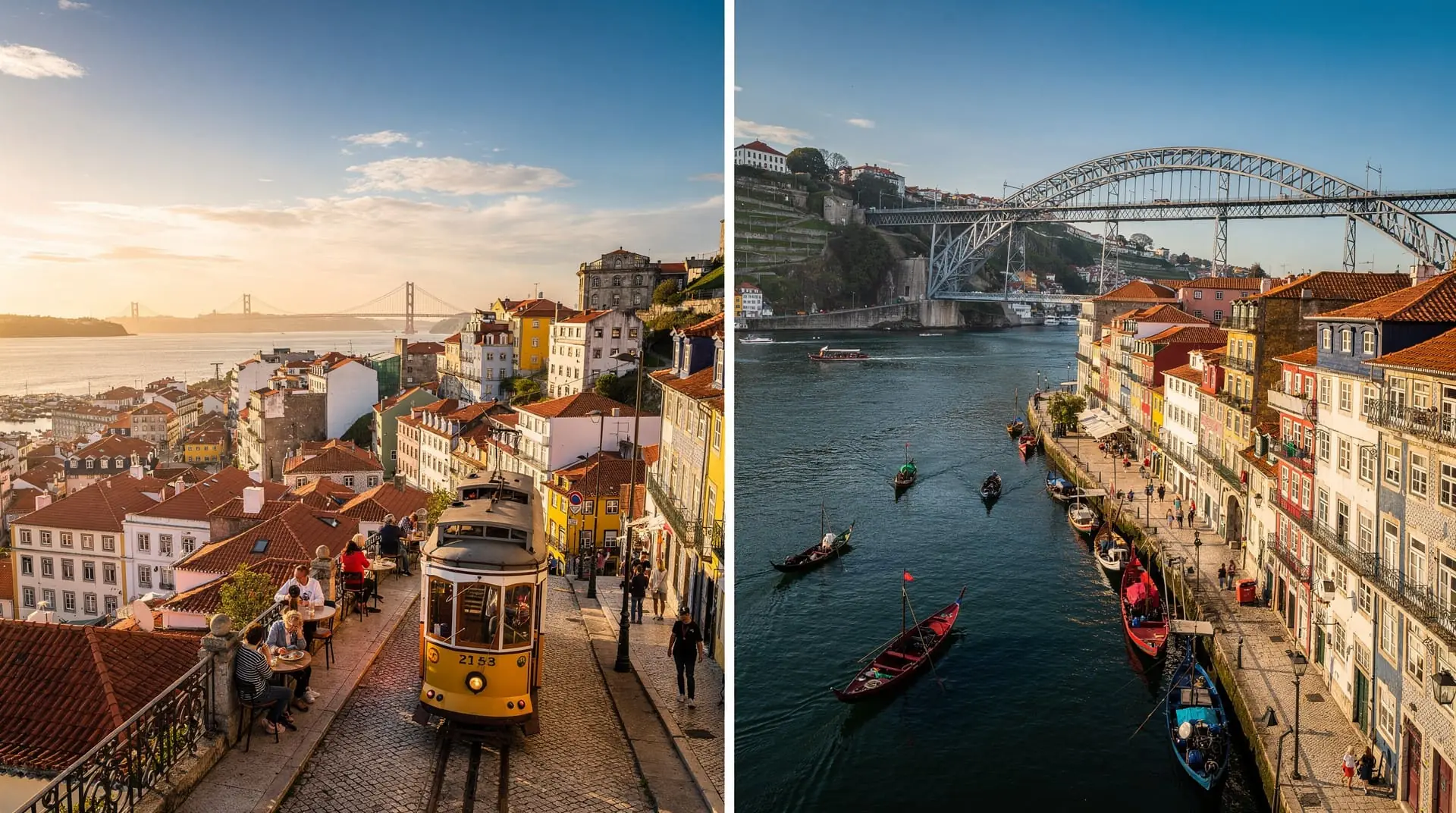
Lisbon vs Porto: which Portuguese city should you visit?
Honest head-to-head: vibe, weather, food, wine, day-trips and budget. Which city wins for your trip — and when to visit both.

Sintra vs Cascais: which day-trip should you pick?
Sintra offers palaces and hills but costs time and crowds. Cascais offers beaches and a marina and half the effort. Pick the right one for your trip.

Fado houses compared: which one should you book?
Side-by-side comparison of Lisbon's main fado venues: atmosphere, price, quality and tourist-trap risk. Honest picks for every budget.

Tram 28 vs tuk-tuk in Lisbon: which is worth it?
Honest comparison: Tram 28 (cheap, iconic, pickpocket risk) vs tuk-tuk (flexible, guided, expensive). When each option makes sense.