Évora
Évora: UNESCO walled city, Roman temple, Chapel of Bones, and Alentejo wine country. The most rewarding full-day trip east of Lisbon.
Quick facts
Top tours and experiences
We earn a small commission if you book through GetYourGuide — at no extra cost to you. Every tour is hand-picked and verified.
Évora: Megalithic Sites and Wine Tasting Tour
From Lisbon: Évora and Monsaraz with Alentejo Wine Tasting
Évora: Small group walking tour with Chapel of Bones
Roman Temple of Evora, Chapel of Bones & Cathedral of Evora
Montemor-o-Novo or Évora: One-Day Tour of Megaliths
Megalithic & Medieval tour on a sidecar Évora
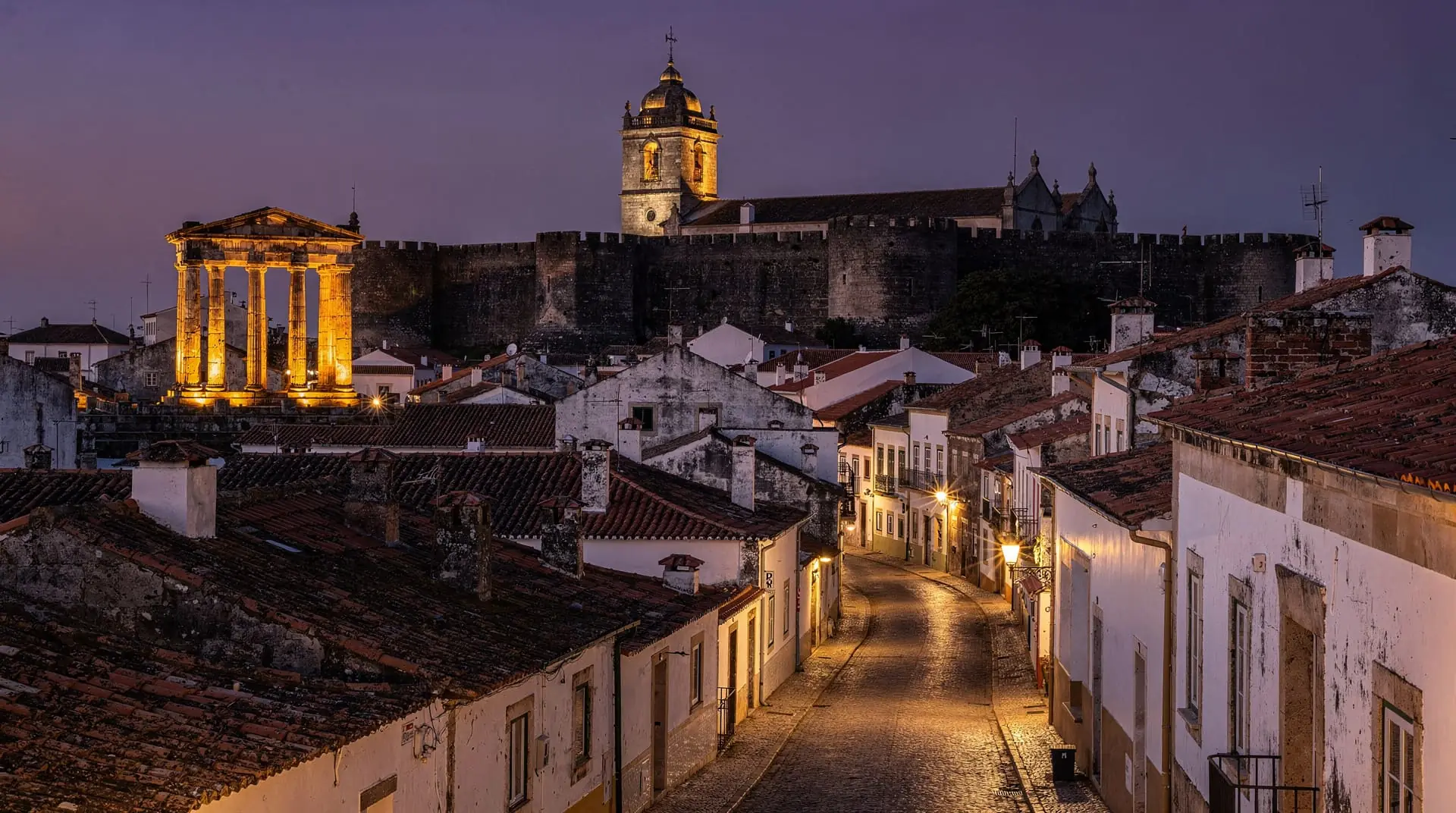
Évora is the capital of the Alentejo and one of the best-preserved historic cities in Portugal. The Roman temple, the medieval cathedral, the 16th-century aqueduct, and the city walls are all within walking distance of each other inside a circuit of walls that has defined this hilltop city for 2,000 years. UNESCO listed the historic centre in 1986; since then, the city has managed tourism without losing the feeling of a real working town — Évora has a university (founded 1559), weekly markets, neighbourhood restaurants, and a population of 56,000 that lives alongside the monuments rather than around them.
The Alentejo landscape beyond the walls is another reason to come. The Alentejo plateau — cork oaks, olive groves, Roman roads, megalithic cromlechs — produces some of Portugal’s most distinctive red wine: earthy, structured, and built for food. The Almendres Cromlech (15 km west of Évora), one of the oldest megalithic monument complexes in Europe, is one of the few experiences in Portugal that genuinely reframes your sense of time.
| Where | Alentejo, 135 km east of Lisbon |
| Cost | Moderate; sights €4–8, dinner €22–34 |
| Time needed | Full day (minimum); overnight recommended |
| Getting there | Rede Expressos from Sete Rios, ~1h30 |
| Best time | March–June and September–November; avoid the extreme summer heat |
The historic centre on foot
The centre of Évora is walkable in 2–3 hours at a purposeful pace, or all day if you stop to eat and linger. The key circuit:
Templo Romano (Roman Temple)
The best-preserved Roman temple on the Iberian Peninsula, and the defining image of Évora. Fourteen Corinthian granite columns survive, standing about 9 metres high, connected by a frieze section, with a platform and steps. Built in the 1st–2nd centuries CE, probably dedicated to Diana (the “Temple of Diana” name is a later attribution without solid evidence). The temple stands in an open plaza next to the Convento dos Loios — the contrast between Roman columns and 15th-century Gothic monastery walls is striking.
Entry to the temple exterior is free. The plaza is accessible at all hours.
Capela dos Ossos (Chapel of Bones)
Built in the 16th century by a Franciscan monk who wanted to concentrate the minds of his fellow monks on mortality, the Chapel of Bones in the Igreja de São Francisco is constructed from the bones and skulls of approximately 5,000 human skeletons — wall panels, column decorations, ceiling details. The inscription above the entrance reads “Nós ossos que aqui estamos, pelos vossos esperamos” — “We bones that are here, await yours.” This is not macabre kitsch; it is a genuinely affecting space with extraordinary craft. Entry approximately €5; open Monday–Saturday 9am–5pm (reduced hours in winter). Queue times are longest between 11am and 2pm — go early or late afternoon.
Sé de Évora (Cathedral)
Portugal’s largest Romanesque cathedral, built between 1186 and 1250, with Gothic additions in the 14th–16th centuries. The cloister is particularly good — 14th-century Gothic with apostle statues in the arches. The terrace roof gives the best views over the city rooftops to the Roman temple and beyond. Entry to cathedral approximately €4; cloister and roof access approximately €6 combined.
Praça do Giraldo
The main square of Évora, with a 16th-century marble fountain, the Igreja de Santo Antão, and café tables that are reliably occupied from 9am until midnight. This is the social centre of the city — a good place to orient yourself before exploring and return to for a coffee and people-watching. The azulejo panels inside Santo Antão (18th century, depicting hunting scenes) are worth a look.
City walls and gardens
The Roman walls, reinforced in the 14th and 17th centuries, are largely intact and define the boundary of the historic centre. The Jardim Público (public garden) on the south side of the walls is pleasant for a 30-minute walk — large plane trees, a ruined Renaissance palace (Palácio de D. Manuel), peacocks. Free and accessible all day.
Day tour from Lisbon: Évora, Chapel of Bones and Roman TempleGetting there from Lisbon
By bus (recommended): Rede Expressos runs frequent coaches from Sete Rios terminal (Jardim Zoológico metro, blue line) to Évora. Journey time approximately 1 hour 30 minutes; tickets around €12 each way. Buses depart throughout the day from 7am onwards; the schedule is generous enough that you can leave Lisbon at 8am and return comfortably by 7–8pm. The bus station in Évora is a 15-minute walk from the historic centre (or a €5 taxi).
By car: Take the A6 (Évora motorway) east from Lisbon — one of the most direct highways in Portugal. Journey time approximately 1 hour 20 minutes without traffic. Parking is available in the city centre (Praça do Giraldo underground car park, also street parking on the perimeter of the walls). Do not try to park inside the walls in the historic core — the lanes are narrow and parking is essentially non-existent.
By train: Comboios de Portugal runs trains from Oriente (with a change at Casa Branca or Pinhal Novo) to Évora, but journey times are 2.5–3 hours with the connection, making the bus a far more sensible option.
The Almendres Cromlech
Fifteen kilometres west of Évora, the Almendres Cromlech (Cromeleque dos Almendres) is one of the largest megalithic monument complexes in the Iberian Peninsula — roughly 95 granite standing stones arranged in two connected circles on a hillside in an oak grove. The stones date from approximately 6000 BCE, making Almendres 2,000 years older than Stonehenge. It’s reached via a dirt track through cork oak and eucalyptus forest (about 3 km of unsealed road — manageable in a normal car in dry weather, but the road is bumpy and slow). A simpler menhir (the Menir dos Almendres) stands 2 km closer to the main road and is easier to reach.
Entry to the cromlech is free. There is no visitor centre and no facilities — just the stones, the oak grove, and views across the Alentejo plain. Early morning visits are recommended for the quality of light and to avoid other visitors.
If you don’t have a car, several organised tours from Évora and from Lisbon include the Almendres circuit. For a longer day that covers Évora itself alongside the stones, a private 10-hour Évora and megalithic circuit tour is built around exactly that combination.
Évora: megalithic sites and Alentejo wine tasting tourAlentejo wine
The Alentejo wine region surrounds Évora on all sides — the wineries (herdades) that produce the DOC wines are within 30 km of the city. Alentejo reds are made primarily from Aragonez (Tempranillo), Trincadeira, Alicante Bouschet, and Touriga Nacional grapes; the wines are full-bodied, structured, and typically aged in French oak. The whites are less well-known internationally but can be excellent: aromatic, with good acidity.
Several estates in the Évora sub-region offer tastings and vineyard visits:
- Herdade do Esporão (30 km south of Évora) is the largest and most internationally known. Tastings from €15; restaurant on site.
- Cartuxa (on the edge of Évora, walking distance from the centre) is a historic winery in a 16th-century monastery building. Tastings from €10.
- Herdade de São Miguel (15 km from Évora) is smaller and more personal; tastings by appointment.
If you’re visiting Évora for wine, consider an afternoon wine tour from the city centre rather than driving yourself between estates — designated driver logistics are easier to skip.
Day tour from Lisbon: Évora and Alentejo wine tastingWhere to eat
Fialho on Travessa das Mascarenhas is the reference restaurant for Alentejo cuisine in Évora — operating since 1948, family-run, exceptional cooking. The migas (bread-based side dish), porco preto (black pork from Alentejo black pigs), and açorda de gambas (prawn bread soup) are the dishes to order. Mains €22–34. Book ahead; this fills up every day, year-round.
Taberna Típica Quarta-Feira is the other name that locals mention without prompting — a converted wine cellar with stone walls, communal tables, and an €18–22 fixed lunch plate that changes daily depending on what’s in the market. Cash only. Closed weekends.
Restaurante A Grelheira near Praça do Giraldo is reliable for grilled meats and bacalhau at mid-range prices (mains €15–22). Convenient location, honest food.
Pastelaria Conventual Pão de Rala is the historic patisserie for Évora’s conventual sweets — sericaia (a regional egg custard), encharcada (egg-yolk confection from the local convent tradition). A plate of three different sweets costs €8–12.
Where to stay
M’Ar de Ar Muralhas occupies a restored palace inside the historic walls — rooms with city views, a small pool, and excellent breakfast. Doubles from €130 low season, €200+ in spring and autumn.
Solar de Monfalim is a more modest guesthouse in a 16th-century manor house on Largo da Misericórdia — doubles from €90, characterful rather than luxurious.
Évora Inn is the practical option — clean, central, no frills, doubles from €65.
For wine-focused stays, several herdades outside the city offer accommodation alongside the vineyards — Herdade de São Miguel and Herdade do Esporão both have rooms. Rates from €150.
Honest tips
July and August heat. The Alentejo is the hottest region of Portugal in summer — inland temperatures regularly reach 38–42°C in July and August. The historic centre has shade, but exploring on foot is genuinely uncomfortable. Spring (March–May) and autumn (September–November) are far more pleasant. If you must visit in summer, go early morning (8–10am before the heat builds) and plan an indoor midday.
The Chapel of Bones queues. The queue to enter the Chapel of Bones peaks between 11am and 2pm, when tour buses deposit their groups. Arrive when it opens (9am) or return after 4pm to avoid the worst of it. Booking online in advance (the Évora Tourism website offers pre-purchase) eliminates the queue entirely.
Almendres road conditions. The 3-km dirt track to the cromlech is passable in dry conditions in a normal car but becomes problematic after sustained rain. Call ahead to the Évora Tourism office to confirm conditions if you’re planning to drive it after wet weather.
Restaurant reservations in Évora. Fialho and Taberna Típica Quarta-Feira both require advance booking — phone reservations (Portuguese language) or email. Don’t arrive without a reservation in spring or autumn and expect a table.
How Évora fits an itinerary
Évora is 135 km from Lisbon — far enough to warrant a full day rather than a half-day rush. The standard Évora day trip from Lisbon works: bus at 8am from Sete Rios, in Évora by 9:30am, full day with lunch, bus back at 6 or 7pm.
An overnight adds the Almendres at sunrise (extraordinary), a wine tasting at Cartuxa in the afternoon, and dinner at Fialho with a reservation — this is the way to really experience the city. In a 7-day Lisbon itinerary, assign day 5 to Évora overnight.
The Alentejo wine day trip guide covers the wine estates in more detail. For the Almendres and other megalithic sites, the day-trip matcher helps build the logistics around your transport.
Évora vs Óbidos vs Sintra: which day trip
Visitors with only one or two day trips to spare from Lisbon often ask which historic town deserves the slot. Here’s the honest breakdown:
| Évora | Óbidos | Sintra | |
|---|---|---|---|
| Distance | 135 km east, 1h30 by bus | 80 km north, 1h by bus | 28 km west, 40 min by train |
| Character | UNESCO Roman/medieval city, Alentejo wine | Tiny walled village, castle | Romantic palaces, forested hills |
| Time needed | Full day, ideally overnight | Half a day | Full day |
| Best for | History depth, wine, quiet pace | A pretty stroll and a quick stop | Fairy-tale architecture, palace-hopping |
| Crowd level | Moderate, rarely overwhelming | Can be crowded midday | Very high in peak season |
If you only have time for one full-day trip, Sintra remains the highest-impact choice for most first-timers because of the palaces. But if you’ve already done Sintra, or if wine and Roman history interest you more than fairy-tale architecture, Évora is the more rewarding — and less crowded — full day out. See which day trip from Lisbon for the fuller comparison across all the main options.
Évora as a base for the wider Alentejo
Évora works well as more than a day trip — an overnight stay opens up a wider circuit of the central Alentejo that’s difficult to compress into a single day from Lisbon. From a base in Évora, the Almendres Cromlech, the wine estates around Reguengos and Redondo, and the walled hilltop town of Monsaraz (an hour east) all become manageable half-day excursions with a rental car. Travellers doing a longer Portugal trip beyond Lisbon sometimes use Évora as a two-night stop between the capital and the Algarve, which spreads the driving and lets the Alentejo breathe rather than being reduced to a single rushed day.
Frequently asked questions about Évora
How do I get from Lisbon to Évora by bus?
Rede Expressos runs coaches from Sete Rios terminal (Jardim Zoológico metro, blue line) to Évora frequently throughout the day. Journey time is approximately 1 hour 30 minutes; tickets cost around €12 each way. Book at rede-expressos.pt or at the Sete Rios terminal. The bus drops you at Évora’s bus station, a 15-minute walk from the historic centre.
Is the Chapel of Bones in Évora disturbing?
The Chapel of Bones is composed of the bones of approximately 5,000 people, covering all interior walls and surfaces. It is designed to be contemplative rather than horrifying — a memento mori, not a spectacle. Most visitors find it striking and thought-provoking rather than disturbing. Children typically find it interesting. It is not appropriate for those with specific sensitivities about death or human remains.
How far is Almendres from Évora?
The Almendres Cromlech is approximately 15 km west of Évora. By car the journey takes about 20 minutes, including 3 km of unsealed but passable dirt track through the oak forest. Without a car, organised tours from Évora’s centre visit the site; several all-day tours from Lisbon include it.
What wine should I try in Évora?
Alentejo reds are the regional speciality — look for wines from the Cartuxa, Herdade do Esporão, Quinta do Carmo, and Cortes de Cima estates. The primary grape varieties are Aragonez, Trincadeira, and Alicante Bouschet. For something unusual, try the white Antão Vaz variety, which produces fresh, aromatic whites unusual in a warm-climate region. Any good restaurant in Évora will have an Alentejo-focused list.
What is the best time to visit Évora?
March–June and September–November are ideal — mild temperatures (18–28°C), good light, and manageable tourist numbers. July and August are genuinely hot (regularly above 38°C) — possible but uncomfortable for a walking-heavy historic city visit. December–February is quiet and mild by northern European standards (10–15°C) but some restaurants reduce hours.
Can I see the Roman temple and the Chapel of Bones in one day from Lisbon?
Yes. A full day is enough to see both comfortably, along with the cathedral, Praça do Giraldo, and a lunch at Fialho. Take the 8am bus from Sete Rios, arrive by 9:30am, finish by 5:30–6pm, and return to Lisbon by 7:30–8pm. You’ll be tired but satisfied.
Should I choose Évora or Sintra if I can only do one day trip?
Sintra has the higher first-time impact — the palaces are unlike anything else near Lisbon. Choose Évora instead if you’ve already done Sintra on a previous trip, if you prefer history and wine over romantic architecture, or if you want a noticeably less crowded day out.
Is Évora worth an overnight stay?
Yes, if your schedule allows it. An overnight lets you catch the Almendres Cromlech at sunrise, fit in a proper wine tasting at Cartuxa or Herdade do Esporão, and have an unhurried dinner at Fialho with a reservation — genuinely a different experience from a rushed day trip.