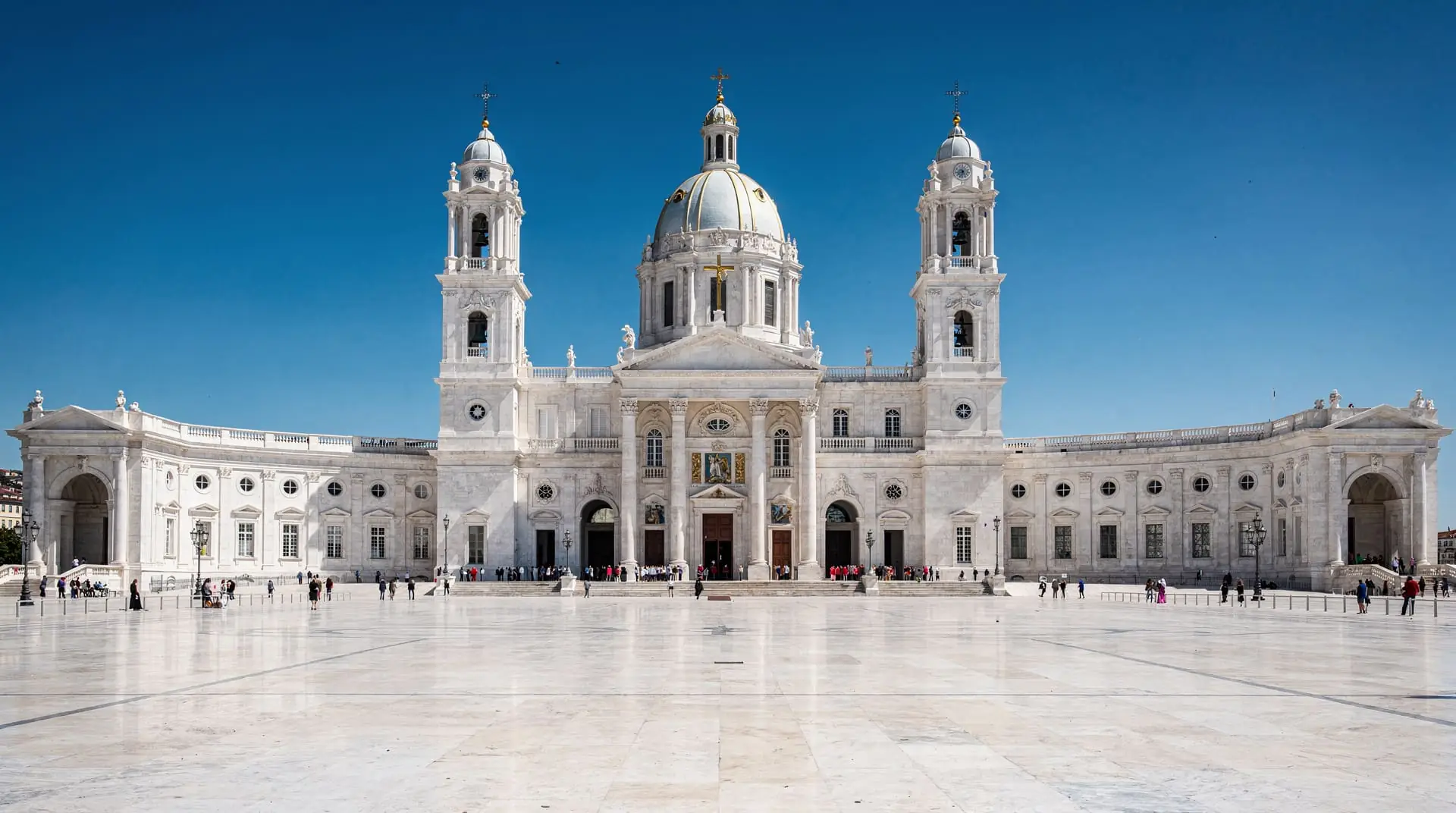
Fátima
Fátima draws 6 million pilgrims a year. The Sanctuary, twin basilicas, and candlelight processions on 13 May and 13 October are the heart of the visit.
Quick facts
Top tours and experiences
We earn a small commission if you book through GetYourGuide — at no extra cost to you. Every tour is hand-picked and verified.
Lisbon: Óbidos, Fátima, Batalha, and Nazaré Day Trip
Lisbon: Fátima, Nazaré and Óbidos Full-Day Tour
Fátima, Batalha, Alcobaça, Nazaré and Óbidos Private Tour
From Nazaré - Tomar, Fátima, Batalha, Alcobaça, & Óbidos
From Lisbon: Tour Fátima, Batalha, Alcobaça, Nazaré, Óbidos
From Coimbra: Sanctuary of Fátima, Batalha, and Nazaré
Fátima’s Sanctuary of Our Lady of Fátima draws approximately 6 million visitors per year, making it one of the most visited religious sites in the world. Most of those visitors are pilgrims. Some walk hundreds of kilometres to reach it, often on their knees for the final stretch across the vast esplanade. Whether you are Catholic, curious, or neither, the site has a genuine weight to it — the scale of devotion on display is unlike anything else in Portugal.
| Where | Centro region, 130 km north of Lisbon |
| Cost | Free (Sanctuary and basilicas); wax museum ~€5 |
| Time needed | Half a day to full day |
| Getting there | Rede Expressos from Sete Rios, ~1h30 |
| Best time | April–June and September–October; avoid 13 May / 13 October unless pilgrimage-focused |
The story begins on 13 May 1917, when three shepherd children — Lúcia Santos, Francisco Marto, and Jacinta Marto — reported seeing a vision of a woman they described as Our Lady of the Rosary in the Cova da Iria, a hollow outside the village of Fátima. The apparitions recurred on the 13th of each month through October 1917. On 13 October, approximately 70,000 people gathered and reported the “Miracle of the Sun” — a shared phenomenon in which the sun appeared to dance, spin, and fall toward the earth. The Catholic Church formally approved the apparitions as worthy of belief in 1930.
Francisco and Jacinta were beatified in 2000 and canonised in 2017. Lúcia became a Carmelite nun and died in 2005; she is buried in the Basilica of Our Lady of Fátima.
The Sanctuary complex
The Sanctuary has expanded continuously since the 1920s and now covers a vast esplanade larger than St Peter’s Square in Rome. The key structures:
Basílica de Nossa Senhora do Rosário de Fátima (the old basilica): Built between 1928 and 1953, in a Portuguese neoclassical style. The tombs of Francisco and Jacinta Marto are here, and Lúcia’s remains were transferred here in 2006. Open daily.
Capelinha das Aparições (Chapel of the Apparitions): A small open-air chapel marks the exact spot where the apparitions occurred. This is the heart of the pilgrimage site. On most days there is a vigil mass; on pilgrimage dates, continuous outdoor masses with hundreds of thousands of participants. Candles are burned here continuously — the smell of wax is the sensory signature of Fátima.
Basílica da Santíssima Trindade (Basilica of the Holy Trinity): Completed in 2007, this vast modernist basilica designed by Greek architect Alexandros Tombazis seats 9,000 people and is one of the largest Catholic churches in the world. The interior is stark and contemporary — polarising among visitors used to traditional church architecture.
Museu de Cera de Fátima: A wax museum depicting the story of the apparitions. Not essential, but useful for understanding the context if you come without prior knowledge. Entry approximately €5.
Museu do Santuário de Fátima: A more serious museum in the Sanctuary complex, with original documents, photographs, and objects related to the apparitions and the children. Entry included in some sanctuary passes.
Private full-day tour from Lisbon to Fátima SanctuaryGetting there from Lisbon
By bus: Rede Expressos runs coaches from Sete Rios terminal (Jardim Zoológico metro, blue line) to Fátima several times daily. Journey time approximately 1 hour 30 minutes; tickets around €11 each way. The bus stops near the Sanctuary.
By car: Take the A1 north from Lisbon to exit 7 (Fátima). Journey approximately 1 hour 20 minutes without traffic. Parking is available throughout the town — large car parks on the perimeter of the Sanctuary, mostly free.
Organised tours: Several day tours from Lisbon combine Fátima with Nazaré and Óbidos (the most popular combination on the Silver Coast/Centro route). These handle transport and add context that an independent visit may miss.
The pilgrimage dates: 13 May and 13 October
These are the two main dates of the Fátima pilgrimages — anniversary of the first and last apparitions. Each brings 400,000–600,000 people to a town of approximately 12,000. The candlelight procession on the evening of the 12th (the night before) draws the largest crowds: pilgrims carry candles and walk the esplanade while reciting the Rosary. The atmosphere is extraordinary — genuinely moving if you have any connection to the tradition, remarkable as a human spectacle if you don’t.
Practical reality on 13 May and 13 October: roads around Fátima are gridlocked from the previous afternoon. Accommodation in a 30-km radius books out months ahead. The bus from Lisbon will be standing room only. If you specifically want to witness the pilgrimage, plan your logistics 6 months ahead. If you want to visit the Sanctuary without crowds, avoid these dates entirely and all surrounding weekends.
Fátima off the pilgrimage calendar
Most days, Fátima is a quiet, unremarkable town that happens to contain one of the world’s major religious sites. The Sanctuary esplanade — vast, white, and mostly empty on a Tuesday in April — has a particular quality of stillness. The Chapel of Apparitions functions with a small continuous candle vigil. There are always some pilgrims present, but the scale is manageable.
This is actually the better time to visit for most travellers. You can approach the key sites without a crowd, understand the spatial layout (which is hard to appreciate when 300,000 people are in the way), and spend time in the museums.
The town itself — beyond the Sanctuary perimeter — is almost entirely made up of shops selling religious souvenirs (rosaries, candles, statues of Our Lady), hotels, and restaurants oriented toward pilgrims. It is not a destination for food or general sightseeing beyond the Sanctuary. Plan your half-day around the religious complex and leave time to drive or bus to Óbidos (55 km west) or Tomar (35 km north) if you want a fuller day.
Day tour from Lisbon: Fátima Sanctuary, Nazaré and ÓbidosWhere to eat
Fátima has dozens of restaurants, almost all oriented toward pilgrims and tour groups. Quality varies widely; most serve safe, predictable Portuguese food at mid-range prices.
Restaurante Tipico near the Sanctuary entrance serves standard Portuguese mains (bacalhau, grilled chicken, caldo verde) at reasonable prices (€12–18 mains). Consistent and reliably open.
Restaurante O Ninho on the edge of town has a local clientele and better food — sopas de pedra (bean and sausage soup), regional Ribatejo dishes, house wine from the Tejo valley. Mains €13–20.
Avoid the restaurants immediately adjacent to the Sanctuary esplanade on pilgrimage dates — they switch to fixed-price pilgrim menus (€15–20) that prioritise turnover over quality.
Where to stay
Most visitors to Fátima come as day trippers. If you are combining Fátima with an extended pilgrimage or want to attend the evening candlelight procession without the logistics of getting back to Lisbon:
Hotel de Fátima is a solid 4-star option adjacent to the Sanctuary — doubles from €80 off-peak, €180 on pilgrimage dates. Book months ahead for May 13 and October 13.
Domus Pacis is a large pilgrim hotel with more modest rooms — essentially a pilgrimage hostel with hotel-level service — doubles from €60. Clean, functional, popular with organised pilgrimage groups.
Honest tips
Dress code: The Sanctuary and its buildings observe a dress code — shoulders and knees covered. The esplanade itself has no formal rule, but the Chapel of Apparitions and the basilicas require modest clothing. Bring a scarf or light jacket if you’re in summer clothes.
Candles and the wax area: Near the Chapel of Apparitions there is a large furnace where pilgrims burn their votive candles. The heat and smoke can be overwhelming in summer. Give yourself space and don’t stand directly downwind.
The solo visit versus organised tour: Fátima is one of the easier sites to visit independently — buses are frequent, parking is plentiful, the Sanctuary is free, and everything is walkable from the bus stop. An organised tour adds context and handles Nazaré/Óbidos logistics, but is not necessary for Fátima alone.
Photography in the chapel: The Chapel of Apparitions is an active place of worship at all times. Photography is permitted but should be unobtrusive — no flash, no positioning yourself in front of worshippers.
How Fátima fits an itinerary
Fátima is 130 km from Lisbon and 55 km east of Óbidos — making it a natural third stop on the classic Silver Coast route (Óbidos morning, Nazaré midday, Fátima afternoon). The Óbidos, Nazaré and Fátima tour packages this efficiently. Alternatively, pair Fátima with Tomar (35 km north, Knights Templar) for a historically themed day.
In a 7-day Lisbon itinerary, assign a full day to the Óbidos–Nazaré–Fátima route: leave Lisbon at 8am, Óbidos by 9am (2 hours), drive to Nazaré (lunch), reach Fátima by 4pm for late afternoon, return to Lisbon by 7:30pm. Use the day-trip matcher to sequence the stops correctly.
Day tour: Fátima, Batalha, Nazaré and Óbidos from LisbonFátima by season and date
Fátima’s crowd levels swing more dramatically by date than almost any other destination near Lisbon:
| Period | Crowd level | What to expect |
|---|---|---|
| 12–13 May, 12–13 October | Extreme (400,000–600,000 visitors) | Gridlocked roads, sold-out accommodation, standing-room buses |
| Other 13ths of the month | Elevated | Smaller monthly pilgrimage gatherings, still busier than average |
| April–June, September–October (non-pilgrimage dates) | Moderate | Comfortable visit, some coach-tour groups |
| July–August (non-pilgrimage dates) | Moderate to busy | Warm weather, family visitors |
| November–March | Low | Quiet esplanade, some reduced museum hours |
If witnessing the scale of devotion is the goal, plan around 12–13 May or 12–13 October six months ahead. If a calm, contemplative visit is the goal, any Tuesday to Thursday outside those dates works well.
Nearby: Batalha Monastery
Batalha Monastery, 20 km northeast of Fátima, is one of Portugal’s UNESCO World Heritage Gothic masterpieces — built to commemorate the 1385 victory over Castile at the Battle of Aljubarrota. The unfinished chapels (Capelas Imperfeitas), left open to the sky, are among the most photographed architectural details in the country. Several organised tours combine Fátima with Batalha, and it’s a natural add-on if you have a car and are already in the area — allow an hour for the monastery itself. A full-day tour from Lisbon covering Fátima, Batalha, Nazaré and Óbidos packages all four stops into one booking. The Fátima, Batalha, Nazaré and Óbidos tour above covers this combination.
Frequently asked questions about Fátima
Do I need to be Catholic to visit Fátima?
No. Fátima receives visitors of all backgrounds and faiths, including many non-religious tourists interested in the history, the architecture, and the remarkable scale of devotion the site represents. The Sanctuary grounds and basilicas are open to all. Respectful dress and behaviour are expected inside the chapels and churches.
How do I get from Lisbon to Fátima?
Rede Expressos runs coaches from Sete Rios terminal (Jardim Zoológico metro, blue line) to Fátima several times daily. Journey time is approximately 1 hour 30 minutes; tickets cost around €11 each way. By car via the A1 the drive takes about 1 hour 20 minutes.
When is the best time to visit Fátima?
For a peaceful visit with manageable crowds, April through June and September through October are ideal — outside the main pilgrimage dates. The 13 May and 13 October pilgrimages bring 400,000–600,000 people; inspiring to witness but logistically demanding to navigate. Mid-week visits are consistently quieter than weekends.
What is the candlelight procession at Fátima?
The candlelight procession takes place on the evenings of 12 May and 12 October (the night before each main pilgrimage date). Pilgrims carry lit candles and walk the esplanade while reciting the Rosary in multiple languages. It is one of the most visually striking religious ceremonies in Europe — hundreds of thousands of candles in the dark. Attendance requires arriving in Fátima the afternoon before the main pilgrimage date and planning accommodation well in advance.
Can I combine Fátima with Óbidos and Nazaré in one day?
Yes, and this is one of the most popular day-trip combinations from Lisbon. Óbidos (morning), Nazaré (midday lunch), Fátima (afternoon) is the logical sequence. It requires an early start from Lisbon (by 8am) and a car or an organised day tour. By bus alone the connections between all three require careful scheduling — an organised tour is more practical.
Is entry to the Fátima Sanctuary free?
Yes. The Sanctuary grounds, esplanade, Chapel of Apparitions, and both basilicas are free to enter. The wax museum (Museu de Cera) and some additional museum spaces charge a small entry fee (approximately €5). There is no admission fee for mass or prayer services.
Can I combine Fátima with Batalha Monastery?
Yes — Batalha is only 20 km northeast and is one of Portugal’s most significant Gothic monuments, easily added to a day that already includes Fátima if you have a car or are on an organised tour that covers both.
How busy is Fátima on a normal day, outside the main pilgrimage dates?
Moderate and manageable — some coach groups and a steady flow of individual pilgrims, but nothing like the 12–13 May or 12–13 October crowds. A weekday visit outside those dates gives you space to appreciate the site’s scale without feeling rushed.