Tomar
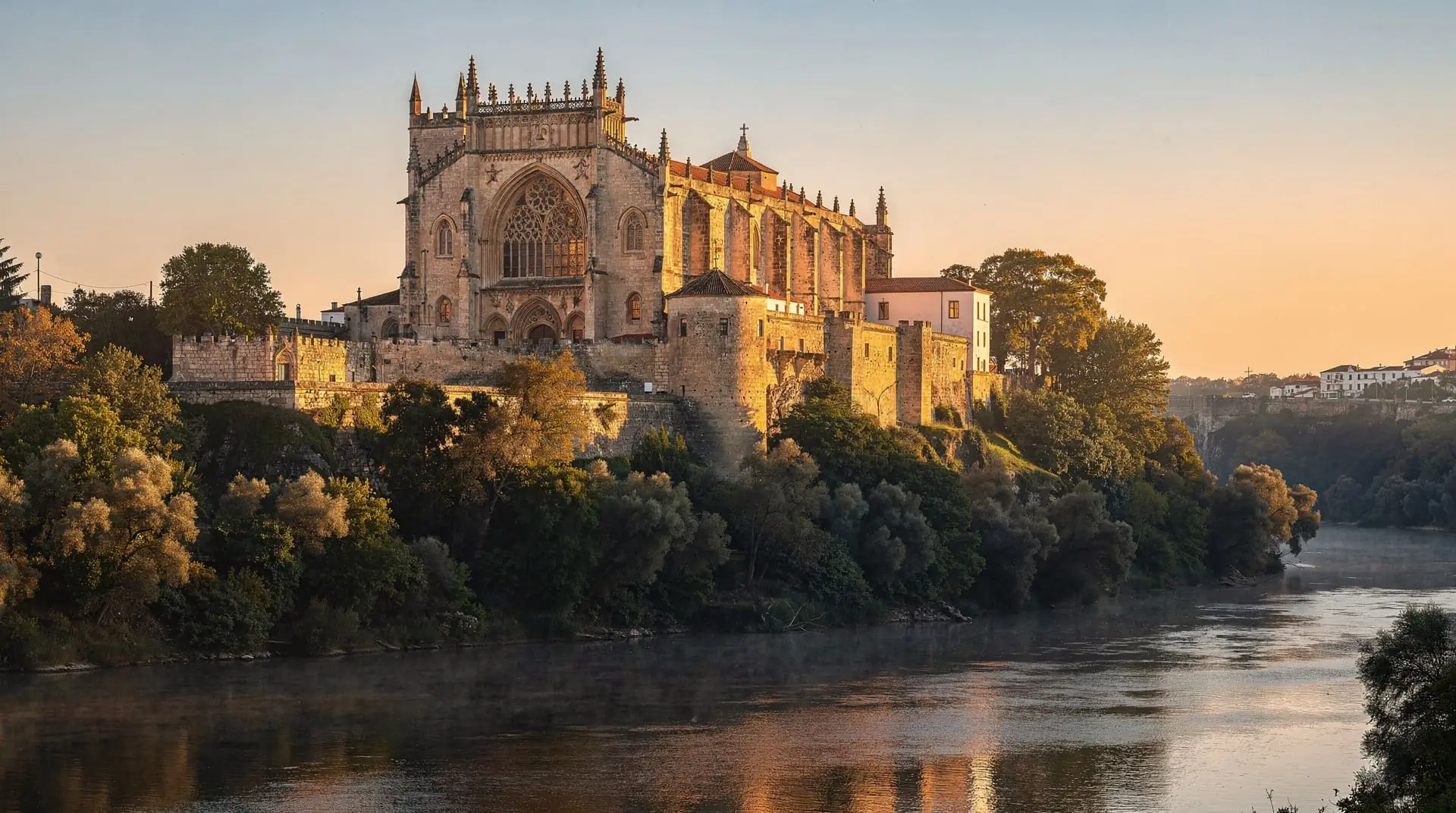
Tomar: Knights Templar HQ, UNESCO Convento de Cristo, and the famous Manueline window. The circular Charola is the finest Templar chapel in Portugal.
Quick facts
Top tours and experiences
We earn a small commission if you book through GetYourGuide — at no extra cost to you. Every tour is hand-picked and verified.
Lisbon: Óbidos, Fátima, Batalha, and Nazaré Day Trip
Lisbon: Fátima, Nazaré and Óbidos Full-Day Tour
Fátima, Batalha, Alcobaça, Nazaré and Óbidos Private Tour
From Nazaré - Tomar, Fátima, Batalha, Alcobaça, & Óbidos
From Lisbon: Tour Fátima, Batalha, Alcobaça, Nazaré, Óbidos
From Coimbra: Sanctuary of Fátima, Batalha, and Nazaré
Tomar exists because of the Knights Templar. The order received land here in 1159 from Portugal’s first king, Afonso Henriques, as a reward for defending the border against the Moors. They built a castle on the hill above the town, and within it a circular chapel modelled on the Church of the Holy Sepulchre in Jerusalem. Over the following three centuries, the Templars and their Portuguese successor order — the Order of Christ — turned that first structure into the Convento de Cristo, a complex of cloisters, chapter houses, churches, and fortifications that is now a UNESCO World Heritage Site and one of the most important examples of Portuguese Manueline architecture anywhere.
The town below the hill is a quiet, pleasant riverine settlement on the Nabão, with a park on the river island and a medieval synagogue that is one of the best-preserved examples of 15th-century Jewish architecture in Portugal. For most visitors, Tomar is a half-day from Lisbon — long enough to visit the Convento properly and walk the town briefly. A full day allows you to slow down considerably.
The Convento de Cristo: what to see
The Convento is a 30-minute walk or 5-minute drive from the town centre, up the hill through pine woods. Allow 2–3 hours to do it justice.
The Charola (Templar Oratory)
This is the reason Tomar exists: a 16-sided Romanesque-Gothic rotunda built by the Templars in the late 12th century, modelled on the Anastasis Rotunda in Jerusalem. The interior has a central octagonal altar supported by columns, with painted panels (some original 16th-century work surviving), an ambulatory where knights attended mass on horseback, and a remarkable sense of contained intensity. It is the oldest and most important structure in the complex.
The Charola became the apse of a larger church in the 16th century under King Manuel I, who added the Manueline chapter window on the exterior and the cloisters around the convent.
The Manueline window (Janela do Capítulo)
Carved in the early 16th century and attributed to Diogo de Arruda, this is one of the most famous pieces of decorative stonework in Portugal. The window is a controlled explosion of maritime motifs — ropes, coral, seaweed, anchors, armillary spheres, and the Cross of the Order of Christ — carved in limestone with extraordinary precision. It appears on the west façade of the chapter house, and its famous image (reproduced on every Tomar postcard) does not adequately prepare you for the scale and detail of the real thing.
The cloisters
The Convento accumulated eight cloisters over three centuries of construction. The most important is the Claustro de D. João III (Main Cloister) — an Italian Renaissance cloister added in the 1550s that contrasts deliberately with the Manueline exuberance elsewhere. The Claustro da Lavagem (Laundry Cloister) and Claustro do Cemitério (Cemetery Cloister) are simpler but give a sense of the monastic life of the order.
The castle walls
The 12th-century Templar castle surrounds the Convento. The walls and towers are accessible and give views over the town, the Nabão valley, and the surrounding hills. The circuit takes about 20 minutes.
Knights Templar tour from Lisbon: Tomar and Almourol CastleGetting there from Lisbon
By train (recommended): Comboios de Portugal (CP) runs regional trains from Lisbon’s Oriente station to Tomar. Journey time approximately 2 hours; tickets around €10 each way. Trains run several times daily; check the CP website for current timetables. The station is in the centre of Tomar, a 20-minute walk from the Convento (or a short taxi ride for approximately €5).
By bus: Rede Expressos operates coaches from Sete Rios terminal to Tomar. Journey time approximately 1 hour 45 minutes; tickets around €11. Less frequent than the train option.
By car: Take the A1 north from Lisbon to Santarém, then the IP6 east to Tomar. Approximately 1 hour 30 minutes without traffic. Parking is available near the Convento (signposted) and throughout the town.
Note: The train is the most convenient option for independent travellers — no parking hassle, direct to the town centre, good frequency.
The rest of the town
Sinagoga de Tomar
One of the best-preserved medieval synagogues in Portugal, built in the early 15th century during a period of Jewish prosperity in Tomar. The Manuel period expelled the Jews in 1496–97; the synagogue subsequently served as a prison, a hay store, and a storehouse before being restored in the 20th century. Now a museum; entry approximately €2. The interior is simple but moving — four stone columns, Gothic arches, iron rings in the walls (for hanging lamps), and an exhibition on the Sephardic Jewish community of Tomar.
Ilha do Mouchão
A small island in the Nabão river, accessible by footbridge from the town centre, with a watermill (moinho) that produces local olive oil and a park with large plane trees. Pleasant for a 30-minute walk after the Convento.
Igreja de São João Baptista
The main church on the central square (Praça da República) has a Manueline portal and an interior with 18th-century painted panels. The square itself — shaded by orange trees, with a café terrace — is where Tomar locals spend Sunday mornings.
Tomar: Knights Templar castle and Convento de Cristo guided tourThe Festa dos Tabuleiros
Every four years (next edition TBC for 2027), Tomar hosts the Festa dos Tabuleiros — one of Portugal’s largest and oldest folk festivals. Young women parade through the streets carrying extraordinary structures on their heads: trays stacked 1.5 metres high with loaves of bread, wheat stalks, paper flowers, and the Cross of the Order of Christ at the top. The structures are as tall as the women carrying them and are constructed from the previous autumn. The festival also involves a distribution of bread and wine to local families. It draws 100,000+ visitors to a town of 40,000. The next full celebration is expected in 2027; confirm dates locally before planning a trip specifically for this.
Where to eat
Taberna do Quintal on Rua Serpa Pinto is the best restaurant in Tomar’s centre — traditional Ribatejo cuisine, excellent bacalhau preparations, fried eels from the Nabão (enguias fritas, a local specialty), good house wine. Mains €14–22. Book ahead on weekends.
Restaurante Bela Vista near the Convento has a terrace with castle views — convenient for lunch after the Convento tour. Food is straightforward Portuguese; the location compensates for the tourist-facing menu. Mains €15–24.
Pastelaria Paraíso on Praça da República is the local café for a coffee and pastel de nata before heading up to the Convento. The orange juice is fresh. Excellent value.
Where to stay
Hotel dos Templários is the main hotel in Tomar — large, functional, with a pool and riverside location. Doubles from €80. Good breakfast buffet.
Estalagem de Santa Iria on the river island (Ilha do Mouchão) is more characterful — a manor house converted to a small hotel, with views of the weir and mill. Doubles from €90.
For a day trip from Lisbon, there’s no need to stay overnight. Tomar is compact enough to see thoroughly in 4–5 hours.
Honest tips
The Convento gets crowded in summer mornings. Tour buses arrive between 10am and noon. Get there when it opens (9am) or go in the afternoon after 3pm. The Charola in particular is best experienced in relative quiet.
The Manueline window is on the exterior. You don’t need to pay entry to see the famous window — it faces west and is visible from outside the walls. But the Charola and cloisters require a ticket.
Almourol Castle detour. If you’re driving and have flexibility, the Castelo de Almourol is 15 km southeast of Tomar — a 12th-century Templar castle on a small rocky island in the Tagus. It’s accessible only by rowboat (operated by local boatmen for a small fee). It’s a remarkable sight and adds about 1 hour to the Tomar visit.
Train return times. Check the return train schedule before you leave Lisbon. The last train back to Oriente runs in the early evening — missing it means a bus or a taxi to Santarém to catch a later connection.
How Tomar fits an itinerary
Tomar sits 35 km north of Fátima and 135 km from Lisbon, making it a natural pairing with Fátima for a historical day trip, or a stand-alone day from Lisbon by train. In a 7-day Lisbon itinerary, assign one day to the Centro region: Tomar in the morning, Fátima in the afternoon (35 km south), return to Lisbon by evening.
The train option makes Tomar one of the more independent-travel-friendly day trips in the region — no car required, no parking stress, the station is central. See the day trips from Lisbon overview and use the day-trip matcher to plan your route.
Private Knights Templar tour from Lisbon to TomarFrequently asked questions about Tomar
How do I get from Lisbon to Tomar by train?
Comboios de Portugal (CP) runs regional trains from Oriente station to Tomar approximately 6–8 times daily. Journey time is about 2 hours; tickets cost around €10 each way. Buy tickets at Oriente or online at cp.pt. The train arrives at Tomar’s central station, a 20-minute walk or short taxi ride from the Convento.
How long does it take to visit the Convento de Cristo?
Allow 2–3 hours to visit the Convento properly — the Charola, the Manueline window, the main cloisters, and the castle walls. A rushed visit in 1.5 hours is possible but leaves you feeling you’ve skimmed it. The site is large enough to reward a slow pace.
What is the Charola in Tomar?
The Charola is the circular Templar Oratory at the heart of the Convento de Cristo — a 12th-century 16-sided rotunda modelled on the Church of the Holy Sepulchre in Jerusalem. It’s where the Knights Templar attended mass on horseback. The ambulatory that surrounds the central altar still has traces of the original painted decoration. It is the oldest and most atmospheric structure in the complex.
Is the famous Manueline window inside the Convento?
The window (Janela do Capítulo) is on the exterior west façade of the chapter house, within the Convento walls but visible from the access path without a ticket. To see it properly in context — with the surrounding stonework and the cloisters — you need to pay entry (approximately €6). The window itself is extraordinary in scale and detail; photographs underrepresent it.
When is the Festa dos Tabuleiros in Tomar?
The Festa dos Tabuleiros takes place every four years, usually in July of a non-leap even year. The next edition is expected around 2027. It is one of Portugal’s largest folk festivals — confirm exact dates locally well in advance if you’re planning to attend.
Can I combine Tomar with Fátima in one day?
Yes. The two are 35 km apart (about 30 minutes by car). Spend the morning in Tomar (arriving by 9am from Lisbon), visit the Convento, have lunch, then drive to Fátima for the afternoon. By public transport the connection is less convenient — a bus links the two towns but schedules are limited. An organised day tour or a rental car is more practical for combining both.