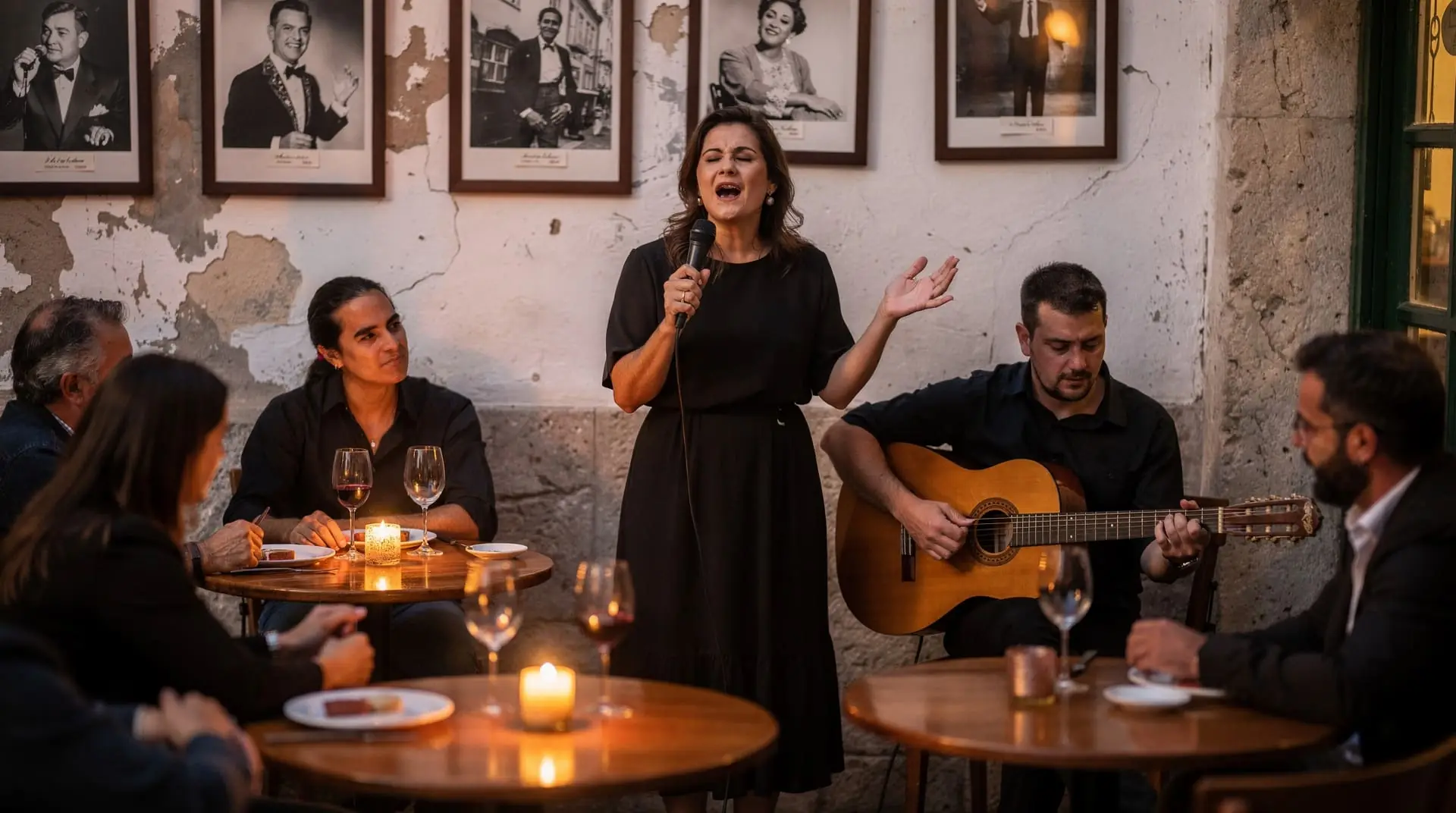
History of fado: from Maria Severa to UNESCO heritage
Last reviewed
What is the history of fado and how did it become a cultural symbol of Portugal?
Fado emerged in Lisbon's Alfama and Mouraria neighbourhoods in the early 19th century, from a mix of African rhythmic traditions, Arabic melodic influences, and Portuguese maritime culture. Maria Severa (1820-1846) was its first star. Amália Rodrigues (1920-1999) transformed it into an internationally recognised art form. During Salazar's Estado Novo, fado was regulated but also used as cultural diplomacy. In 2011, UNESCO inscribed fado as Intangible Cultural Heritage of Humanity.
Fado is not a simple folk music. It is a genre with a complicated social history — born in poverty, exploited by an authoritarian regime, mourned as a dying tradition, and reborn as a living art form that fills concert halls from São Paulo to Tokyo. Understanding that history changes how you listen. This guide covers the origins, the key figures, the political complications, and the contemporary scene.
| Where it began | Alfama and Mouraria, Lisbon, early 19th century |
| Key figures | Maria Severa, Amália Rodrigues, Mariza, Camané |
| UNESCO status | Intangible Cultural Heritage since 2011 |
| Where to experience it | Museu do Fado (€5) or a fado house in Alfama |
| Best context | Read this before booking a fado dinner, not after |
Origins: Lisbon’s 19th-century underbelly
Fado first appears in historical records in Lisbon’s Alfama and Mouraria neighbourhoods in the early decades of the 19th century. The precise origin remains contested — which is appropriate, because fado is itself a genre about irresolvable longing.
What historians broadly agree on: fado emerged from the intersection of several musical traditions in Lisbon’s poorest, most cosmopolitan districts. The Alfama and Mouraria were home to sailors recently returned from or about to leave for Brazil and Africa, to women who waited and mourned, to the working poor, to criminals, to Mouriscos (descendants of Lisbon’s Muslim population), and to Africans brought to Lisbon from the colonies. The music absorbed rhythms from African traditions (particularly lundum, a Brazilian-African dance form that Portuguese sailors had carried back from Brazil), melodic structures from the Arabic music that had been in Lisbon since the Moorish occupation, and the emotional raw material of a port city whose primary relationship with the sea was absence and loss.
The word “fado” comes from the Latin fatum — fate, destiny — and this etymology captures something essential. Fado is not protest music; it does not rage against its circumstances. It accepts them, holds them, transforms suffering into beauty without pretending the suffering is not real.
The guitarra portuguesa
Central to any account of fado’s origins is the guitarra portuguesa — the 12-string pear-shaped instrument that provides fado’s distinctive sound. Its ancestor was the English guitar, brought to Lisbon by British merchants in the 18th century. Portuguese instrument makers and musicians transformed it over several generations: adding strings, adjusting the body shape, developing a different right-hand technique using metal fingerpicks. By the mid-19th century, the guitarra portuguesa was an established instrument with its own repertoire, technique, and cultural identity distinct from its English source.
The guitarra is played alongside the viola baixo (a standard Spanish guitar providing harmonic support) and sometimes a second guitarra or bass guitar in more elaborate arrangements. The guitarra alone is what makes fado sound like fado — the bell-like shimmer of its doubled strings is unmistakable.
Maria Severa Onofriana (c.1820-1846)
If there is a founding figure in fado history, it is Maria Severa. Born in Mouraria, daughter of a tavern owner, she began singing in her mother’s tasca (tavern) in her teenage years. Her voice was extraordinary — described by contemporaries as overwhelming, physically striking. She became the lover of the Count of Vimioso, an aristocrat who was also a bullfighter, and this aristocrat-fadista liaison became the stuff of legend: fado as the music that could bridge class boundaries, that could compel even the nobility.
Severa died young (the records suggest she was around 26) and the circumstances are unclear — illness, possibly related to the difficult conditions of her life. Her early death contributed to her legendary status. She became the archetype of the tragic fadista: gifted, passionate, cursed by fate (fado again as fatum).
A Severa, the Bairro Alto fado house, is named after her. Her image appears in tiles throughout Alfama and Mouraria. She was the subject of Portugal’s first sound film (A Severa, 1931). As an actual historical figure she is only partially documented; as a fado myth she is total.
Fado in the late 19th and early 20th centuries
Through the second half of the 19th century, fado spread from the tascas of Alfama and Mouraria to cafés-cantantes (singing cafés) in the Chiado and Bairro Alto, and from there to bourgeois drawing rooms where it was performed in a domesticated, more polished form. The urban poor sang fado in one mode; the upper-middle classes heard it in another.
Several developments shaped this period:
Fado mouraria vs fado de Lisboa: A distinction emerged between the rougher, more rhythmically driven Mouraria style and the more melodically refined Lisboa style. The Lisboa style eventually dominated the mainstream.
The guitarra professionalisation: By the late 19th century, guitarra players were recognised as specialist musicians with distinctive techniques. Augusto Hilário (1864-1896) and Reinaldo Varela were among the first professionally recognised guitarists.
Sheet music and recording: Early recordings of fado date to 1903-1905, among the first Portuguese recordings of any kind. These primitive cylinders and discs — scratchy, compressed — document a musical world that was already shifting from purely oral tradition to documented performance.
The Estado Novo and fado: regulation and ambiguity
When António de Oliveira Salazar consolidated power in the early 1930s and established the Estado Novo (the authoritarian regime that would govern Portugal until 1974), fado entered a complicated new political context.
On one hand, fado was regulated. Fadistas required official licenses (carteiras profissionais) from the Secretariado de Propaganda Nacional (SPN, later SNI). Lyrics underwent censorship; political content was prohibited. The moral policing of fado houses — previously associated with prostitution, crime, and the working poor — intensified.
On the other hand, fado was promoted as a symbol of Portuguese national identity. The Estado Novo needed a cultural product that could project an image of Portugal abroad, and fado — emotionally intense, distinctively Portuguese, apparently apolitical — was ideal. Fado films of the 1940s and 1950s depicted an idealised Portugal of honest fishermen, faithful wives, and fado sung at the water’s edge. These films were propaganda in the technical sense: they shaped perception without being overtly political.
The regime favoured fado, saudade, and a mythology of the Portuguese as a naturally melancholic, sea-faring people — the “soft power” version of Salazarism that supplemented the harder instruments of repression. This association between fado and the Estado Novo left a complicated legacy: in the years immediately after the Carnation Revolution of April 25, 1974, fado was sometimes dismissed as music of the dictatorship, and fadistas who had performed under the regime faced a hostile reception from the new democratic left.
Amália Rodrigues and this contradiction
Amália Rodrigues (1920-1999) is Portugal’s greatest fadista and one of the most complicated figures in this history. Born in poverty in Alcântara, raised partly in Alfama, she began singing professionally in the late 1930s and by the 1940s was the most famous Portuguese performer in the world — recording in Portuguese, Spanish, Italian, and French, performing at Carnegie Hall and the Olympia in Paris, selling out venues across Europe and South America.
Her voice was extraordinary: a contralto of immense range and expressivity, capable of moving from intimate whisper to powerful projection within a single phrase. She collaborated with great poets — Luís de Camões (16th century), David Mourão-Ferreira, Alexandre O’Neill — setting literary texts to music in a way that elevated fado’s cultural prestige.
The political complication: Amália performed during the Estado Novo and was associated with the regime, at least superficially. She was photographed with Salazar’s ministers, received state honours, and her music was used in regime cultural promotion. In the volatile years after 1974, her house in Alfama was marked with communist graffiti; she lived in semi-exile for a period.
The revisionist assessment — now broadly accepted by Portuguese historians — is that Amália’s relationship with the Estado Novo was one of circumstantial accommodation rather than ideological alignment. She was a performer, not a political figure, in a country where performers had no choice but to operate within the regime’s framework if they wanted a career. Her music itself carries no political content; its emotional register is too personal, too focused on love and loss, to be captured by any regime.
When Amália Rodrigues died in 1999, the Portuguese government declared three days of national mourning. She was buried in the National Pantheon. That recognition — thirty years after the end of the regime — was Portugal’s answer to the question of her legacy.
Experience fado vadio with tapas in AlfamaCoimbra fado: the other tradition
While Lisbon fado was developing in tascas and cafés, Coimbra — university city 200 km north — developed a parallel fado tradition with a distinct character. Coimbra fado is sung exclusively by men (traditionally university students and alumni), accompanied by a somewhat different guitarra technique, and has a more elaborate, ornate melodic style influenced by academic music culture.
The emotional register differs: Coimbra fado is about unrequited love, the beauty of the city, nostalgia for student life — melancholic but not the raw urban grief of Lisbon fado. Amália Rodrigues famously said she could never sing Coimbra fado because its sorrow was too refined.
In Lisbon’s fado houses, you hear exclusively the Lisbon tradition.
The post-1974 crisis and revival
After the Carnation Revolution of April 25, 1974, fado fell out of favour. The new democratic left associated it with the Estado Novo; young Portuguese turned to rock, soul, and the protest music that had been banned during the dictatorship. The fado houses emptied, the radio stopped playing it, and by the mid-1980s the genre seemed genuinely at risk of dying.
The revival began in the 1990s through two converging forces: a younger generation of fadistas who performed the traditional repertoire with genuine conviction, and the international world-music market’s interest in “authentic” non-Western musical traditions. Fado, marketed as such, began reaching audiences in Japan, France, and Germany who had never previously encountered it.
Mariza (born 1973, raised in Mouraria) was the key figure of the early revival. Her debut album (Fado em Mim, 2001) won the BBC Award for World Music in 2002. She brought visual theatricality to fado performance — she typically performs in white, shaved-head, commanding the stage — while maintaining strict fidelity to the musical tradition.
Camané (born 1967) represents a different strand: less visually theatrical, focused entirely on vocal precision and emotional depth. His recordings of traditional fado are considered among the finest ever made; his collaboration with pianist Mário Laginha (Ao Vivo No São Luís, 2015) shows fado in dialogue with jazz without losing its identity.
Ana Moura (born 1979) achieved crossover visibility after performing with Keith Richards and the Rolling Stones. Her version of “Desfado” is among the most streamed fado recordings online.
Ricardo Ribeiro represents the current younger generation — born 1980, technically accomplished, emotionally mature, and increasingly interested in the original 19th-century repertoire.
UNESCO recognition: 2011
In November 2011, UNESCO inscribed “Fado, urban popular song of Portugal” on its Representative List of the Intangible Cultural Heritage of Humanity. The inscription was the result of a candidature submitted by Portugal’s government and supported by a coalition of fado houses, schools, and cultural associations.
The UNESCO recognition had both symbolic and practical effects. Symbolically, it ended any remaining association between fado and the Estado Novo — the UNESCO inscription positioned fado as a living community practice, democratic in its origins and participation. Practically, it boosted tourism (the Museu do Fado saw attendance increase significantly after 2011) and gave fado schools access to public funding.
The inscription also specified what makes fado “intangible heritage”: the practice of its performance in specific social contexts (casas de fado, tascas), the oral transmission of repertoire and technique from mentor to student, and the role of fado schools in training new generations of fadistas.
Contemporary fado: tradition and evolution
Today’s Lisbon fado scene is healthy. The traditional houses — Clube de Fado, Mesa de Frades, Tasca do Chico — are booked weeks ahead in high season. The new generation of fadistas performs alongside the established names. Fado schools (including the Escola de Fado at the Casa da Severa in Mouraria) train dozens of students annually.
There is also a zone of experimentation: fadistas working at the edges of the tradition, bringing in jazz harmonics (Camané’s Mário Laginha collaboration), electronic production (some younger artists), and cross-cultural dialogue. The purists resist; the tradition absorbs and continues.
Current artists to know:
- Mariza: The face of fado internationally; theatrical, powerful
- Camané: The most technically refined fadista of his generation
- Ana Moura: Crossover appeal, emotionally direct
- Ricardo Ribeiro: Depth and fidelity to tradition
- Gisela João: Raw, unconventional, polarising — closest to the original tasca energy
- Salvador Sobral: Won Eurovision 2017 with a ballad that draws on fado’s melodic world (though he would not call himself a fadista)
Where to experience fado in historical context
Museu do Fado (Largo do Chafariz de Dentro 1, Alfama, €5 entry): The essential starting point. The permanent collection covers the guitarra portuguesa, key artists including Amália Rodrigues, and the social history of the genre. Audio and video listening stations bring the history to life.
Casa da Severa (Rua das Gaveas 50, Bairro Alto): Named after Maria Severa, now a cultural centre with fado school and occasional concerts. Not the famous A Severa restaurant (which is across the street, different entity).
Cemitério dos Prazeres (Rua Saraiva de Carvalho, Estrela): Amália Rodrigues was buried here before the state reburial at the National Pantheon. The pantheon is the final resting place.
Panteão Nacional (Campo de Santa Clara, Alfama): Amália Rodrigues and other Portuguese cultural figures are interred here. Entry €4.
Fado houses for live performance: See best fado houses and fado in Alfama for specific venue recommendations.
Join a fado and food experience in historic AlfamaFurther listening
Before or after your Lisbon visit, these recordings give the best introduction to fado’s history:
Amália Rodrigues, Busto (1961): Generally considered the essential Amália album; includes “Estranha forma de vida” and “Barco negro.” The voice, the guitarra, the silence between notes.
Carlos do Carmo, Um Homem na Cidade (1977): Carlos do Carmo (1939-2021) is the male equivalent of Amália — refined, literary, the son of the great fadista Lucília do Carmo. This album was made just after the Carnation Revolution and has a different emotional charge from anything recorded under the Estado Novo.
Mariza, Fado em Mim (2001): The album that relaunched fado internationally. Mariza at her most direct and powerful.
Camané, Esta Coisa da Alma (1995): His debut. Still among the finest fado recordings of the post-revival period.
Various, Fado: The Rough Guide: A compiled introduction covering different eras and artists; available on streaming platforms.
For how this history connects to visiting Lisbon’s fado houses, see best fado houses, fado dinner shows, and the Alfama neighbourhood guide. For fitting fado into a Lisbon itinerary, Lisbon 3-day itinerary and Lisbon romantic trip include fado evening recommendations.
The guitarra portuguesa today: who still makes them
Beyond the performers, the instrument itself has its own living tradition worth knowing about. Guitarra portuguesa makers (luthiers) are a small, specialised trade concentrated in Lisbon, with workshops passing techniques down across generations much like the fado repertoire itself. A well-made guitarra can take weeks of work and cost several thousand euros — the doubled steel strings and the distinctive pear-shaped body require precision that mass production cannot replicate. Some fado houses display older instruments on their walls; asking about the guitarra’s age and maker, if you get the chance to speak with a musician between sets, is usually well received and often reveals a story worth hearing.
Fado etiquette: listening like it matters
Knowing the history changes how a fado performance should be experienced, not just understood. Fado vadio (amateur, unscheduled fado sung by regulars in a tasca) and the professional fado house circuit both share an unwritten rule: silence during the singing. Conversation, phone screens and clinking cutlery are noticed and, in the more traditional houses, quietly discouraged by staff. This is not stuffiness — it reflects fado’s roots as an intimate, almost confessional form, where the singer’s connection to the room is the entire performance. See the Portuguese etiquette guide for the broader cultural context around dining and performance manners in Lisbon.
Because “fado house” is not a protected term, some venues near Rossio and the main tourist streets sell a diluted, tourist-paced version with recorded backing tracks or singers rotating through multiple restaurants in one night. The fake fado warning guide covers how to tell the difference before booking, which matters more once you understand what a genuine performance is actually trying to do.
FAQ
Is fado still performed by amateurs, or only professionals now? Both. Fado vadio — amateur fado sung by regulars, often in small tascas in Alfama and Mouraria — remains a living tradition alongside the professional fado-house circuit. Some of the most memorable Lisbon fado experiences happen in fado vadio settings precisely because the performers are singing for the love of it rather than for a paying tourist audience.
Why is fado sometimes called “Portuguese blues”? The comparison to blues music is common shorthand because both genres transform hardship and longing into structured, emotionally direct song, and both emerged from marginalised urban communities. It is an imperfect analogy — fado’s saudade is a specific, culturally rooted concept rather than a direct musical equivalent — but it gives newcomers a useful reference point before their first live performance.
Do fado lyrics matter if I don’t speak Portuguese? Yes, more than the melody alone conveys, though the emotional register comes through regardless of language. Many fado houses provide printed English translations of the evening’s repertoire, and it is worth asking for one — knowing that a song is about a fisherman’s widow or a lost love changes how the performance lands, even for listeners who cannot follow every word live. A short pre-visit read of this history, and a glance at a translated lyric sheet on the night, together do more for your experience than either alone.
Related guides
Best fado houses in Lisbon: authentic picks and honest warnings
The best fado houses in Lisbon: Clube de Fado, Mesa de Frades, Tasca do Chico, A Severa. Real prices, booking tips, tourist-trap warnings.
Fado dinner shows in Lisbon: what to expect, prices, and honest advice
Fado dinner shows in Lisbon: €45-90 prices, tasca fado vs dinner venues, what to expect, and how to avoid overpaying. Honest 2026 guide.
Fado in Alfama: the walking circuit, casas, and Museu do Fado
Why Alfama is fado's true home: the best casas, a walking circuit through fado history, Museu do Fado, and where to hear live fado on Alfama's steep streets.
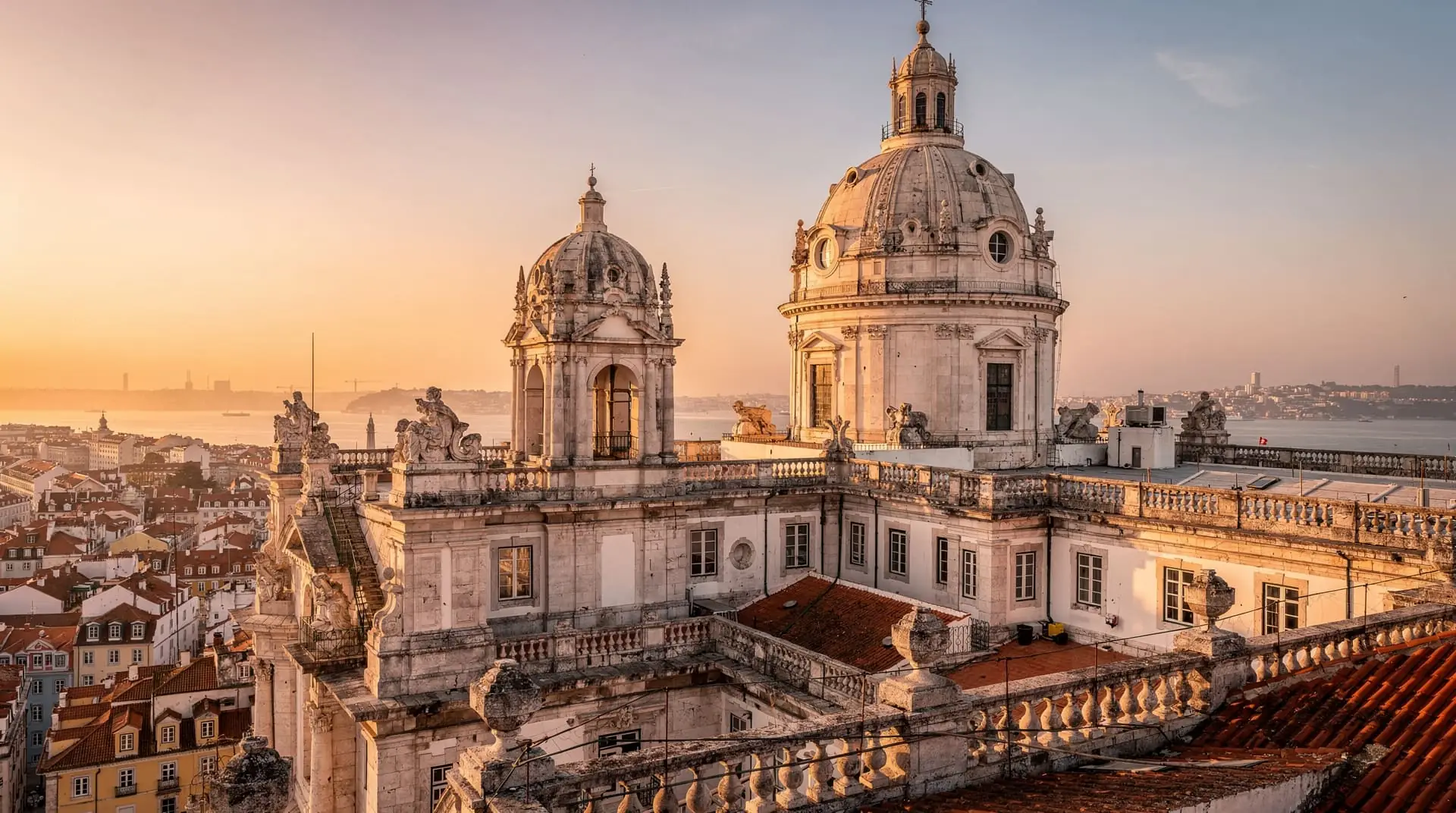
National Pantheon Lisbon: the Santa Engrácia dome and rooftop views
Lisbon's National Pantheon — Amália Rodrigues' tomb, the baroque dome, rooftop views over Alfama, and combining with the Feira da Ladra flea market.
Ready to book? Top tours for this guide
We earn a small commission if you book through GetYourGuide — at no extra cost to you. Every tour is hand-picked and verified.
Lisbon: 48-Hour Hop-On-Hop-Off Bus Tour and Oceanarium Entry
Lisbon: MAAT Entry Ticket & Dolphin Watching Boat Tour
Lisbon: Alfama, Mouraria Walking Tour with Fado Night, Tapas
Lisbon: Hop-On Hop-Off Bus Tour
Lisbon: 1-or 2-Day Hop-On Hop-Off Bus Tour