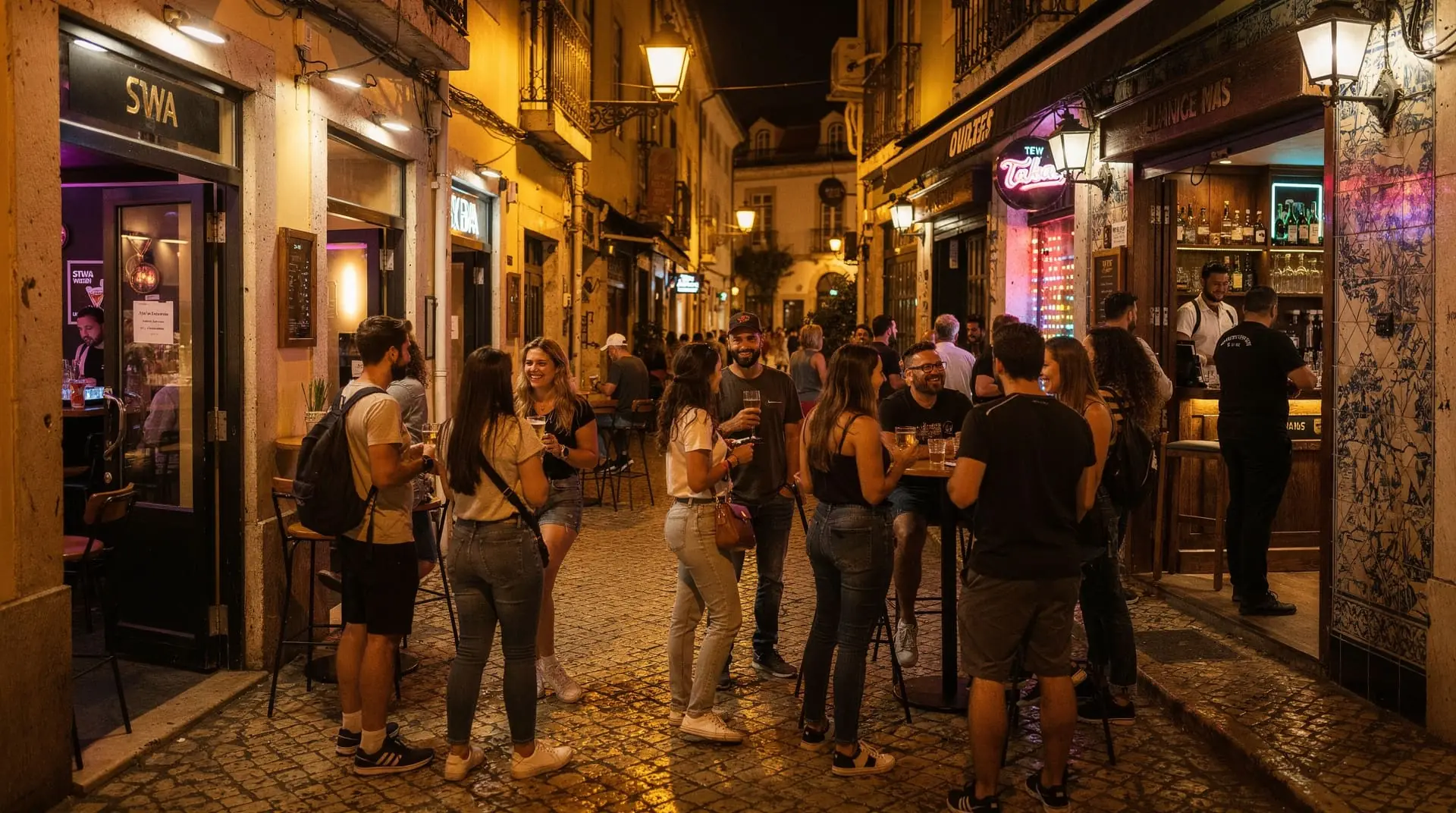
Pub crawls in Lisbon: organised vs DIY, safety, and what to watch out for
Last reviewed
Are Lisbon pub crawls safe and worth doing?
The major organised pub crawls on GYG and Viator are generally safe and can be a good way to meet people in a new city. The risks are: drink theft (never leave your glass unattended), overcrowding at the included stops, and the financial economics that push you toward buying more than the included open bar. Stick to GYG-listed crawls with recent positive reviews. Avoid crawls sold aggressively on the street.
Lisbon is one of Europe’s most popular backpacker destinations, and the pub crawl industry reflects this. On any given Friday or Saturday night in summer, there are 10-15 separate organised crawls running across the Bairro Alto and Cais do Sodré areas, with a combined total of several hundred participants. Most are reasonably well-run; a few are poorly managed; and a handful operate in ways that create genuine safety problems.
This guide covers how the pub crawl ecosystem works, which operators are legitimate, what the real risks are, and when the DIY alternative makes more sense.
| Where | Bairro Alto and Pink Street / Cais do Sodré |
| Cost | around €15–25 organised; €25–40 for a DIY night |
| Time needed | 3–4 hours structured, longer with club entry |
| Getting there | metro or tram to Baixa/Cais do Sodré |
| Best time | Friday and Saturday, meeting 9–10pm |
How Lisbon pub crawls work
The standard format: pay €15-25 online or at a meeting point, receive a wristband, join a group of 20-50 people at a central location (usually near Praça do Comércio or Cais do Sodré), and walk between 4-6 bars and/or clubs over 3-4 hours.
What’s typically included:
- 1 hour of open bar or a fixed number of shots at the first venue
- Free or discounted entry to 2-3 clubs after the bar portion
- VIP entry claiming (often means a shorter queue rather than an exclusive room)
- A guide who knows the bars and facilitates introductions
What’s typically not included:
- Drinks beyond the open bar hour
- Transport between venues (you walk)
- Taxi home
The economics to understand: The crawl operators pay the bars for a group deal on the first-hour drinks. The bars profit on additional drinks you buy during and after the open bar period. The clubs profit on the additional drinks and food you consume after entry. Everyone’s incentive is for you to spend more; the included drinks are the bait. This isn’t dishonest — it’s just how the model works — but understanding it helps you budget.
The legitimate operators
What to look for in a legitimate crawl:
- Listed on GYG (GetYourGuide) or Viator with genuine reviews
- A fixed meeting time and location stated clearly in the booking
- A clear statement of what’s included (number of bars, type of drinks)
- A guide who introduces people and manages the group, not just leads them between venues
What to avoid:
- Crawls sold by people approaching you on Rua Augusta or at your hostel who can’t show you an official booking page
- Crawls with no reviews online or with reviews that all sound identical
- Any operation where the “open bar” terms are vague until you’ve paid
The GYG-listed options are the most vetted:
Lisbon pub crawl with open bar, shots, and VIP club entry Lisbon premium pub crawl — extended open bar and VIP access Lisbon nightlife adventure: pub crawl, shots, and gamesIf the fixed open-bar hour feels too limiting, there’s also an unlimited-drinks pub crawl with shots and VIP club entry that removes the one-hour cutoff entirely.
Safety: the real risks
Drink tampering
Drink spiking (drugs added to an unattended drink) occurs in Lisbon, as it does in most European party cities. The risk is higher in the pub crawl context because:
- You’re with strangers in a group
- The open bar format creates situations where drinks are left unattended
- The venues used by crawls are often crowded and chaotic
How to protect yourself:
- Never leave your drink unattended, even in your group
- If you find your glass left on a bar or table, don’t drink from it — get a fresh one
- Travel in at least pairs; keep track of your group member
- If you feel suddenly much more intoxicated than the amount you’ve drunk should explain, sit down, tell someone you trust, and consider leaving the venue
Drink theft (the other risk)
More common than spiking: someone simply takes your drink. This sounds trivial but in the open-bar-hour context, you lose your allocation. The mitigation is the same — keep your drink in your hand.
Scams from non-legitimate operators
The specific scam: a person approaches you on the street claiming to represent a pub crawl. You pay €10-15 cash upfront for “the meeting point” or “the wristband.” They take your money and either don’t deliver what was promised (the included drinks don’t materialise, the “VIP” club entry isn’t VIP) or disappear entirely. This is rare but it happens. Mitigation: book online only, from a page with a verifiable GYG or Viator URL.
The “enhanced” crawl pitch
A guide on a legitimate crawl may offer an upgrade mid-crawl: “Pay €10 more and we skip the queue at [club].” This is usually legitimate — they have a relationship with the venue — but it’s not what you paid for initially. You can decline without consequence.
The backpacker scene: hostel-led crawls
Most Lisbon hostels with social programming run their own in-house pub crawls, usually free for guests or €5-10. These are often the most social option because you already know the people from the hostel common room.
Hostels with the strongest social programmes:
Home Lisbon Hostel (Rua de São Nicolau 13): Consistently rated one of Europe’s best social hostels. Their weekly crawl takes in both Bairro Alto and the Cais do Sodré area, run by hostel staff who actually know the neighbourhood.
Lisbon Destination Hostel (Rossio train station, inside the building): Boutique hostel inside a historic station. Weekly themed nights. Smaller groups.
WC Hostel (Rua de São Julião 131): Boutique hostel with a bar scene; their social events tend toward Bairro Alto.
The hostel crawl format is also safer — you’re with people you’ve met, the hostel staff know your name, and there’s accountability if something goes wrong.
The DIY alternative
For anyone who finds the pub crawl format (large groups, fixed timing, compulsory shots) unappealing, the Bairro Alto DIY approach is better:
The route: Start at Pensão Amor (Rua do Alecrim 19, Pink Street, 9pm, drink at the bar). Walk north 10 minutes to Bairro Alto via Rua do Alecrim. Enter the grid — Rua do Norte first (choose one bar that appeals from the street, go in, one drink). Continue to Rua da Atalaia and Rua do Diário de Notícias. Pick bars by gut feel: if the crowd inside looks like people you’d talk to and the price on the board doesn’t make you wince, go in.
Budget per person for a proper DIY night: €25-40, including transport home.
The advantage: No group management, no forced shots, no fixed timing, no strangers with various agendas. You go at your pace, spend money where you choose, leave venues when you want.
The disadvantage: If you’re solo or with one other person and want to meet people, the organised crawl group is more social by design.
Which neighbourhoods do the crawls cover?
Most Lisbon pub crawls cover one of two areas, or both:
Route 1: Bairro Alto circuit: Starts near Praça do Comércio or Rossio, walks to Bairro Alto (Rua do Norte, Rua da Atalaia). Most common for the “classic” Lisbon crawl.
Route 2: Pink Street / Cais do Sodré: Starts near Cais do Sodré station, covers Rua Nova do Carvalho and the surrounding area, typically ending at a club (Lux Frágil, Music Box, or one of the Santos clubs).
Route 3: Combined: 2-3 bars in Bairro Alto, then walk down to Pink Street for the club portion.
The combined route gives the most variety and is increasingly the standard. See our Bairro Alto nightlife guide and Pink Street guide for what each area actually offers.
Timing and meeting points
Most Lisbon pub crawls start between 9pm and 10pm, with meeting points near Praça do Comércio, the Cais do Sodré metro exit, or specific hostels in the Baixa area. The organisers confirm the exact meeting point in the booking confirmation.
How long does a pub crawl last? Typically 3-4 hours for the structured portion (bars section), with the club entry extending to 2-3am or later. Budget for a full evening — you’re unlikely to be home before midnight.
Days: Friday and Saturday are the main crawl nights. Some operators run Sunday and Thursday crawls targeting backpackers with flexible schedules. Sunday evenings in Lisbon are quieter — the bar crowd is thinner and the crawl atmosphere is accordingly less energetic.
Practical tips
What to wear: Casual. Trainers are fine everywhere on the crawl circuit; there’s no dress code enforcement at the bars. Some clubs request no sportswear (football jerseys, tracksuits) — a pair of jeans and a shirt avoids all potential issues.
What to carry: Cash (some small bars are cash-only), ID (clubs enforce minimum age — 18 in Portugal — and will card you), your phone (Uber/Bolt for the journey home), and a card for larger purchases. Don’t carry your passport — a photocopy or phone photo of the bio page is sufficient for most ID checks.
What not to carry: Expensive camera, unnecessary cards, large amounts of cash. The environment is crowded and your bag will be jostled.
After the crawl: Book your Uber/Bolt before you need it — demand is high after 2am and wait times stretch. If you’re in a group, share a large vehicle (Uber XL) to split the cost.
For the wider nightlife context, see our Bairro Alto nightlife guide, rooftop bars guide, and Lisbon safety guide. For planning your broader Lisbon trip, the first-time Lisbon tips and 3-day Lisbon itinerary are good starting points.
Organised crawl vs DIY: which suits you
| Organised crawl | DIY route | |
|---|---|---|
| Best for | Solo travellers, meeting people, first night in the city | Couples, small groups who know what they want |
| Cost | €15–25 plus extra drinks | €25–40, no fixed spend |
| Social factor | High — built-in group | Low unless you already have company |
| Flexibility | Fixed route and timing | Choose bars, pace, timing freely |
| Best night | Friday or Saturday | Any night, quieter midweek |
Budgeting for the whole night
A realistic total for a full crawl night — ticket, extra drinks beyond the open bar, a late-night snack, and the taxi home — runs €50–80 per person once everything is added up, noticeably more than the headline €15–25 ticket price suggests. Setting this expectation before the night starts avoids the surprise of an empty wallet by 2am. If budget is the main constraint, a hostel-run crawl at €5–10 with your own pace on extra drinks keeps costs closer to the advertised figure.
Solo travellers and group safety
Pub crawls are one of the easier ways to have a social first night in Lisbon if you’re travelling solo, precisely because the format forces interaction with strangers in a low-stakes setting. That said, solo travellers should apply the same rules as anyone else: keep your drink in hand, let someone at your hostel know roughly when you expect to be back, and avoid leaving a group midway through the night with someone you’ve just met unless you’ve told a friend or hostel staff where you’re going. Hostel-led crawls are generally the safer entry point for solo travellers precisely because the staff know your name and your room number — see the hostel section above for the strongest social programmes.
Related guides
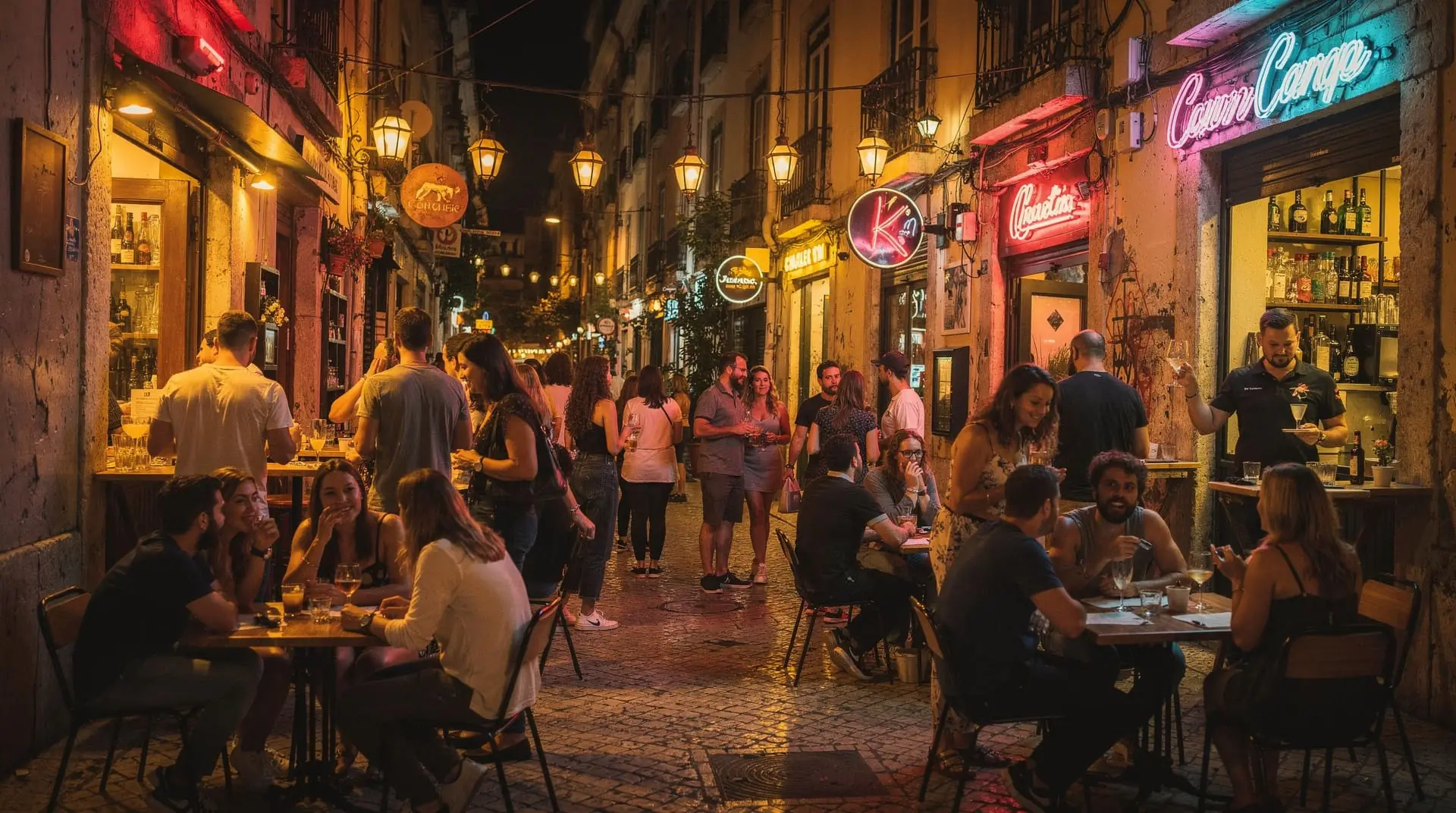
Bairro Alto nightlife: the complete bar-hop guide
Honest guide to Bairro Alto's bar scene. Best streets, what to drink, which bars to avoid, timing, and how to do the neighbourhood without getting scammed.
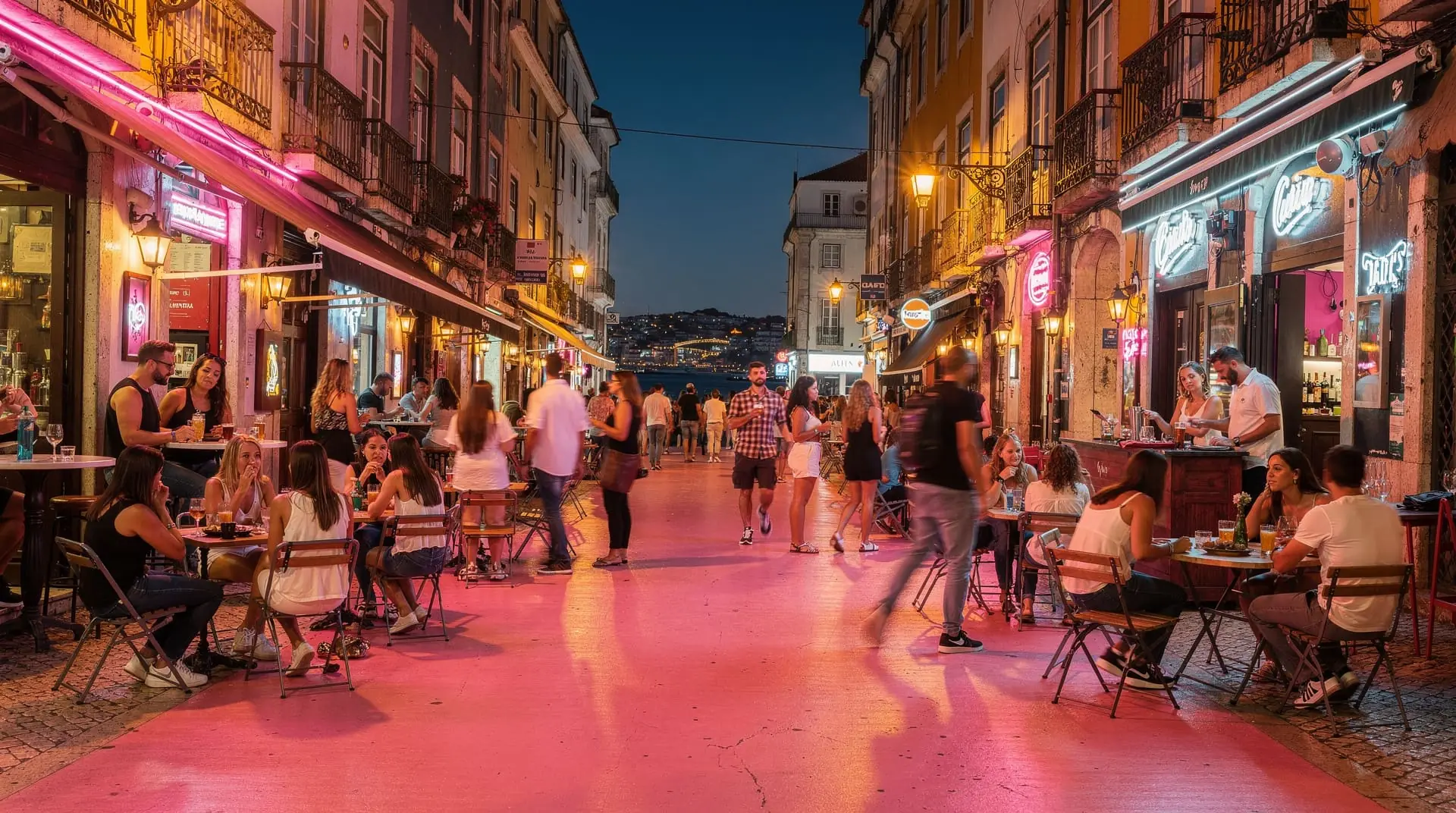
Pink Street and Cais do Sodré: Lisbon's riverside nightlife strip
Rua Nova do Carvalho (Pink Street), Pensão Amor, Sol e Pesca, and the sailor-bar heritage of Cais do Sodré. What it is, when to go, and what's overrated.

Best rooftop bars in Lisbon: views, prices, and honest picks
Lisbon's best rooftop bars in 2026: Park, Topo Martim Moniz, LUMI, Lost In, Memmo Alfama, and the Bairro Alto Hotel terrace. Prices, access, and honest tips.
Best fado houses in Lisbon: authentic picks and honest warnings
The best fado houses in Lisbon: Clube de Fado, Mesa de Frades, Tasca do Chico, A Severa. Real prices, booking tips, tourist-trap warnings.
Ready to book? Top tours for this guide
We earn a small commission if you book through GetYourGuide — at no extra cost to you. Every tour is hand-picked and verified.

Lisbon: 48-Hour Hop-On-Hop-Off Bus Tour and Oceanarium Entry
Lisbon: MAAT Entry Ticket & Dolphin Watching Boat Tour
Lisbon: Alfama, Mouraria Walking Tour with Fado Night, Tapas
Lisbon: Hop-On Hop-Off Bus Tour
Lisbon: 1-or 2-Day Hop-On Hop-Off Bus Tour