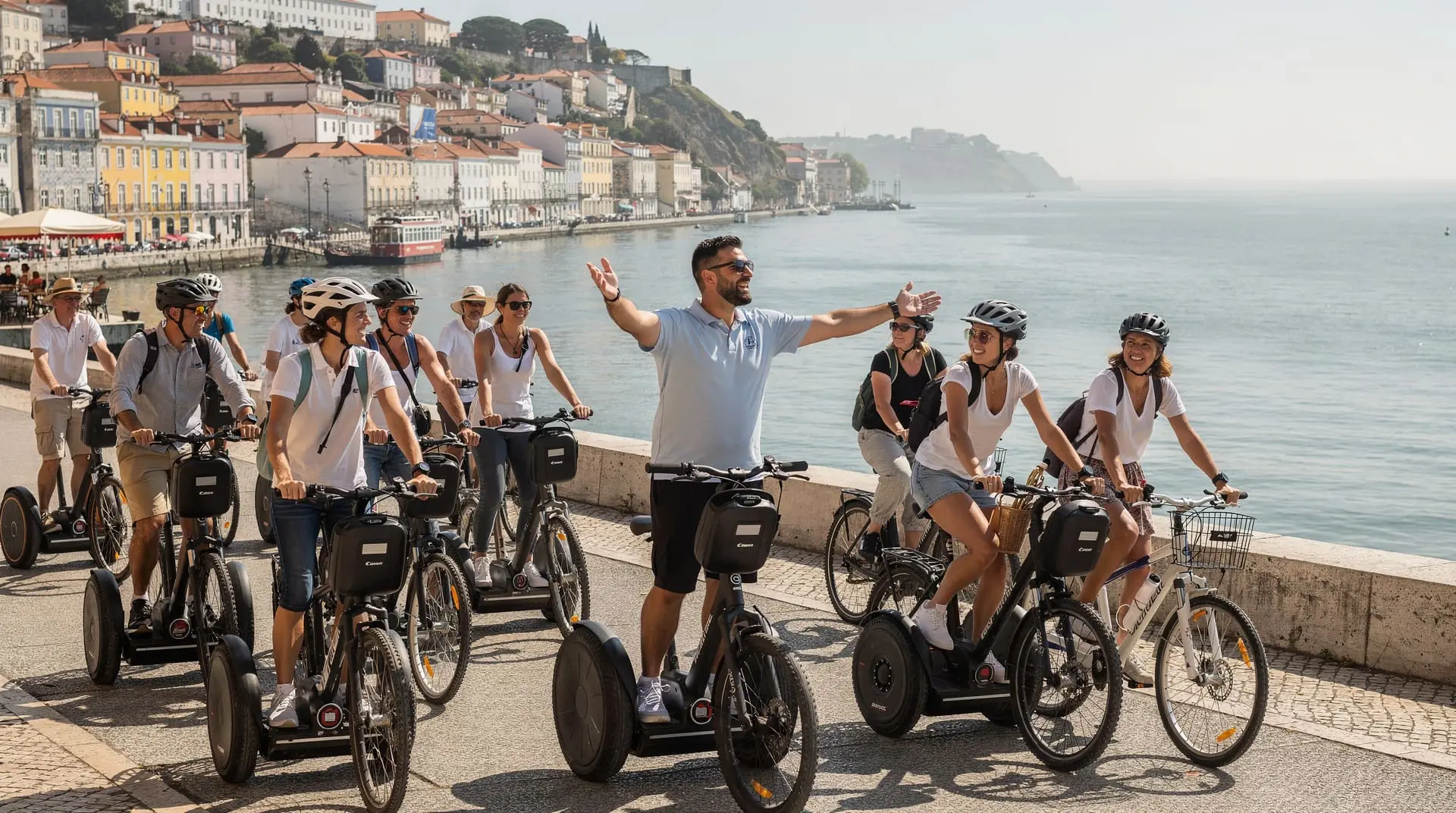
Segway and bike tours in Lisbon — riverside rides, hill logistics, and who they suit
Last reviewed
Are segway or e-bike tours good in Lisbon?
E-bike tours are excellent for the Tagus waterfront (Terreiro do Paço to Belém) and the Cascais coast path. Segways work well on the flat waterfront and riverside park sections. Neither format handles Alfama and Graça well — the hills are too steep for safe segway operation and the narrow streets are awkward on bikes. Both are genuinely fun for the right route.
Segways and e-bikes: the honest comparison
Segway and e-bike tours solve the same Lisbon problem from slightly different angles: how to cover the long flat waterfront distances efficiently without a car, bus, or the aching legs that come from walking Lisbon’s hills.
The Tagus waterfront from Praça do Comércio west to Belém is 6km. On foot it is a good 75-90 minute walk, much of it along a pleasant but sun-exposed riverside path with no shade in summer. By tram 15E it takes 20 minutes and costs €1.60 but the tram does not stop at all the waterfront points of interest. By e-bike or segway, it is 20-25 minutes at a comfortable pace with freedom to stop anywhere.
This is the core value proposition. Everything else — the commentary, the group dynamic, the fun factor — is secondary to solving the distance problem.
| Where | Praça do Comércio hub, riverside to Belém, Parque das Nações |
| Cost | Around €35–60 per person for a 2–3 hour tour |
| Time needed | 1.5–4 hours depending on route |
| Getting there | Meet at Praça do Comércio or Cais do Sodré rental hubs |
| Best time | Morning departures, or sunset tours from ~6–7pm |
Segway vs e-bike vs walking, at a glance:
| Format | Distance covered | Handles hills | Cost |
|---|---|---|---|
| Segway | Flat waterfront only | No | €40–60 (2hrs) |
| E-bike | Waterfront + gentle hills | Yes, with e-assist | €35–55 |
| Walking | Whatever pace you set | Yes, on foot | Free |
Segway tours in Lisbon
Where they operate
Segway tour hubs are concentrated around Praça do Comércio (the main riverside square in the Baixa) and along the Tagus waterfront east towards Parque das Nações. Several operators are based here with segways available for pre-booked tours.
Segway operations are restricted to flat and semi-flat terrain. The riverside promenade, the Belém waterfront, and Parque das Nações are the principal operating zones. Alfama and the historic hills are not suitable — the gradient and the narrow streets both create safety problems that operators will not attempt.
Route options
Tagus riverside (2-3 hours): The classic Lisbon segway route, following the waterfront from Praça do Comércio past Cais do Sodré, through Alcântara, and along the Belém riverside to the monument cluster. Covers the Monument to the Discoveries, Jerónimos Monastery exterior, Belém Tower visible from the river, and MAAT museum. Operators stop at key points for commentary and photographs.
Lisbon guided riverside segway tourParque das Nações circuit (1.5-2 hours): The Expo 98 area east of the city centre is purpose-built for cycling and has an excellent network of flat, wide paths. Segway tours of this area cover the Oriente railway station (Santiago Calatrava architecture), the Oceanário (Lisbon’s oceanarium), the riverside gardens, and the Vasco da Gama tower. Good for families and anyone who wants to see a different part of Lisbon from the usual historic centre focus.
Alfama segway (1.5 hours): Available from some operators but genuinely limited by the terrain. The routes avoid the steepest streets and the experience is less satisfying than the riverside alternatives. A handful of operators instead run a 2.5-hour private segway tour of Alfama, where a dedicated guide can pick a slower pace and detour around the steepest lanes — worth it if you specifically want the hills covered rather than the flat riverside route. The Alfama is otherwise better approached by tuk-tuk (more manoeuvrable and can go everywhere) or on foot.
Lisbon city centre and river 3-hour guided segway tourWhat segways are and are not good for
Good for: First-time visitors who want an orientation of the riverside and Belém; visitors with mobility issues who cannot walk 6km but can operate a segway; anyone who finds the logistics of public transport stressful and wants a guided framework; people who enjoy the novelty element.
Not good for: Deep exploration of Alfama and the historic hills; visitors who want to go off-route and explore independently; rainy or very windy days (the balance element becomes more challenging); anyone who wants to move at their own pace between sites.
Minimum age: Most operators set a minimum age of 12-14 for segways. Weight limits typically 20-120kg.
Price: 2-hour segway tour approximately €40-60 per person depending on the operator and route. Pre-book through GetYourGuide for best availability and cancellation terms.
E-bike tours in Lisbon
E-bikes are a more versatile option than segways. They can tackle gentle hills that would be brutal on a standard bike, they cover distance quickly, and they are familiar enough that almost any adult can operate one competently within 5 minutes.
The Tagus waterfront to Belém route
The standout e-bike experience in Lisbon. Operators depart from the Praça do Comércio area or from rental hubs near Cais do Sodré, following the dedicated cycle path along the Tagus waterfront. Stops typically include: Museu do Oriente (if the tour includes it), LX Factory area, MAAT museum, Monument to the Discoveries, Jerónimos Monastery exterior, Belém Tower viewpoint, the custard tart competition at Pastéis de Belém or Fábrica de Pastéis de Belém.
The Belém cluster represents significant monument density — Belém Tower, Jerónimos, Monument to the Discoveries, and the Coach Museum are all within 800m of each other. A guided e-bike tour provides the mobility to cover them efficiently without feeling rushed.
Lisbon electric bike tour by the river to BelémDuration: 3-4 hours for the full Tagus-to-Belém circuit. Some operators offer 2-hour abbreviated versions.
Price: €35-55 per person depending on duration and operator.
7 Hills e-bike circuit
The 7 Hills e-bike tour is the attempt to solve Lisbon’s primary geography problem using battery power. Routes vary by operator but typically cover: Baixa, then up to Bairro Alto via a gentle hill route, across to Príncipe Real, up to the Rato area, and a loop through the hill neighbourhoods before returning to the riverside.
Lisbon city highlights and viewpoints e-bike tourThe e-assist genuinely makes the hills manageable — a climb that would leave most visitors gasping on a standard bike becomes a moderate effort on an e-bike. The caveat is that the narrowest Alfama streets are still not suitable for bikes — the circuit takes you near Alfama but not through the densest sections.
Who this suits: Active visitors who want to cover more of the city than a walking tour allows; anyone who cycles regularly; visitors with two half-days to spare (waterfront one day, hills the other).
Cascais coast e-bike
Not a Lisbon city tour but the most satisfying cycling route in the greater Lisbon area. The cycle path from Cascais town centre west along the coast to Guincho (5km) or north from Cascais towards Estoril is excellent — flat, well-marked, and visually rewarding. E-bike rental in Cascais: €15-25/day. The ride to Guincho and back, with lunch at Bar do Guincho, is a perfect afternoon.
See the Cascais beaches guide and Guincho surf beach guide for context.
Self-guided e-bike rental vs organised tour
Organised e-bike tours provide a guide, a defined route, and stops with commentary. Self-guided rental (available from bike shops near Praça do Comércio, Cais do Sodré, and Cascais) provides freedom but requires navigation.
Choose an organised tour if: You are unfamiliar with Lisbon’s cycle infrastructure, want to understand what you are looking at, or prefer a group social experience.
Choose self-guided rental if: You are confident navigating, want to go at your own pace, and have specific stops in mind that may not be on any tour route.
Most bike shops near the waterfront rent e-bikes at €15-25/day with a map of the riverside cycle route. The route from Praça do Comércio to Belém is clearly marked and hard to get wrong.
Safety and practical notes
Helmets: Provided and mandatory on all organised tours. Legally recommended (though not always enforced) for self-guided rental.
Traffic: The Lisbon waterfront cycle path is separated from traffic for most of its length. The section through Alcântara (between Cais do Sodré and LX Factory) involves some mixed-traffic sections — follow the tour guide’s lead. The Belém section is excellent — a wide dedicated path along the river.
Weather: Both segways and e-bikes are compromised by rain. Most operators have cancellation policies for genuinely poor weather. Check before booking in winter.
Minimum fitness level for e-bikes: Very low. The electric assist does most of the work on hills. Even visitors who rarely cycle find them manageable within 5 minutes.
Minimum fitness level for segways: Standing ability only. The balance learning curve is typically 5-10 minutes.
Night and sunset bike tours
Several operators run evening e-bike tours timed for sunset, departing around 6-7pm and returning after dark. The riverside path from Praça do Comércio to Belém at golden hour — with the Ponte 25 de Abril silhouetted against a Tagus sunset and the Jerónimos lit from the side — is one of the best cycling experiences available in any European city.
Night tours (departure after 8pm) cover the illuminated monuments and the riverside at a time when daytime traffic has cleared. The city changes character after dark, and cycling through the Baixa and Chiado at 10pm with the monuments lit and the restaurants full provides a different perspective from the same route in afternoon heat.
Typical sunset/night tour format: 2-2.5 hours, departing from near Praça do Comércio, riding west to Belém, stopping at the Monument to the Discoveries and the Belém Tower riverfront, returning via the Alcântara waterfront. €35-45 per person with e-bike and guide.
Longer e-bike routes and multi-day cycling
For visitors spending more time in the Lisbon region, the coastal and inland cycling infrastructure extends beyond the day-tour circuit.
Cais do Sodré to Cascais (coastal path): A largely continuous cycle path follows the Tagus estuary and then the Atlantic coast from Belém through Estoril to Cascais — about 35km in total from central Lisbon. Most of this is on a dedicated cycle path or shared waterfront promenade. The full route makes an excellent full-day ride by e-bike, with stops at Estoril and Cascais. Take the train back from Cascais to Cais do Sodré when done (bikes allowed on trains outside peak hours, check Comboios de Portugal rules).
Sintra via the coast: The road from Cascais north to Sintra through the Sintra-Cascais Natural Park is one of the most dramatic cycling routes in the Lisbon area — via Guincho, up to Cabo da Roca, and then inland to Sintra through forested mountain roads. This is a challenging route even on e-bikes due to the elevation gain between Guincho and Sintra (the Sintra hills rise to 500 metres). The guided tour version handles the logistics.
Parque das Nações cycling: The east of Lisbon (Expo 98 area) has the best urban cycling infrastructure in the city — dedicated lanes, flat terrain, and interesting architecture. For visitors who want cycling as exercise rather than sightseeing, the park’s 10km circuit of riverside and garden paths is the most accessible option.
Equipment quality and what to expect
E-bikes used by tour operators in Lisbon vary in quality. The better tours use mid-drive or hub-drive e-bikes with reliable battery capacity (at least 50km range, usually more). Ask about the bike brand if this matters to you — Specialized, Trek, and Scott are among the reputable brands some operators use; cheaper alternatives are also common.
Battery life: All operator bikes should have sufficient battery for the tour route. For self-guided rental of full days, ask about battery range and whether the rental shop has replacement batteries.
Gearing and weight: Standard e-bikes for tours weigh 20-25kg. Mid-drive systems (motor in the bottom bracket) handle hill gradient more smoothly than hub motors. For the 7 Hills circuit specifically, mid-drive is noticeably better.
Helmet fit: Operators provide helmets; try a few if the first does not fit well. A properly fitted helmet matters more than most visitors acknowledge.
In case of breakdown: Reputable operators have support vans or can arrange roadside assistance. For self-guided rental, get the shop’s phone number before setting off.
Comparing the e-bike tour operators
The Lisbon e-bike tour market has 10-15 active operators. A few distinguishing factors:
Group size: Maximum 8-10 for quality; 12-15 for budget operators. Smaller groups move faster and get more guide attention.
Guide knowledge: The best guides are cyclists who know Lisbon’s cycling infrastructure well and have strong knowledge of the monuments and neighbourhoods on the route. Ask one question about the history of something on the route — the answer quality tells you a lot.
Route flexibility: Some operators stick rigidly to a fixed route; others adapt based on group pace and interest. The latter makes for a better tour.
Duration vs distance: A 3-hour tour covering 18-20km is a good benchmark. Tours claiming to cover more in less time either rush the stops or skip content.
Booking platforms: Most operators are on GetYourGuide. Reviews filtered for language and recent date are the most reliable signal.
Accessibility of e-bike tours
E-bike tours are considerably more accessible than walking tours for visitors with moderate physical limitations. The electric assist removes most of the aerobic barrier — you do not need to be fit to complete a flat e-bike tour, you just need to be able to balance and steer.
For the 7 Hills circuit, some climbing is involved even with e-assist — not suitable for visitors with severe mobility limitations.
Minimum physical requirement: Ability to balance on a two-wheeled bike, moderate grip strength for brakes. Most operators have a minimum height of 155cm and weight limit of 120kg for their bikes.
Alternative for those who cannot use a standard bike: Some operators offer e-trike options (three-wheel electric bikes) that provide stability without requiring balance. These are not always available — enquire specifically when booking.
The Belém circuit by e-bike: a worked example
To make the e-bike tour value concrete, here is what a standard Tagus waterfront e-bike tour covers in practice:
Departure point: Near Praça do Comércio or the Terreiro do Paço cycling hub. Time: usually 9am or 10am morning departures, 5pm or 6pm for sunset tours.
Route west: Riding along the riverfront cycle path through Cais do Sodré (the ferry terminal where boats cross to Cacilhas and south bank), past the LX Factory complex in Alcântara (visible from the riverside road — the former printing works converted to a creative hub, Sunday market, restaurants), continuing to the MAAT museum (Museum of Art, Architecture, and Technology — the red-roofed building that can be entered via a walk across its curved roof), then to the Monument to the Discoveries (the concrete prow overlooking the Tagus), Belém Tower (riding to the waterfront path that gives the best view of the tower from river level), and Jerónimos Monastery (the guide stops outside for the Manueline facade context — entry is separate).
Return: Same route east or via the parallel street slightly inland. Total cycling distance: approximately 12-14km round trip. Stops add another 2-3km of walking. Total tour time: 3-3.5 hours with stops.
Calories burned, approximately: 300-400 calories on the e-bike (pedal assist reduces but does not eliminate the rider’s effort). Enough to justify a pastel de nata at the stop near Jerónimos.
What the guide covers: Each monument gets 5-10 minutes of explanation covering the historical context, key visual features to note, and honest practical information (which are worth paying to enter, which are best from outside). Questions are answered on the move or at stops.
Weather and cancellation considerations
Lisbon’s weather is generally cycling-friendly from April through October. Rain is uncommon in summer (July-August virtually never rains) and when it occurs is usually brief.
Rain during a tour: Most operators have a light-drizzle policy (tours continue with rain ponchos provided) and a heavy-rain cancellation policy (full refund). Check the specific operator’s terms.
What to wear: Closed shoes are strongly recommended for both formats — sandals and flip-flops are a real hazard around pedals and segway footplates, and several operators will refuse riders in open-toed footwear. Light layers work best, since the riverside can be noticeably windier than the streets a few hundred metres inland. Sunglasses and sunscreen matter more than most riders expect, since a 3-hour outdoor tour in summer means sustained sun exposure with no shade along most of the waterfront route.
Photography on the move: Most operators build in dedicated photo stops rather than expecting riders to shoot while moving, which is both safer and produces better results — the segway and e-bike speeds are usually too fast for handheld phone photography to work well. If photography is a priority, mention it when booking; some guides are more generous with stop time than others.
Traveling with a companion who doesn’t want to ride: A few operators allow a non-riding companion to walk or take public transport to designated meeting points along the route, effectively splitting the group for parts of the tour. This isn’t universally offered, so ask specifically when booking if it matters to your group.
Language and group composition: Most Lisbon segway and e-bike operators run English-language tours as standard, with some offering Spanish, French or German on request or via specific departure times. Mixed-nationality groups are the norm rather than the exception, and guides typically default to English commentary unless a group specifically books a single-language private tour.
Wind: The Atlantic west wind can be noticeable on the riverside cycling path between Cais do Sodré and Belém. An e-bike handles the headwind on the westbound section without effort. The return (eastbound) is typically with the wind.
Winter tours: December-February tours operate but are shorter daylight hours and cooler temperatures (10-15°C). Layers are necessary. The monuments have shorter queues and the waterfront is very quiet — some visitors find this preferable to the summer crowds.
See also: tuk-tuk tours in Lisbon, walking tours, getting around Lisbon, Belém half-day guide, Cascais beaches guide.
Fitting a tour into your wider Lisbon plan
Segway and e-bike tours work best as a targeted solution for a specific distance problem rather than a full-day activity. If you’re planning a car-free Lisbon trip, see the Lisbon without a car itinerary for how these tours slot in alongside trams and the metro, and day trip transport for getting further afield afterwards. For the Belém cluster specifically, most riders combine the ride with time on foot in Belém itself once they arrive — see the Belém half-day guide for what to prioritise there. Parque das Nações riders should also check the Parque das Nações guide for what’s worth stopping at along the route. If you’re weighing a rental car against these guided options for getting around the wider region, the driving and parking in Lisbon guide explains why most visitors are better off without one in the city centre.
Related guides

Free walking tours in Lisbon — how they work, what they cost, and the best operators
Lisbon free walking tours: tip-based economics, expect €10-15 per person, best operators (Sandeman's, Chill-Out), and themes available.

Is hop-on hop-off worth it in Lisbon? An honest assessment
Honest verdict on Lisbon hop-on hop-off buses: routes, prices €25-35, when it makes sense and when the metro plus walking beats it every time.

Tram 28 guide — route, stops, timing, and the pickpocket reality
Everything about Lisbon's tram 28: the full Martim Moniz to Campo Ourique route, best boarding times, pickpocket risks, and the tram 12E alternative.

Tuk-tuk tours in Lisbon — where they're useful, what they cost, and scams to avoid
Honest guide to Lisbon tuk-tuks: Alfama hills access, pricing €20-40 per hour, licensed operators, and how to avoid overcharging and unlicensed drivers.
Ready to book? Top tours for this guide
We earn a small commission if you book through GetYourGuide — at no extra cost to you. Every tour is hand-picked and verified.

Lisbon: 48-Hour Hop-On-Hop-Off Bus Tour and Oceanarium Entry
Lisbon: MAAT Entry Ticket & Dolphin Watching Boat Tour
Lisbon: Alfama, Mouraria Walking Tour with Fado Night, Tapas
Lisbon: Hop-On Hop-Off Bus Tour
Lisbon: 1-or 2-Day Hop-On Hop-Off Bus Tour