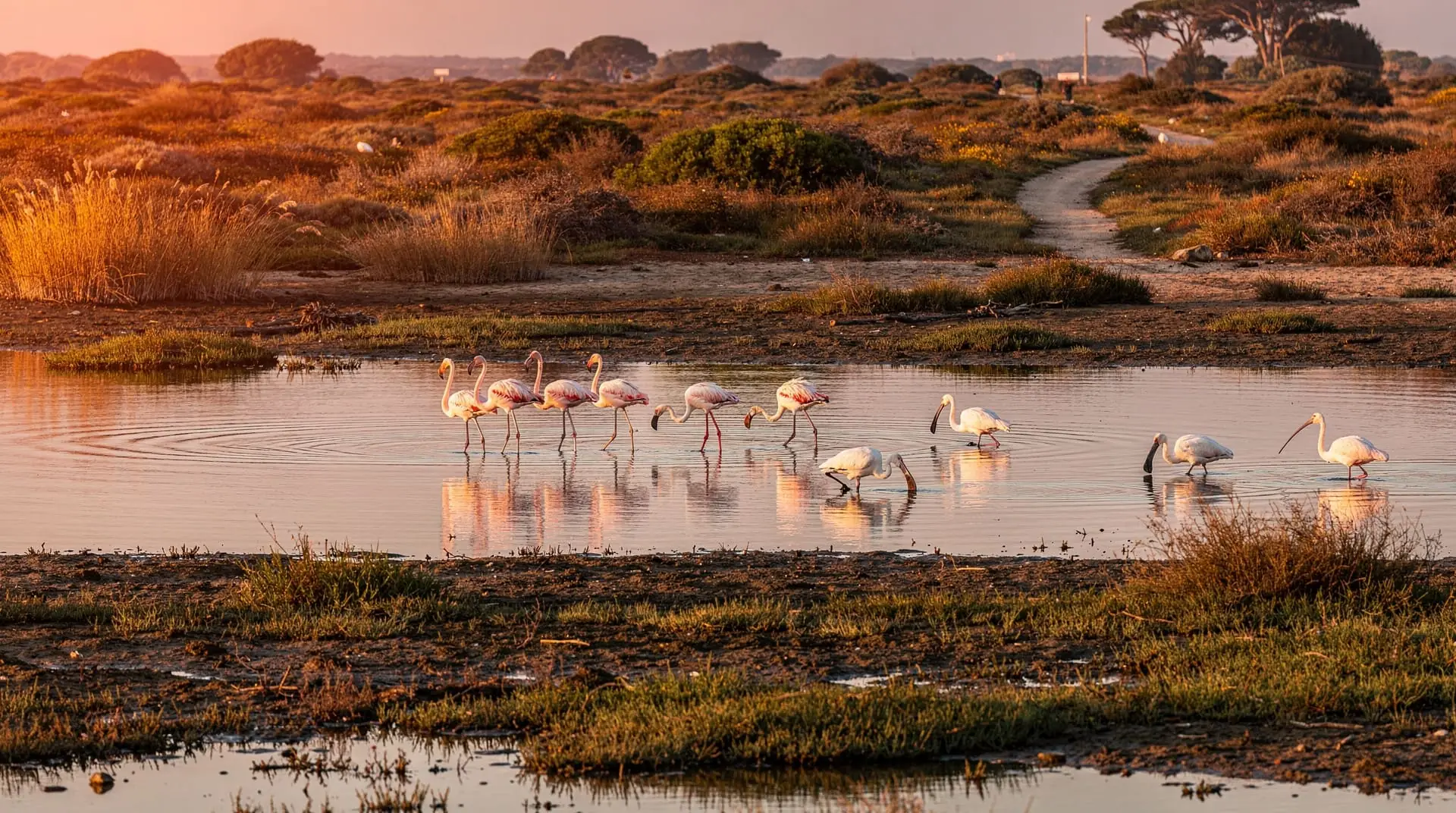
Tagus estuary birdwatching: flamingos, spoonbills and the Alcochete reserve
Last reviewed
Where can you see flamingos and spoonbills near Lisbon?
The Reserva Natural do Estuário do Tejo (Tagus Estuary Natural Reserve) on the south bank of the Tagus hosts one of Western Europe's most important waterbird sites. Flamingos and spoonbills are present in large numbers, especially September–March. Access from Lisbon via ferry to Montijo (20 min) then bus or taxi to the Alcochete visitor centre, or by car across the 25 de Abril bridge (30–40 min).
The Tagus estuary is the largest estuary in Western Europe. Most of it lies south of the city, beyond the 25 de Abril bridge, across the water from Lisbon’s waterfront — visible but rarely visited by tourists. The Reserva Natural do Estuário do Tejo (RNET), which protects the largest section of this estuary, is one of the most important wetland bird sites in Europe. On a good winter day you can see 150,000+ waterbirds from a single embankment. Flamingos walking in the shallows, spoonbills sleeping on sandbars, clouds of dunlin wheeling over the mud as a peregrine makes a pass.
It requires a half-day commitment and a small amount of transport planning. For birders, it is not optional.
| Where | Alcochete, south bank of the Tagus |
| Cost | Free entry; around €15–20 return by ferry+taxi, or free parking by car |
| Time needed | Half day, 4–6 hours around low tide |
| Getting there | Ferry to Montijo + taxi, or car via the 25 de Abril bridge |
| Best time | November–February for peak numbers, arrive 2hrs before low tide |
The reserve: scale and ecology
The Reserva Natural do Estuário do Tejo covers 14,416 hectares of intertidal mudflats, saltmarshes, rice paddies and open water on the south and east banks of the Tagus. It was designated a Ramsar Wetland of International Importance in 1980 and a Special Protection Area under the EU Birds Directive.
The intertidal mudflats: The core bird habitat. At low tide, vast areas of nutrient-rich mud are exposed — feeding grounds for thousands of wading birds (dunlin, grey plover, knot, black-tailed godwit, avocet). The timing of your visit relative to the tidal cycle matters significantly: low tide is when the birds feed and are visible; high tide pushes them to the saltmarsh edges. Always check the tide times for Alcochete before visiting.
The saltmarshes: Cordgrass and glasswort saltmarsh at the upper tidal zone, used by breeding birds in spring and as high-tide roosts for waders and wildfowl.
The rice paddies: Flooded after harvest (September–February), these provide shallow-water habitat for flamingos, spoonbills and herons. The famous flamingo flocks are most reliably found in the flooded rice paddies east of Alcochete.
Key species: what you will see (and when)
Greater flamingo (Phoenicopterus roseus) Flamingos are present in the Tagus estuary year-round but numbers peak dramatically in autumn and winter. September–March: groups of 500–3,000+ birds in the rice paddies and shallow saltmarshes east of Alcochete. These are not captive animals — they are genuinely wild birds that have learned the productivity of the Tagus mudflats and return annually. Pink, tall, surprisingly luminous against the green winter rice fields.
Eurasian spoonbill (Platalea leucorodia) Spoonbills breed in the Netherlands and France, winter in the Tagus estuary and West Africa. September–March numbers: 50–200+ birds roosting communally on the Tagus sandbars and feeding in the shallows. The characteristic bill (flat, spatula-shaped) and white plumage with yellow breast wash make them unmistakable. Roosting flocks are often visible from the Alcochete embankment.
Black-tailed godwit (Limosa limosa) The Tagus is the wintering ground for a significant portion of the European black-tailed godwit population. August–April: flocks of 5,000–15,000 birds on the mudflats at low tide. One of Portugal’s most important sites for this declining species.
Dunlin (Calidris alpina) The commonest wader in winter, often in huge wheeling flocks of 10,000–50,000 birds that perform coordinated aerial displays (murmurations). On a cold January morning, watching a dunlin murmuration over the estuary is one of the most spectacular wildlife spectacles in Portugal.
Avocet (Recurvirostra avosetta) Elegant black-and-white wader with an upturned bill. Winters in large numbers — 2,000–5,000 birds — on the shallower saltmarsh pools. Usually very approachable.
Little egret, grey heron and purple heron: Year-round residents. The little egret is everywhere; purple heron uses the reedbeds in the eastern reserve sections.
Marsh harrier: Resident breeder. Regularly hunts over the saltmarsh.
White stork: Breeds in the reserve (50+ pairs nest on electricity pylons around Alcochete). Present year-round, with maximum numbers in summer when migrants join residents.
Purple swamphen (Porphyrio porphyrio): A large, brilliantly-coloured rail. Resident, noisy and surprisingly visible from the Alcochete paths.
Access: getting to Alcochete
By ferry and bus (no car): The Soflusa ferry from Terreiro do Paço (Praça do Comércio waterfront) runs to Montijo, on the south bank of the Tagus. Journey: 25–35 minutes, runs roughly every 30–60 minutes, costs around €2.50 with Viva Viagem card. From Montijo, bus connections toward Alcochete run a few times a day (confirm current TST bus timetable). Alternatively, taxi from Montijo to Alcochete costs approximately €15–20 (12 km).
By car: The most practical option. Cross the 25 de Abril bridge, take the A2 south toward Setúbal, exit for Alcochete on the Via Rápida (N4). Total: 30–40 minutes from central Lisbon depending on bridge traffic. Parking in Alcochete is free and easy.
By car via Vasco da Gama bridge: Cross the Vasco da Gama bridge (toll: €3.40) and head south toward Alcochete. Slightly longer route but avoids the 25 de Abril bridge queues if travelling during rush hour.
The Alcochete visitor centre and viewing points
The RNET visitor centre (Centro de Visitantes da Reserva Natural do Estuário do Tejo) is in Alcochete village, 1 km from the waterfront. Opening hours: Tuesday–Sunday, 9 am–12:30 pm and 2–5:30 pm. Free entry.
The centre has:
- Species lists and current sightings board
- Telescopes for loan (sometimes — call ahead)
- Maps of the embankment paths
- Information on guided tours
The embankment walks: The key viewing area is the levee system east of Alcochete town, accessible on foot from the waterfront. Walk east along the Tagus bank toward the rice paddies (1.5–4 km, flat, easy). At low tide the mudflats spread for hundreds of metres and the birds are close enough for binoculars. At high tide the birds compress onto the near edge.
Paul de Canhestros: The best single area for flamingos, located 3–4 km east of Alcochete in the flooded rice fields. This requires a car or bicycle to reach comfortably. In winter, flamingo flocks here can be extraordinary — 1,000+ birds in the flooded paddies.
Guided birdwatching tours
Several operators run guided eco-tours to the Tagus estuary from Lisbon. These are worth considering if:
- You do not have a car and the ferry-bus combination seems logistically complex
- You want expert identification (many winter waders look very similar to non-specialists)
- You want to maximise sightings in limited time — guides know which sections to visit based on current tide and recent sightings
Some river cruise operators offer a “Tagus River cruise to the ocean and dolphin watching” that passes through the outer estuary and may encounter birds in the wider estuary. This is not a dedicated birdwatching tour but offers a different perspective on the waterway.
Book the Tagus River cruise to the ocean and dolphin watchingFor a more traditional river experience that includes estuary views, the Tagus Express cruise in a traditional vessel covers the outer Tagus.
Book the Tagus River Express cruise in a traditional vesselWhat to bring for birdwatching
Binoculars: Essential. 8x42 or 10x42 are the standard recommendations for waterbird watching. The distances on the estuary are large enough that 7x35 is marginal. Many birders bring a spotting scope (20-60x zoom) for roosting flocks and distant species.
Field guide: Collins Bird Guide (Svensson et al.) covers all European species including Portugal. Downloadable app versions (Collins, Merlin by Cornell Lab) work offline.
Tide tables: Check marés.pt or Windfinder for Alcochete tide times before visiting. Plan your arrival 2 hours before low tide (when birds are actively feeding on the exposed mud at closest range).
Footwear: Wellies or waterproof boots if you want to walk the levee paths in wet conditions. In dry summer conditions, trainers are fine.
Clothing: Muted colours (greens, browns, grey). Bright colours and white clothing are not strict requirements for estuary birds that are accustomed to human presence, but are standard birdwatching practice.
Best seasons at a glance
| Season | Highlights | What to expect |
|---|---|---|
| September–October | First winter arrivals, flamingos building up, godwit flocks arriving | 50,000+ birds possible, warm weather |
| November–February | Peak winter — flamingos at maximum, spoonbills roosting, dunlin murmurations | Cold but spectacular, 100,000+ birds on best days |
| March–April | Winter departures, first spring migrants arriving, breeding season starts | White stork spectacular, marsh harrier displaying |
| May–August | Breeding birds, fewer waders, flamingos reduced to small flocks | Warm, quieter, good for resident species and herons |
The peak birdwatching window is November–February, though the cold and short days require more planning. For most visitors combining birdwatching with other Lisbon activities, October–November and March offer a good balance.
Combining with other south-bank attractions
The south bank of the Tagus is underused by Lisbon tourists. A full day combining:
- Morning at the Tagus Estuary reserve (Alcochete, 9 am–1 pm at low tide)
- Lunch in Alcochete village (Restaurante Adega do Gordo for local grilled fish)
- Afternoon in Setúbal (30 min south by car) for dolphin watching or Arrábida beach
This covers wildlife, coast and food in a single day without entering the city. For the complete south-bank planning, combine with dolphin watching in Setúbal and Arrábida Natural Park.
For the broader context of day trips from Lisbon and which to prioritise, see which day trip from Lisbon.
Book the Tagus River yellow boat cruise for estuary viewsIs this trip for you?
Birdwatchers will already know this reserve is worth the transport hassle — it’s one of Iberia’s genuinely important wetland sites, not a minor local attraction. For non-birders travelling with a keen birder, it’s worth setting expectations: this is a slow, quiet half-day of scanning mudflats, not a wildlife-park experience with guaranteed close encounters. The reward is real (flamingo flocks in the thousands, dunlin murmurations, spoonbills at close range with a scope) but it takes patience and the right tide.
If a dedicated birdwatching trip feels like too much commitment for your itinerary, the wider south bank still has appeal without binoculars — dolphin watching near Setúbal and the beaches and trails of Arrábida Natural Park are both reachable from the same general direction and don’t require tide-timing precision. For a gentler taste of the estuary itself without committing to Alcochete, the Tagus sunset cruises pass through parts of the wider waterway, though they won’t get you close to the wading-bird flocks the reserve is known for. Travellers without a car should also check the Lisbon without a car itinerary and the Tagus ferries guide before committing to the ferry-and-taxi route described above.
Frequently asked questions about Tagus estuary birdwatching
Do I need a guide to birdwatch at the Tagus estuary?
No, independent visits work well if you have binoculars, a tide table and basic species knowledge — the embankment paths are easy to walk and well-signed. A guide adds value mainly through expert identification of similar-looking waders and local knowledge of where birds are concentrated on a given day, which matters most for visitors with limited time.
Can I see flamingos at the Tagus estuary in summer?
Yes, but in much smaller numbers than winter. Small resident or non-breeding flocks remain through summer, but the spectacular flocks of 1,000+ birds are a September–March phenomenon tied to the flooded rice paddies and the arrival of wintering birds from further north in Europe.
Related guides

Arrábida Natural Park: beaches, hiking trails and the summer road permit
Arrábida Natural Park guide: summer N379-1 road restriction, hiking trails, Convento da Arrábida, best beaches inside, and access tips.

Monsanto Park: Lisbon's urban forest, trails, mountain biking and Panorâmico
Parque Florestal de Monsanto: Lisbon's massive urban forest, the abandoned Panorâmico restaurant, hiking and MTB trails, safety tips.

Sintra-Cascais Natural Park: Pena gardens, Capuchos convent and Cabo da Roca
Sintra-Cascais Natural Park: Pena gardens, Capuchos convent, coastal dunes, Cabo da Roca cliffs, and how to explore beyond the monuments.
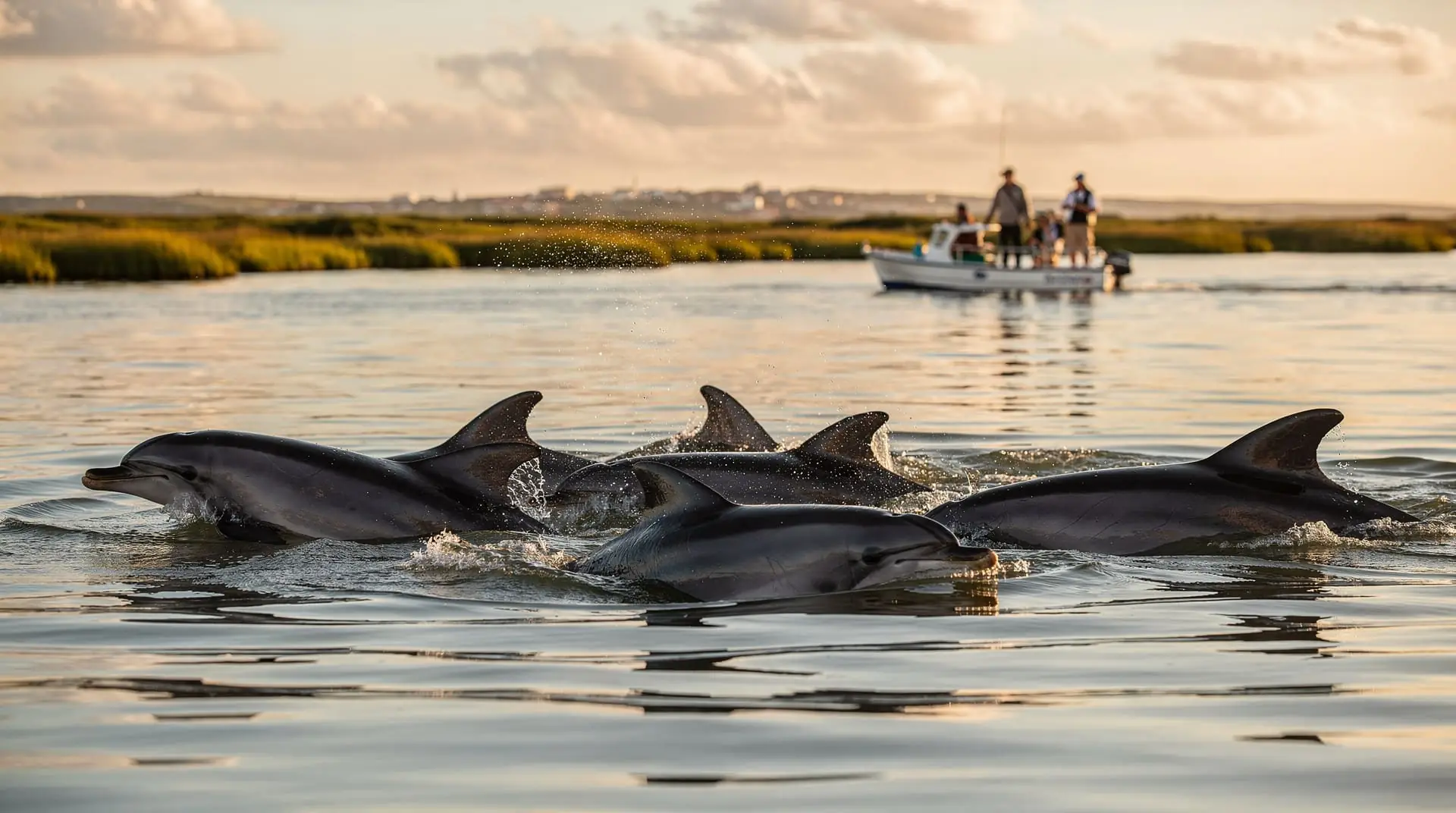
Dolphin watching in Setúbal: Sado estuary pods, tours and best season
Dolphin watching in Setúbal Sado estuary: resident bottlenose pod, eco-tour operators, best season Apr–Oct, what to expect, cancellations.
Ready to book? Top tours for this guide
We earn a small commission if you book through GetYourGuide — at no extra cost to you. Every tour is hand-picked and verified.

Lisbon: 48-Hour Hop-On-Hop-Off Bus Tour and Oceanarium Entry
Lisbon: MAAT Entry Ticket & Dolphin Watching Boat Tour
Lisbon: Alfama, Mouraria Walking Tour with Fado Night, Tapas
Lisbon: Hop-On Hop-Off Bus Tour
Lisbon: 1-or 2-Day Hop-On Hop-Off Bus Tour