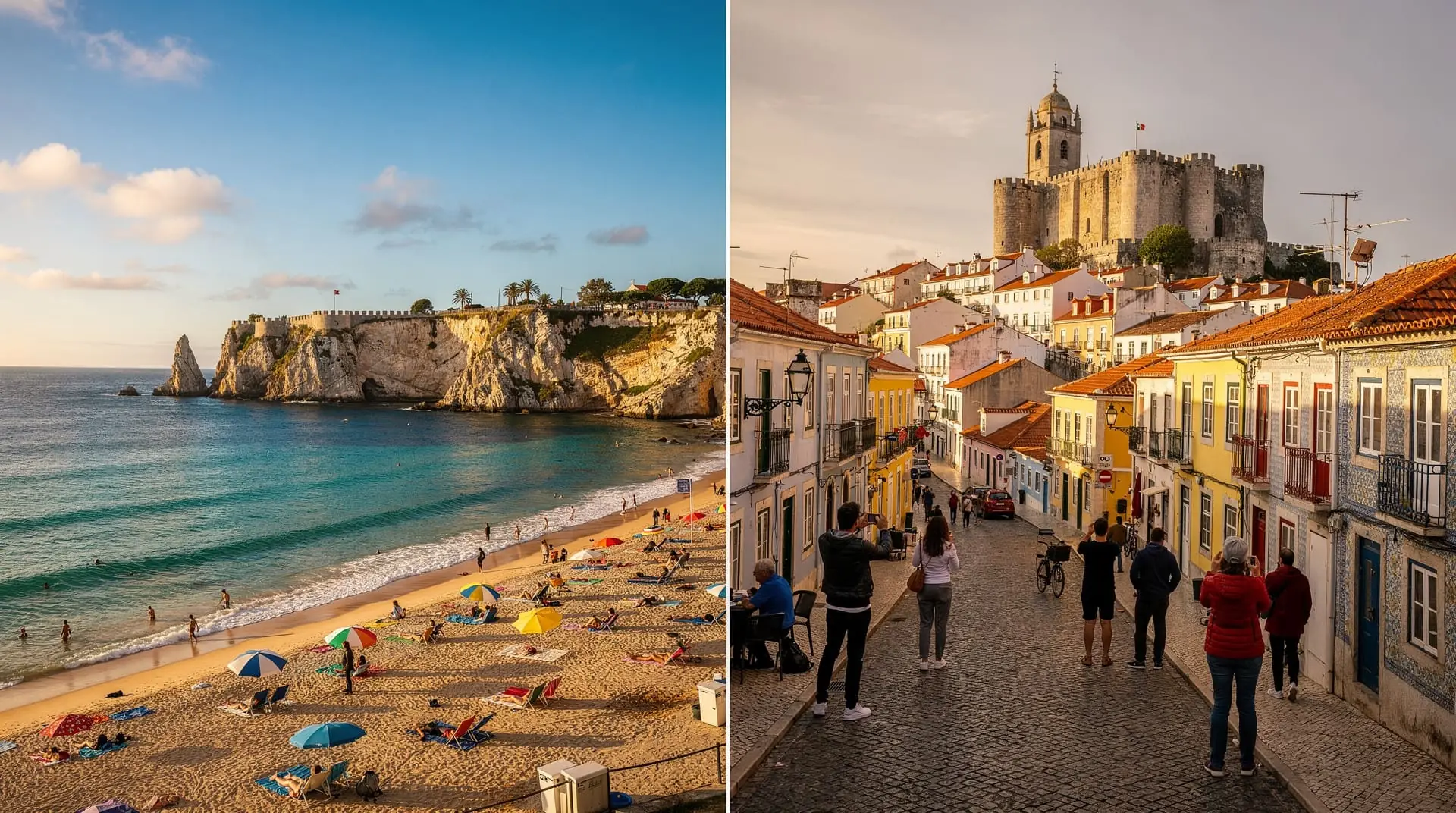
Which day-trip from Lisbon is right for you?
Last reviewed
What is the best day-trip from Lisbon?
For first-timers, Sintra is non-negotiable. Second visit? Évora for the Roman ruins and bone chapel. Foodie trip? Setúbal peninsula and Arrábida. Family beach day? Cascais. Travelling with kids who want a storybook town? Óbidos. Religious pilgrimage? Fátima. Each of these is under 2 hours from Lisbon.
Six excellent day-trips and how to choose between them
Lisbon is unusually well served for day-trips. Within two hours by public transport or car, you have one of Europe’s finest palace complexes, a Roman-era walled city, a natural park with turquoise Atlantic coves, a medieval fortified village, the world’s most visited Marian shrine, and a beach resort with a casino. Most visitors have time for two day-trips at most. This guide is the flowchart.
| Where | Sintra, Cascais, Évora, Arrábida/Setúbal, Óbidos, Fátima |
| Cost | €25-90 per person depending on destination and independent vs tour |
| Time needed | Full day for each; half-day possible for Cascais or Óbidos |
| Getting there | Train (Sintra, Cascais), bus (Évora, Fátima, Óbidos), car or tour (Arrábida) |
| Booking | Book Sintra palace tickets and Arrábida tours in advance, especially summer |
If this is your first time in Portugal → Sintra
Sintra wins by default for first-timers. It is the postcard image of Portugal — Pena Palace in yellow and red above Atlantic clouds, the narrow streets of the village below, eucalyptus forests on every slope. It is UNESCO-listed. It is genuinely extraordinary. And it takes a full day to do properly.
The logistics brief: Train from Rossio station (40 min, €2.45 one-way). Bus 434 or 435 from the station to Pena Palace (€5 each way, buy at machine). Pena Palace ticket €17.50 — book online in advance, not on the day. Quinta da Regaleira €10, also book ahead. Allow 5-6 hours minimum; 7-8 is better.
The honest warning: Sintra in July or August without pre-booked tickets is miserable — bus queues of 45 minutes, palace queues of another hour. Read Sintra crowds and parking before you go. Dawn arrival (first train, around 7am) transforms the experience.
Full-day Sintra tour from Lisbon with entry tickets includedSee the full Sintra day-trip guide and Sintra without a car for detail.
If you have already done Sintra → Évora
Évora is Lisbon’s most underrated day-trip. It sits in the Alentejo plains 90 minutes east by bus — a medieval city still mostly inside its Roman walls, with a 1st-century Roman temple improbably intact in the centre, a 16th-century Cathedral, a bone chapel (Chapel of Bones / Igreja de São Francisco) lined with 5,000 human skulls and femurs, and Alentejo cuisine at its most honest.
The logistics brief: Rede Expressos buses from Lisbon Sete Rios (and some from Oriente) to Évora, 1h45 min, roughly every 2 hours, €12-14 each way. Book online at rede-expressos.pt. Depart 8:30am, arrive 10:15am, explore until 5pm, last bus back around 7:30pm. Alternatively, organised tours include a driver and often a wine tasting near Reguengos de Monsaraz.
What to see: Roman Temple (free, outdoor), Cathedral (€4 to climb the roof), Chapel of Bones €5, Praça do Giraldo for lunch at one of the pork-heavy Alentejo restaurants. The megalithic sites (Almendres Cromlech, 15 km outside town) are worth an afternoon but require a car or taxi.
Évora and Megaliths full-day tour from LisbonSee the full Évora day-trip guide.
If you are a foodie → Setúbal and Arrábida
The Setúbal peninsula south of Lisbon is Portugal’s best-kept food and wine secret. The Arrábida Natural Park has beaches rivalling anything in the Algarve (turquoise, limestone cliffs, cold-clear Atlantic water). The Setúbal region produces Moscatel wine and fresh seafood at genuinely non-touristy prices. Azeitão village has artisan cheese (queijo de Azeitão — a runny sheep’s milk washed-rind cheese). This is where Lisboetas go when they want to eat seriously.
The logistics brief: Car is the best option — 40 minutes on the A2 to Setúbal, another 20 to the Arrábida coast. Without a car: organised tours from Lisbon, or train to Setúbal (1h from Roma-Areeiro) then taxi/local bus. The best beaches (Portinho da Arrábida, Galapinhos) are inaccessible by public transport — a car or tour is essentially mandatory.
What to eat: Choco frito (fried cuttlefish) in Setúbal, cheese at a quinta in Azeitão, fresh grilled fish in Sesimbra, Moscatel de Setúbal with dessert.
Arrábida Natural Park and Sesimbra day trip from LisbonSee Setúbal and Arrábida day-trip and dolphin watching.
For a family beach day → Cascais
Cascais is the easiest day-trip from Lisbon and the best choice when you need a stress-free day with children or when you simply want to turn off the tourist-planning brain. The train from Cais do Sodré runs every 20 minutes and drops you 5 minutes from the main beach. No booking required for anything. The beach is safe for swimming, there are restaurants at all price points, and the coastal path to Boca do Inferno (sea arch) is one of the nicer 2 km walks in the Lisbon area.
Cost: Return train €4.90. Beach is free. Budget €25-40 for food and an ice cream.
For a longer beach option: 10 km west of Cascais is Praia do Guincho — long, wild, facing the open Atlantic, backed by dunes. Best reached by taxi from Cascais (€12-15 each way) or rental bike. It is a surf beach; swimming conditions vary.
See Cascais day-trip guide and best beaches near Lisbon.
With kids who want a storybook → Óbidos
Óbidos is a medieval fortified village 80 km north of Lisbon, completely enclosed by intact 13th-century walls. You walk the ramparts. The streets are whitewashed with blue and yellow azulejo borders. The main product sold in every doorway is ginjinha (sour cherry liqueur) served in tiny chocolate cups. It is, objectively, extremely cute. For children who respond well to “this is what it looked like in the Middle Ages,” it is perfect.
The honest assessment: Óbidos is small. Two or three hours covers it comfortably. It pairs well with Nazaré (giant waves — surfable in winter, dramatic from the cliffs) or Fátima on the same day. Solo as a full-day trip it feels thin. Many organised tours combine two or three of these.
The logistics brief: Rede Expressos bus from Campo Grande station, around 80 minutes, €8-10 each way. Or an organised tour combining multiple sites.
From Lisbon: Nazaré and Óbidos day tripFor a pilgrimage → Fátima
Fátima is one of Catholicism’s most important Marian shrines — the site of the 1917 apparitions of Our Lady of Fátima to three shepherd children. Around 6 million pilgrims visit annually. The basilica complex is enormous and surprisingly moving even for secular visitors. The atmosphere on major feast days (13th of each month, May and October especially) is extraordinary.
The honest assessment: Fátima the town exists almost entirely for religious tourism. Outside the basilica complex, there is not much there. If you are making a genuine religious visit or are deeply interested in 20th-century Catholic history and the connections to Portuguese politics (Salazar used Fátima heavily in Estado Novo propaganda), it is genuinely worthwhile. For purely sightseeing purposes, Évora or Sintra offers more.
The logistics brief: Rede Expressos buses from Sete Rios (2 hours). Or combine with Batalha Monastery (stunning Manueline Gothic) and Nazaré on an organised tour.
From Lisbon: Fátima, Batalha, Nazaré and Óbidos full-day tourThe comparison at a glance
| Day-trip | Best for | Train/bus time | Advance booking? | Budget (independent) |
|---|---|---|---|---|
| Sintra | First-timers, palace lovers | 40 min (train) | Essential | €55-80 |
| Cascais | Beach, families, easy day | 40 min (train) | No | €25-50 |
| Évora | History, food, second visit | 1h45 (bus) | Recommended | €35-55 |
| Arrábida | Beaches, seafood, nature | 60-90 min + taxi | For tours: yes | €60-90 (tour) |
| Óbidos | Families, medieval villages | 80 min (bus) | No | €25-40 |
| Fátima | Pilgrims, religious interest | 2h (bus) | Recommended | €30-50 |
A note on combining day-trips
The Sintra → Cascais loop (bus 403) is the classic combination and works well with an early start. See Sintra vs Cascais for the logistics.
Nazaré + Óbidos are routinely combined into a single day (tours, or self-drive). Fátima + Batalha + Nazaré + Óbidos is ambitious but doable on an organised tour.
Évora pairs with the Alentejo megalithic circuit (Almendres Cromlech) or Monsaraz village — both require a car.
For the full transport breakdown — trains, buses, which tours are worth the price — see day-trip transport from Lisbon and use our day-trip matcher tool to narrow down based on your dates and interests.
Frequently asked questions about choosing a day-trip from Lisbon
What if I only have one day for a day-trip?
Go to Sintra if you have not been. Arrive on the first train (Rossio, around 7am in summer), pre-book Pena Palace online. If you have already seen Sintra, Évora is the runner-up for a single impactful day.
Are day-trips better by car or public transport?
For Sintra and Cascais: public transport is better — parking is a nightmare, especially at Sintra. For Évora: bus is excellent. For Arrábida: car or organised tour wins clearly. For Fátima and Óbidos: bus works fine.
Which day-trip is most worth it with a guide?
Sintra (the guide handles tickets and logistics under time pressure) and Évora (the context for Roman and medieval history makes the visit far richer). Cascais does not need a guide.
How far are these day-trips from Lisbon?
Sintra: 28 km. Cascais: 33 km. Évora: 130 km. Setúbal: 50 km. Óbidos: 80 km. Fátima: 130 km.
What is the best day of the week for day-trips?
Weekdays. Sintra especially becomes significantly more manageable Tuesday to Thursday. Mondays are awkward — some attractions are closed (many Portuguese museums close Mondays). Weekends in summer at Sintra are brutal.
Is there a free day-trip from Lisbon?
The train to Cascais costs €4.90 return, and the beach is free. The coastal walk from Cascais to Boca do Inferno is also free and beautiful. That is the closest thing to a free day-trip from Lisbon.
Can I visit multiple day-trip destinations in a week-long trip?
Two is comfortable; three is possible but tiring. Plan: Day 1-4 Lisbon city, Day 5 Sintra, Day 6 free or Cascais, Day 7 rest or Évora. Cramming more than two day-trips into a 7-day Lisbon trip risks exhaustion and rushed visits.
Budget vs guided: which day-trips actually need a tour
Not every destination here benefits equally from an organised tour. Sintra and Cascais are entirely doable independently and often cheaper that way, with the tour’s main value being ticket queue-skipping at Pena Palace. Évora and Fátima work well independently by bus if you’re comfortable with Portuguese bus schedules, though a tour adds context (Évora) or combines multiple sites efficiently (Fátima with Batalha and Nazaré). Arrábida is the clearest case for a tour — the best beaches are genuinely hard to reach without a car, and a tour solves that in a way independent travel can’t easily match. See the day-trip transport guide for the full independent-vs-tour cost breakdown on each route.
Matching day-trips to the season
Some of these day-trips shift meaningfully with the season, beyond the obvious summer-crowds factor.
| Season | Best day-trip pick | Why |
|---|---|---|
| Summer (Jun-Aug) | Cascais or Arrábida | Beach weather; Sintra is brutal without pre-booked tickets |
| Autumn (Sep-Oct) | Évora | Harvest season in the Alentejo, comfortable walking temperatures |
| Winter (Nov-Feb) | Évora or Fátima | Interior sites work well in cooler, rainier weather; Sintra’s palace interiors also hold up |
| Spring (Mar-May) | Sintra | Gardens and forests at their greenest, before peak crowds |
What locals do differently
Lisboetas treat Cascais and the Arrábida coast as their own weekend escape rather than a tourist day-trip, which is worth knowing if you want to time your visit around when it’s quieter. Locals avoid Sintra almost entirely in summer, going instead in the shoulder seasons or very early on weekday mornings — the same strategy visitors should adopt. For Évora, a weekday visit means sharing the Chapel of Bones with far fewer coach groups than a Saturday.
Related guides

Sintra vs Cascais: which day-trip should you pick?
Sintra offers palaces and hills but costs time and crowds. Cascais offers beaches and a marina and half the effort. Pick the right one for your trip.
Lisbon vs Porto: which Portuguese city should you visit?
Honest head-to-head: vibe, weather, food, wine, day-trips and budget. Which city wins for your trip — and when to visit both.
Fado houses compared: which one should you book?
Side-by-side comparison of Lisbon's main fado venues: atmosphere, price, quality and tourist-trap risk. Honest picks for every budget.
Lisboa Card vs paying separately: is it worth it?
Worked break-even examples for 1, 2 and 3-day Lisboa Cards. Honest verdict: who saves money and who pays more.
Ready to book? Top tours for this guide
We earn a small commission if you book through GetYourGuide — at no extra cost to you. Every tour is hand-picked and verified.

Lisbon: 48-Hour Hop-On-Hop-Off Bus Tour and Oceanarium Entry
Lisbon: MAAT Entry Ticket & Dolphin Watching Boat Tour
Lisbon: Alfama, Mouraria Walking Tour with Fado Night, Tapas
Lisbon: Hop-On Hop-Off Bus Tour
Lisbon: 1-or 2-Day Hop-On Hop-Off Bus Tour