Parque das Nações
Parque das Nações is Lisbon's Expo '98 district — the Oceanário, cable car, MEO Arena, modern architecture and a flat 7 km riverside walkway.
Quick facts
Top tours and experiences
We earn a small commission if you book through GetYourGuide — at no extra cost to you. Every tour is hand-picked and verified.
Lisbon: 48-Hour Hop-On-Hop-Off Bus Tour and Oceanarium Entry
Lisbon: MAAT Entry Ticket & Dolphin Watching Boat Tour
Lisbon: Alfama, Mouraria Walking Tour with Fado Night, Tapas
Lisbon: Hop-On Hop-Off Bus Tour
Lisbon: 1-or 2-Day Hop-On Hop-Off Bus Tour
Lisbon: Boat Tour Ticket and Hop-on Hop-off 48-Hour Bus
Parque das Nações is the newest part of Lisbon. Built for the 1998 World Exposition on a former industrial wasteland and fuel depot on the eastern Tagus bank, the district was designed from scratch: wide promenades, modernist pavilions, no cobblestones, no hills. It is the only part of Lisbon where you can walk 7 km along the river without climbing a single step.
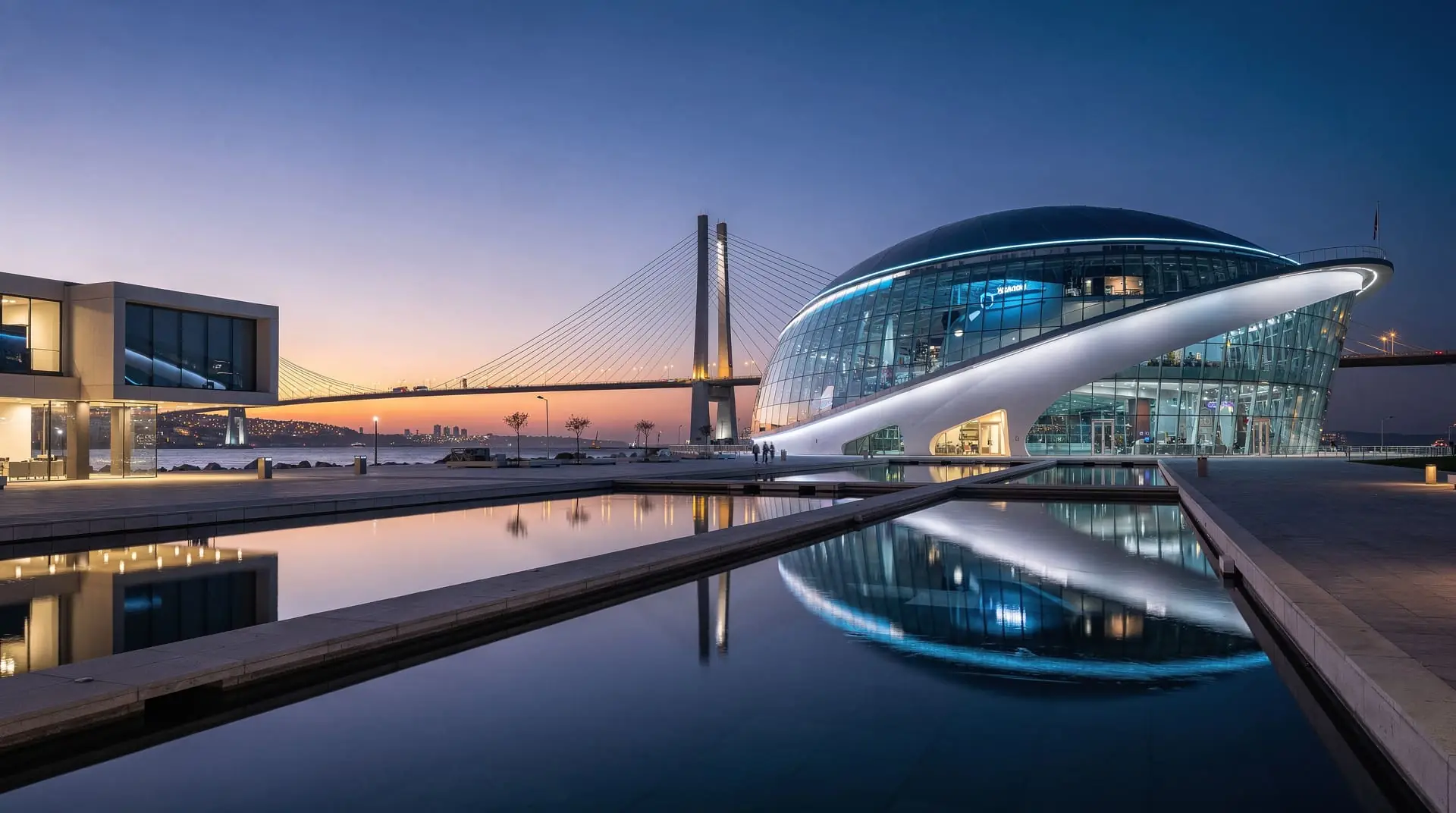
The Expo’s central pavilion (now Pavilhão de Portugal, designed by Álvaro Siza Vieira) and Gare do Oriente train station (Santiago Calatrava) are genuine works of contemporary architecture — worth seeing even if the district as a whole feels more like a European business park than a neighbourhood. The Oceanário is the standout attraction: one of Europe’s finest aquariums, and the single best reason to come here.
Most Lisbon visitors spend two to four days in the historic centre and never reach Parque das Nações. It is worth a half-day, particularly for families.
Getting there
Metro red line — the simplest option. Board at Aeroporto (airport), São Sebastião, or Alameda and ride to Oriente station. Journey from Alameda is about 8 minutes; from the airport, directly 5 minutes. The metro runs every 4–8 minutes during the day.
Oriente station is a destination in itself — Calatrava’s steel-and-glass structure is one of the most photographed train stations in Europe. Worth 10 minutes of looking before heading out to the waterfront.
From the city centre — about 8 km from Baixa. The metro is by far the easiest option (no direct tram or bus route that competes). A taxi or Uber takes 15–25 minutes (€12–15) depending on traffic.
If arriving at the airport — Parque das Nações is 5 minutes on the metro (one stop). Conveniently positioned for a first afternoon if you arrive in the morning, before checking into accommodation in the centre.
What to see and do
Oceanário de Lisboa
The Oceanarium is consistently one of the best-reviewed attractions in Lisbon — and one of the most expensive (€21 adults, €14 under-13). The main tank is a large central ocean habitat visible from four sides at different levels: a single school of fish moving through open water, with sharks, manta rays, and sunfish. Surrounding satellite tanks recreate the Atlantic, Pacific, Indian, and Antarctic ocean ecosystems.
Crowds peak between 11:00 and 15:00. Book tickets online — same price but no queue at the desk. An early slot (09:00 opening) or late afternoon entry (after 16:00) is significantly less crowded.
Plan 1.5–2 hours inside. Children under 5 are free. The aquarium is almost entirely accessible for wheelchairs and pushchairs — a rare characteristic in Lisbon.
Oceanário de Lisboa entrance ticket — book online to skip the desk queue. Worthwhile year-round for families.
Teleférico (Cable car)
The cable car runs 1.2 km along the waterfront between Torre Vasco da Gama and Feira Internacional de Lisboa. Journey time is about 10 minutes one way (€6 single, €9 return). The views are good but not spectacular — the river, the Vasco da Gama bridge (Europe’s longest at 17.2 km), and the Oceanarium building below. More of an activity than a viewpoint; good for children and as a gentle orientation exercise.
The cable car runs approximately 10:00–19:00 (longer in summer), weather permitting.
Torre Vasco da Gama
The 145-metre Vasco da Gama tower is the district’s most visible landmark — it was the Expo’s signature structure and now houses a hotel (Myriad by Sana). Non-guests cannot access the top. Worth seeing from outside.
Architecture walk
The district was designed with architectural ambition. The main points:
- Gare do Oriente (Calatrava, 1998) — the station concourse’s steel tree columns are the highlight. Ground floor is purely functional (trains, taxis, buses); go to the upper level for the full canopy effect.
- Pavilhão de Portugal (Álvaro Siza Vieira, 1998) — the extraordinary suspended concrete “sail” canopy between two porticoes. The concave curve of a concrete slab 70 m wide held only at its edges is a structural achievement.
- Pavilhão Atlântico (MEO Arena, 1998) — now the main concert venue. The egg-shaped structure by Regino Cruz, faced with curved steel, seats 20,000.
- Museu de Arte, Arquitectura e Tecnologia (MAAT) — technically in Belém, 10 km west, but often grouped with the Expo heritage.
Riverside park and cycling
The waterfront promenade extends 7 km along the Tagus from Oriente station south to the Vasco da Gama bridge. Completely flat and paved. Good for cycling (rentals available at several points from €5/hour), jogging, or walking. The gardens between the promenade and the pavilions are well-maintained. At the south end, Jardim do Tejo is a quiet park with good river views and relatively few tourists.
MEO Arena and events
The MEO Arena (formerly Pavilhão Atlântico) is Portugal’s largest indoor venue — 20,000 capacity for concerts, 10,000 for sports. It hosts international touring acts, EuroLeague basketball, and domestic sporting events. If you are in Lisbon during a major concert or event, the arena is straightforward to reach by metro (Oriente, one minute’s walk). Check the venue’s programme before your trip; it occasionally provides a compelling reason to spend an evening in Parque das Nações.
The surrounding restaurants increase in price significantly on event nights — arrive early (before 19:00) or eat elsewhere and come in for just the show.
Where to eat
The waterfront has a concentration of restaurants ranging from chains to upmarket seafood. Independent options:
Restaurante Laurentina (Avenida Conde Valbom — technically not in the district but worth noting as a nearby bacalhau specialist if you extend your visit north) — well outside the tourist circuit.
Tasca do João (Rua de Moscavide) — a neighbourhood tasca 10 minutes’ walk from the waterfront, daily specials for €10–12, packed with locals working in the district.
Centro Comercial Vasco da Gama — the large mall adjacent to Oriente has a food court with chain restaurants and a decent supermarket. Convenient if travelling with children.
Eleven — not in Parque das Nações but worth noting: it is Joachim Koerper’s Michelin-starred restaurant on Avenida da Liberdade, about 15 minutes by taxi. The best cooking near the district’s hotel cluster.
For the waterfront restaurants at the north end of the promenade: quality is variable and prices reflect the location rather than the food. Stick to simpler dishes (fish, shellfish) and check the menu before sitting.
Where to stay
Parque das Nações has the largest and most modern hotels in Lisbon — convenient for the airport and the Fairs complex, less interesting for exploring the historic centre.
Myriad by Sana Hotels (Torre Vasco da Gama) — the most distinctive address: rooms inside the tower with river views. ~€200–350/night. Rooftop restaurant is one of the best viewpoints in the city.
Wyndham Grand Algarve equivalent options — the district has several international chain 4-stars around Gare do Oriente at €120–200/night.
Ibis and Ibis Styles at Oriente — budget options at €80–120/night, very near the metro. No character but excellent logistics.
Staying here suits people with early flights, attending events at MEO Arena, or with children who need a quieter, flat neighbourhood. For everything else, the city centre is more interesting.
Jardins Garcia de Orta and the waterfront gardens
Between the Oceanarium and the Vasco da Gama tower, the Jardins Garcia de Orta take their name from the 16th-century Portuguese naturalist and physician. The gardens are thematic — divided into sections representing the territories once connected by Portuguese maritime trade: Brazil, Africa, India, Macau. Unusual plants, good shade, interpretation panels in Portuguese and English.
This part of the waterfront is also the start of the cycling path that runs south along the river, eventually connecting to the Tagus Estuary Nature Reserve — a completely different Lisbon from the tourist circuit. Renting a bike at the Parque das Nações cycleshare points and heading south for 5–10 km gives access to wetland birdwatching and empty riverside paths that few visitors ever see.
On weekends, the waterfront between Oriente and the Vasco da Gama tower fills with Lisbon families: runners, cyclists, people with dogs, children on kick scooters. It is the city at its most relaxed and unpretentious. Quite different from a weekday, when the district is dominated by office workers and conference attendees.
Honest tips
The scale — Parque das Nações is a large, spread-out area. Distances between things look shorter on a map than they feel on foot in direct sun. Wear comfortable shoes and bring water in summer.
Weekdays vs weekends — on weekdays the Oceanarium is manageable. On Saturday and Sunday mornings in school holidays it is very busy; book the earliest time slot.
Combining with the airport — if you arrive on an early morning flight with luggage, this is the only Lisbon district where you can leave a bag in a locker (Gare do Oriente has left-luggage facilities) and spend the morning sightseeing before checking in. The airport transfer guide covers logistics.
The megarail connection — Oriente is Lisbon’s main intercity train station. High-speed services to Porto (1h15 on Alfa Pendular) depart from here, not Rossio. If you are taking a day trip to Porto by train, add the architecture detour at no extra cost.
How it fits your Lisbon itinerary
Parque das Nações works best as a dedicated half-day slot rather than something tacked onto a full day elsewhere. The most logical combinations:
With the airport arrival day — if you land before noon, drop luggage at Oriente left-luggage, spend the afternoon at the Oceanarium and riverside, then take the metro to your accommodation in the centre. Avoids the mistake of arriving exhausted and immediately tackling Alfama’s hills.
As a family day — Oceanarium in the morning, cable car after lunch, riverside park in the afternoon. Children tolerate the modern architecture walk better than most grown-up itineraries.
As a contrast to the historic centre — after two days in medieval Alfama and Pombaline Baixa, the flat, car-free, rational design of Parque das Nações is a deliberate gear-change. Some visitors find the contrast refreshing; others find it soulless. Both reactions are legitimate.
Parque das Nações does not belong in a 2-day Lisbon stay — there is simply too much more important historic city to see. It belongs in a 4–5 day trip, slotted alongside one of the day trips. If you are going to Sintra or Cascais on days 3–4, use Parque das Nações for the afternoon of day 4 before an early flight.
The Lisbon 4-day itinerary positions Parque das Nações on the final afternoon, after Belém in the morning. The Lisbon with kids itinerary devotes more time here, combining the Oceanarium with a morning bus to Belém.
Frequently asked questions about Parque das Nações
Is Parque das Nações worth visiting?
For families with children: yes, primarily for the Oceanarium, which is genuinely excellent. For visitors without children: maybe. The architecture is interesting, the riverside walk is pleasant, but the district lacks the texture and history of the older city. Allocate half a day if you have a 3+ day stay.
How do I get to the Oceanarium from the city centre?
Metro red line to Oriente (8 minutes from Alameda, 20 minutes from Baixa-Chiado). Walk 10 minutes from the station south along the waterfront to the Oceanarium. Or take an Uber (€10–12 from Baixa, 15–20 minutes).
Can I walk from the city centre to Parque das Nações?
It is 7–8 km and takes around 1.5 hours on foot through mostly unremarkable urban fabric. Possible in good weather but not the best use of time. The metro is 8–12 minutes.
Is the cable car worth doing?
It is a pleasant 10-minute ride rather than a must-do. Children enjoy it. The views are good but not comparable to the historic city viewpoints. Do it if you are already in the district and it fits your budget (€9 return).
What is the best time to visit the Oceanarium?
Either first thing at opening (09:00) or after 16:00. The 11:00–15:00 slot is most crowded. Book online in advance regardless of timing — the desk queue can add 20–30 minutes even out of peak hours.