Cabo da Roca
Cabo da Roca: the westernmost point of continental Europe. Dramatic cliffs, a historic lighthouse and honest wind warnings.
Quick facts
Top tours and experiences
We earn a small commission if you book through GetYourGuide — at no extra cost to you. Every tour is hand-picked and verified.

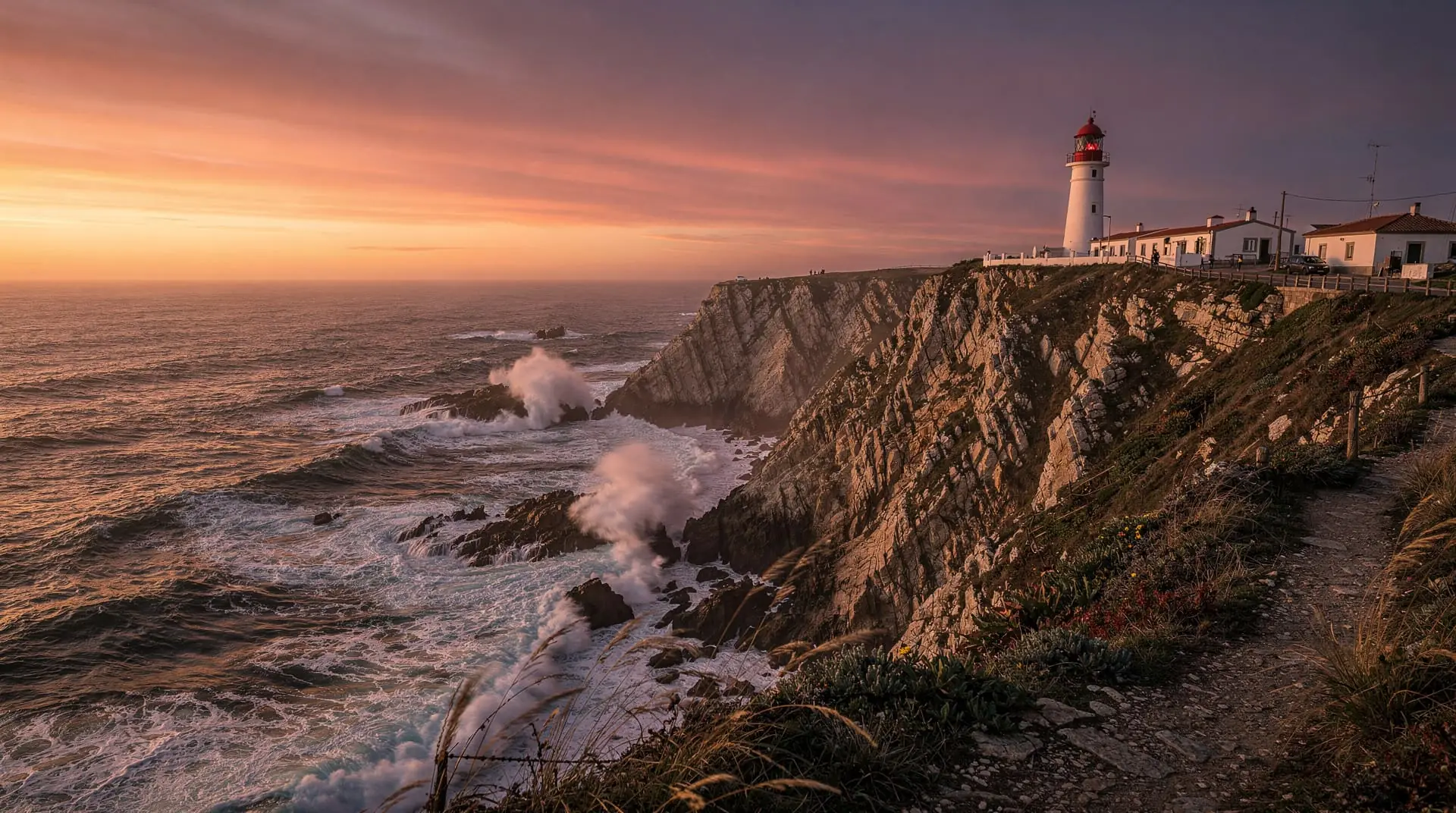
At 38°47’N, 9°30’W, Cabo da Roca is the westernmost point of continental Europe — the place where, as the 16th-century poet Luís de Camões wrote, “the land ends and the sea begins.” The cliffs drop 140 metres straight to the Atlantic. When the wind is up (and it usually is), the spray carries half a kilometre inland. There’s a lighthouse, a small visitor centre, a café, and a stone monument marking the coordinates. Nothing else.
This simplicity is the point. Among all the destination options in the Sintra-Cascais area, Cabo da Roca is the most elemental — just sea, rock, wind, and the fact of being at the edge of a continent. Whether you find that profound or anticlimactic depends on what you bring to it. Arrive in morning light before the tour buses, stand on the cliff edge with the Atlantic in front of you, and most people find it worth the journey.
| Where | 140m cliffs, westernmost point of continental Europe |
| Cost | Free entry; certificate €6 |
| Time needed | 1–2 hours |
| Getting there | Bus 403 from Sintra or Cascais, or car via N247 |
| Best time | Morning, before 11am, for calmer wind and better light |
Why go to Cabo da Roca
The geographic fact — westernmost point of continental Europe — is the draw that gets people here. The experience, if conditions cooperate, exceeds the expectation. The combination of height (140 metres of sheer cliff) and horizontal distance (the next land westward is North America, more than 5,500 km away) creates a genuine sense of exposure that photographs don’t fully capture.
The flora along the cliffs adds another dimension. The Serra de Sintra’s UNESCO Natural Park designation protects this coastline, and the scrubby vegetation — lavender, rockrose, wild thyme, gorse — clings to the clifftops and scents the air even when the wind strips it. In spring (March–May), the wildflower display is exceptional.
The lighthouse dates to 1772, one of the oldest on the Portuguese coast. The stone pillar near the car park bears an inscription of Camões’ verse and the coordinates; most visitors photograph it.
The visitor centre sells the certificado da extremidade do mundo — a certificate declaring that you stood at the westernmost point of continental Europe. €6, and obviously a tourist souvenir, but more dignified than most.
Getting to Cabo da Roca
Bus 403 — the only public transport option
Bus 403 (Scotturb) runs between Cascais bus terminal and Sintra station via Cabo da Roca. This is the key public transport link that makes the Sintra–Cabo da Roca–Cascais day circuit possible without a car.
From Cascais: roughly 40–50 minutes to Cabo da Roca. From Sintra: roughly 40 minutes. The bus runs roughly every 40–70 minutes depending on the season — check the current Scotturb schedule at scotturb.com before you go, as timing can change. The stop at Cabo da Roca is well-signed.
Return options: continue to Sintra or Cascais by bus, or take the same bus back. If you’re doing the classic circuit (Sintra palaces in the morning, Cabo da Roca en route, Cascais in the afternoon), the direction Sintra → Cabo da Roca → Cascais makes the most sense logistically.
Our Sintra without a car guide maps the full public transport circuit in detail, including the train from Lisbon, bus to the palaces, and bus 403 to the cape. The trains to Sintra and Cascais guide covers the rail connections that bookend this bus route.
By car
Driving is straightforward: the N247 from Sintra or the N247-3 from Cascais both reach the cape. There’s a free car park at the viewpoint. On summer weekends, it fills by mid-morning; the overflow park is 500 metres back on the road. Arriving before 9:30 AM avoids the problem. Our driving and parking guide covers the western Sintra coast roads in more detail.
On an organised tour
Most Sintra day trips from Lisbon include Cabo da Roca as a stop — typically 30–45 minutes at the viewpoint before continuing to Cascais.
Sintra, Cabo da Roca and Cascais combined day tour from LisbonWhat to see and do at Cabo da Roca
The cliff viewpoints
The main viewpoint is directly in front of the lighthouse, at the cliff edge. A second path leads south along the clifftop for about 400 metres to a quieter, less-photographed viewpoint — worth taking if you want to escape the main crowd. No fencing in many sections; keep well back from the edge, particularly if the ground is wet or the wind is strong.
The lighthouse
The lighthouse itself (working, not open to visitors) is the most prominent landmark. Its beam covers a range of 26 nautical miles; visible from ships approaching from the Atlantic. The walls carry the marks of several centuries of Atlantic storms.
The Sintra Natural Park coastal walk
If you have time and energy, the clifftop path north from Cabo da Roca (toward Azenhas do Mar and beyond) is one of the finest coastal walks in the Lisbon region — wild, undeveloped, largely free of other walkers outside summer weekends. The walk to Azenhas do Mar village (famous for its cliff-edge sea pool) takes about 2 hours one way on rough coastal paths. Not a casual stroll; proper footwear is essential.
Praia Grande and Praia das Maçãs
Two Atlantic beaches lie about 5 km north of Cabo da Roca (accessible by car or a further bus stop on different lines). Praia Grande is long and exposed — good surf but serious waves; Praia das Maçãs is calmer and has summer tram access from Sintra (a historic narrow-gauge tram that runs in summer, worth taking in itself). These beaches are also worth combining with a visit to the charming village of Azenhas do Mar, perched on the clifftop between Praia das Maçãs and Praia Grande, with a natural sea pool below the whitewashed houses.
Where to eat near Cabo da Roca
There’s a café at the viewpoint itself — hot drinks, sandwiches, reasonable prices for the location. For a proper meal, wait until you reach Cascais or Sintra.
One exception: Restaurante Carvalho at Azoia, a small village 2 km inland from the cape, serves excellent local food at very fair prices — fresh fish, good local wines, no tourist markup. Favoured by the locals from the surrounding area. Worth the small detour if you’re driving.
If you’re doing the full Sintra–Cabo da Roca–Cascais circuit on public transport, your lunch timing will likely be in Cascais — where the fishing harbour restaurants are among the best on the coast. See the Cascais destination guide for specific restaurant recommendations near the waterfront.
Honest tips: what to actually expect
It is almost always windy. This is not a warning to ignore. The cape sits at the convergence of Atlantic swell from the northwest and the thermal gradient between the Serra de Sintra and the sea. Even on calm summer days in Lisbon, Cabo da Roca often has 30–40 km/h winds. In winter, gusts can exceed 80 km/h. Bring a windproof outer layer, even in July.
It’s not a beach. Some visitors arrive expecting to swim. The cliffs make this impossible at the cape itself. The nearest beaches (Praia Grande, Praia das Maçãs) are 5 km north, and they are serious Atlantic surfing beaches, not calm swimming spots. For a beach near the cape, return to Cascais.
30 minutes is enough, 90 minutes is plenty. The viewpoints, the monument, the lighthouse and a walk along the clifftop — you’ve seen the best of it in under 2 hours. This is not a destination to linger at for a full afternoon; it’s a strong stop on the way between Sintra and Cascais.
The certificate: The certificado is a legitimate souvenir and the money supports the visitor centre. Buy it if you want a tangible memento of standing at the edge of Europe. Skip it if you find the concept slightly self-congratulatory — that’s also a valid position.
Photography: Morning light (before 11 AM) hits the lighthouse and cliffs from the east and is dramatically better than afternoon, when the sun is behind you from the sea side. Sunset shots require staying late and the bus schedule is thin in the evening — check the last bus time before committing.
For the broader honest picture of day-trip planning from Lisbon, our which day trip from Lisbon guide helps you compare options. Budget calculators and day-trip timing tools are also available in our tools section — in particular the day-trip matcher and Sintra ticket planner.
How Cabo da Roca fits into a day trip
Classic Sintra circuit (no car): Rossio train → Sintra (bus 434 up to Pena Palace and Moorish Castle, morning) → bus 403 from Sintra to Cabo da Roca (45 min stop) → bus 403 continues to Cascais (seafood lunch, afternoon beach) → train back to Lisbon from Cascais. Total: a full, satisfying day with no car.
Cascais extension: If you’re based in Cascais, a half-day trip to Cabo da Roca by bus (bus 403, 40 min) works easily — leave at 9 AM, spend 2 hours at the cape, return for lunch in Cascais.
With a car: Combine Cabo da Roca with Praia Grande, Azenhas do Mar, the western Sintra coast and Colares village in a scenic loop that doesn’t work well on public transport. Check our Sintra Cascais Natural Park guide for these less-visited western coast spots.
Pena Palace, Moorish Castle, Monserrate and Cabo da Roca tourFor the full context on this region, see the Sintra Cascais coast itinerary and the Sintra Natural Park guide.
Wind and weather by season
| Season | Typical wind | Crowds | Notes |
|---|---|---|---|
| Spring (Mar–May) | Moderate–strong | Low–moderate | Best wildflower display on the cliffs |
| Summer (Jun–Aug) | Strong, near-constant | High, especially midday | Tour buses peak 11:00–15:00 |
| Autumn (Sep–Oct) | Moderate–strong | Low | Good light, fewer crowds than summer |
| Winter (Nov–Feb) | Strong, can exceed 80 km/h | Very low | Dramatic but genuinely exposed |
The wind is the one constant across every season — there is no time of year when Cabo da Roca is reliably calm, so the packing advice (windproof layer, always) applies whenever you go. What changes seasonally is really the crowd pattern and the light, not the exposure itself.
What people get wrong about the visit
The most common disappointment isn’t the wind or the crowds — it’s arriving expecting more than a viewpoint. Cabo da Roca has a lighthouse, a monument, a small visitor centre and a café; there is no village, no beach, and nothing resembling a half-day’s worth of activity on its own. Visitors who treat it as a standalone destination rather than a stop on the Sintra–Cascais route tend to feel shortchanged. Visitors who treat it as the dramatic 30–90 minute punctuation mark it actually is — between a morning at Sintra and an afternoon in Cascais — get exactly what the cape delivers. Setting that expectation before you go is the single biggest factor in whether the visit feels worthwhile.
A second, smaller mistake is underestimating how much the bus 403 timetable governs the visit. Unlike a car, which lets you leave whenever the cliffs stop being interesting, the bus dictates your window — miss one departure and the next can be 40–70 minutes away. Visitors doing the full public-transport circuit should check the timetable before leaving Sintra or Cascais and build in a buffer, rather than assuming a bus will simply appear when they’re ready to move on.
Frequently asked questions about Cabo da Roca
Is Cabo da Roca really the westernmost point of Europe?
Westernmost point of continental Europe, yes. There are islands further west — Flores in the Azores is the westernmost point of Portugal and of Europe overall. But on the European mainland, Cabo da Roca’s coordinates of 9°30’W are unmatched. Iceland’s Bjargtangar extends further west but is an island. The distinction matters to some people; most visitors are happy with “edge of Europe.”
How do I get to Cabo da Roca without a car?
Bus 403 (Scotturb) runs between Cascais and Sintra via Cabo da Roca, roughly every 40–70 minutes. From Cascais: 40–50 minutes. From Sintra: about 40 minutes. Check the Scotturb website for current timetables, as they vary by season. No direct bus from Lisbon — you connect through Sintra or Cascais.
How long should I spend at Cabo da Roca?
60–90 minutes is the ideal window: enough to walk the clifftop path, take in both main viewpoints, visit the lighthouse monument and have a coffee at the café. You can be in and out in 30 minutes if you’re on a tight schedule, but the cliff walk south of the main viewpoint is worth the extra 20 minutes.
Is it cold and windy at Cabo da Roca?
Almost always. The atlantic-facing cliffs channel wind that is 10–15°C cooler than Lisbon or the sheltered coast. Even in August, when Lisbon temperatures are 30°C+, the cape can feel cold in a windproof layer. Always bring a jacket. In winter, winds of 60–80 km/h are not unusual — still safe to visit, but exhilarating rather than comfortable.
Can I swim near Cabo da Roca?
Not at the cape itself — there’s no beach, only 140-metre cliffs. The nearest beaches are at Praia Grande (5 km north, serious surf beach) and Praia das Maçãs (7 km north, calmer). For calm swimming close to the Sintra–Cascais coast, Cascais town beaches are the most convenient option.
What is the certificate sold at Cabo da Roca?
The certificado da extremidade do mundo (“certificate of the end of the world”) is sold at the visitor centre for €6. It confirms your name, the date and your visit to the westernmost point of continental Europe. Not a legally meaningful document — simply a souvenir. Popular with groups of friends and families, and a small revenue stream for the visitor centre.