Belém Tower: tickets, queues and what to expect inside
Last reviewed
Do you need to book Belém Tower tickets in advance?
Yes, absolutely. Walk-up queues in high season (May–September) routinely reach 60–90 minutes. Buy a fast-track or timed-entry e-ticket online before you leave your hotel. The tower is small — only 30 people enter at a time — so the line moves slowly even on quiet days.
| Where | Riverside promenade, Belém, 6 km west of central Lisbon |
| Cost | €8 adult, €4 concessions, free under-12 |
| Time needed | 45-60 min visit, 90 min door-to-door in peak season |
| Hours | Tue-Sun 10:00-18:00 (17:00 Oct-Apr), closed Mondays |
| Booking | Essential April-October; book online, not at the door |
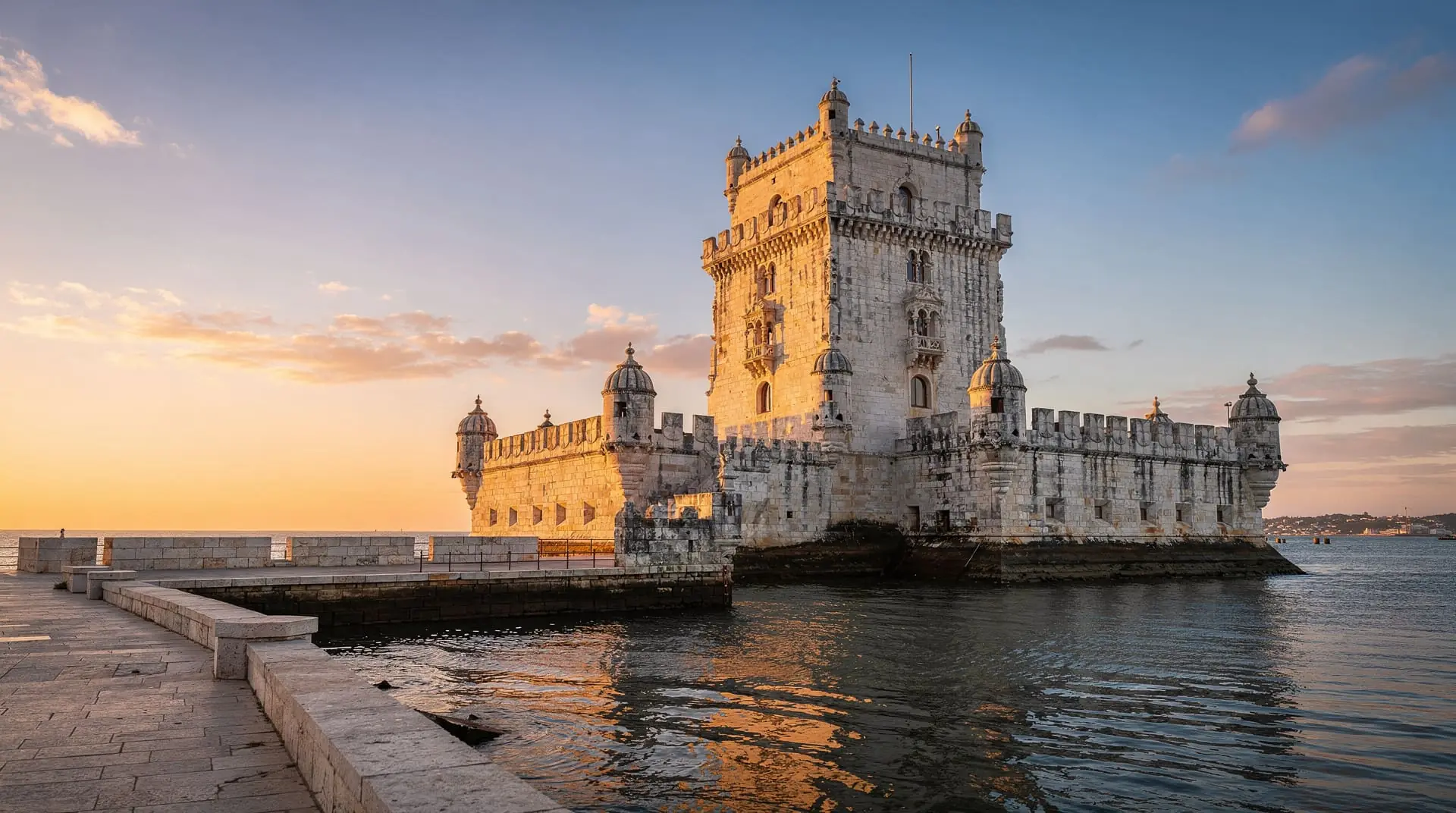
Belém Tower stands in the Tagus estuary like a stone chess piece, its Manueline carvings — armillary spheres, twisted rope, rhinoceroses — looking almost incongruously ornate for a military watchtower built in 1516. It is one of the most recognisable monuments in Portugal and, in high season, one of the most poorly managed in terms of visitor flow. This guide gives you the practical reality, not the brochure version.
What the tower actually is (and is not)
The Torre de Belém was built between 1516 and 1521 under Diogo de Boitaca and Francisco de Arruda to guard the mouth of the Tagus. Its job was to control river traffic entering Lisbon — it functioned as a customs post, an artillery battery and occasionally a prison. It was never a lighthouse.
The interior is genuinely cramped. There are five floors connected by a very narrow spiral staircase (single-file only, with a separate descent route on busy days). Each floor offers one or two small rooms and increasingly good views as you climb. The terrace at the top has panoramic views of the Tagus, the 25 de Abril bridge, and the Jerónimos monastery inland. On a clear day you can see across to Almada on the south bank.
The dungeons are in the basement, accessible from the ground floor. They held political prisoners during the Salazar dictatorship — the building has a longer and darker history than most visitors realise.
What the tower is not: a large exhibition space. There are almost no interpretive displays inside. You walk through mostly empty stone rooms with modest arrow-slit windows. The architecture itself — particularly the Manueline loggia on the riverside terrace, with its stone tracery and armillary spheres — is the point. If you go expecting a museum, you will leave underwhelmed. If you go for the architecture and the views, it delivers.
Is the tower worth it compared to just viewing it from outside?
This is a genuinely fair question given the modest interior. The exterior — the Manueline loggia, the rhinoceros carving (visible from certain angles even without entering), the overall silhouette against the river — delivers most of the site’s visual impact for free, from the promenade. What you gain by paying and queuing is the terrace view (a wide, elevated panorama not available from ground level), the sensation of walking through a 500-year-old fortification, and the interior carvings you cannot see from outside. If your time in Belém is limited and you have already committed to Jerónimos Monastery, it is reasonable to view the tower from outside only and redirect that hour toward MAAT or the Coach Museum instead.
Tickets and fast-track entry: the honest breakdown
The tower’s 30-person-at-a-time capacity is the root of the queue problem. There is no way around this physical constraint — the staircase simply cannot handle more people simultaneously.
Standard ticket: €8 per adult (2026), €4 for EU students/seniors, free for under-12s. These are timed-entry tickets that you buy at the box office on site or, much better, online.
Online purchase: Buy from the official Patrimônio Cultural website (patrimoniocultural.gov.pt) or a reputable third-party — the Belém Tower entry ticket with audioguide is one such option that adds commentary to the visit. You still wait to enter — the ticket controls your entry window, not a priority lane — but you skip the ticket-purchase queue, which is where most of the time is lost.
Fast-track guided tickets: These typically guarantee entry within a specific 30-minute window and come with an audio guide or a human guide.
Book Belém Tower fast-track ticketsThe Belém Tower + São Jorge Castle combo ticket (€14) makes sense if you plan to visit both on the same trip, which is efficient.
Belém Tower and São Jorge Castle combined e-ticketLisboa Card: includes free entry to Belém Tower and Jerónimos Monastery, plus unlimited public transport. Worth calculating against your planned itinerary — see the Lisboa Card calculator.
When to go: queues by time of day and season
The tower opens at 10:00 Tuesday–Sunday (closed Monday). Last entry is at 17:30, closing at 18:00 (17:00 and closed Monday in winter, October–April).
Best time slot: arrive for 10:00 opening, or visit after 16:00 when coaches have left. The worst window is 11:00–15:00, especially from June to September.
Seasons:
- July–August: queues of 60–90 minutes walk-up; book at least 48 hours ahead.
- April–June, September–October: 30–45 minutes walk-up; book 24 hours ahead to be safe.
- November–March: 10–20 minutes; online booking still recommended but rarely essential.
Day of week: Saturdays are consistently the busiest day of the week year-round. Tuesdays and Wednesdays are quietest.
Queue times by season, at a glance
| Season | Walk-up queue | Booking advice |
|---|---|---|
| July-August | 60-90 min | Book 48h+ ahead |
| April-June, September-October | 30-45 min | Book 24h ahead |
| November-March | 10-20 min | Online booking optional |
Getting to Belém Tower
Belém is 6 km west of central Lisbon along the Tagus. Most visitors combine it with Jerónimos Monastery (300 m inland) and the Coach Museum (another 500 m east).
Tram 15E (electric): from Praça da Figueira or Praça do Comércio, direction Algés. Journey ~25 minutes. Costs a standard metro/tram fare (€1.65 with Viva Viagem card). Do NOT take the historic tram 28 — it does not serve Belém.
Train from Cais do Sodré: Linha de Cascais, direction Cascais, to Belém station. One stop, under 10 minutes, €1.65. This is the fastest option from central Lisbon.
Uber/Bolt: Belém from Baixa costs €7–10 and takes 15–20 minutes depending on traffic on the riverside road. Parking is difficult — if you are driving, use the large car park near the CCB (Centro Cultural de Belém) and walk from there.
The tower sits right on the riverbank, 300 m west of the Mosteiro dos Jerónimos along the riverside promenade. You cannot miss it — approach from the promenade for the classic view.
Photography at Belém Tower
The classic shot — the tower isolated against the Tagus with the loggia and turrets clearly visible — works best from the riverside walkway to the west, particularly at low tide when the surrounding rocks emerge and add foreground interest. Early morning light (soon after the 10:00 opening) is softer and avoids the harsh midday glare that flattens the stonework’s carved detail. From the terrace itself, the wide-angle view across the Tagus toward the 25 de Abril bridge is the standout shot, though the wind up there can make handheld long exposures difficult. Drones are not permitted without prior authorisation given the site’s protected status.
Inside the tower: floor by floor
Ground floor / entrance: You enter through the portcullis gate. The governor’s quarters are here. Note the Manueline rope-twist carving framing the entrance portal — this is the architectural signature of the reign of Manuel I, who commissioned the tower.
Basement (dungeons): Access via the ground floor. Low ceilings, tidal flooding marks still visible on the walls. Prisoners were held here in later centuries. Atmospheric but not an extensive exhibition.
Second floor: The hall of arms, with thick stone walls and narrow windows designed for artillery. The rhinoceros carved on a corbel is famous — believed to be the first stone representation of a rhinoceros in Europe, likely based on a live animal that passed through Lisbon in 1515 en route to the Pope as a gift from the King of Portugal.
Third and fourth floors: Progressively lighter and more elegantly decorated rooms. The loggia on the third floor — a Venetian-influenced open gallery facing the river — is the most photographed detail of the interior. The stone balustrades and corner watchtowers visible from outside are best appreciated from here.
Terrace (fifth floor): Open-air. 360-degree views of the Tagus, the suspension bridge to the south, and the Jerónimos roofline to the north. The wind can be strong — hold your hat.
Allow 45–60 minutes for a comfortable visit, including the queue to climb to each floor (yes, there are internal queues too).
Combining Belém Tower with Jerónimos Monastery
Almost everyone who visits the tower also visits Jerónimos Monastery, 300 m north along the riverside promenade. They are both UNESCO World Heritage Sites, both Manueline in style, and both included in the Lisboa Card.
The optimal order depends on your ticket timing. If you have a 10:00 tower entry, do Jerónimos first (10 minutes’ walk, queue before it fills up), then walk to the tower. If your tower entry is at 15:00, do it first, then Jerónimos before its 18:00 closing.
The famous Pastéis de Belém bakery is on Rua de Belém, 400 m from the tower. The queue is substantial in summer — see the Belém pastéis queue guide for realistic time estimates. The interior seats are pleasant; the line moves faster than it looks.
Belém walking tour with Jerónimos entry includedIf you have mobility limitations
The tower’s single spiral staircase makes the upper floors inaccessible to wheelchair users and difficult for anyone with significant mobility limitations — there is no lift and no alternative route. The ground floor, the riverside terrace outside, and the surrounding promenade remain fully accessible and give a genuine sense of the building even without climbing it. See the Lisbon accessibility guide for the wider picture of what is and isn’t manageable in Belém and across the city.
The Manueline style explained
You will see the term “Manueline” on every sign in Belém, and it deserves a brief explanation. Manueline architecture (named after King Manuel I, r. 1495–1521) is a Portuguese late-Gothic style that incorporates maritime motifs — coral, anchors, armillary spheres, ropes, sea creatures — alongside Flemish, Moorish and Renaissance influences. It emerged exactly when Portugal was dominating global sea trade and is the architectural expression of that extraordinary wealth.
Belém Tower and Jerónimos Monastery are the two finest surviving examples. The carvings are not decorative excess — they are a deliberate visual statement of imperial power and oceanic ambition. The armillary sphere (a navigational instrument) appears repeatedly because Manuel I adopted it as his personal symbol.
The rhinoceros and what it tells you
The rhinoceros carved on a corbel on the second floor of the Belém Tower is the most discussed single carving in the building. It is believed to be the first three-dimensional stone representation of a living rhinoceros in Europe — and it is unusual because it appears to be accurate, not mythologised.
In 1515, an Indian rhinoceros arrived in Lisbon as a diplomatic gift from Sultan Muzaffar II of Cambay (Gujarat) to the Governor of Portuguese India, who sent it on to King Manuel I. It was the first live rhinoceros seen in Europe since the Roman period, and it caused a sensation. Albrecht Dürer made his famous woodcut based on a written description and a sketch — without ever seeing the animal. The Belém Tower carver, working on the tower at exactly this time, apparently had access to better information: the corbel rhinoceros is stocky, thick-skinned and recognisably accurate.
The rhinoceros died in 1516 in a shipwreck when Manuel sent it as a gift to Pope Leo X. The Belém Tower carving survives as the best 16th-century stone representation of the animal in existence. Look for it on the northeast corner of the second floor, facing toward the river.
The armillary sphere on the tower
The armillary sphere — a model of the celestial sphere showing the positions of astronomical circles — appears multiple times on the Belém Tower, and it deserves a specific moment of attention. It was Manuel I’s personal heraldic device, adopted by him to associate the Portuguese crown with the age of navigation.
An armillary sphere was a navigational instrument used to determine the altitude of stars and calculate latitude. The Portuguese had been using simplified versions since at least the 1480s. By adopting it as his emblem, Manuel I was making a very specific claim: that the Portuguese crown’s power derived from, and was expressed through, maritime exploration and navigation. The sphere appears on the Belém Tower, the Jerónimos Monastery, and dozens of other Manueline buildings and documents of the period.
It also appears on the current Portuguese flag — the armillary sphere behind the royal shields is the direct descendant of Manuel I’s emblem, retained through the republican revolution of 1910 as a symbol of Portugal’s historical identity.
What families should know
Children generally find the tower’s staircase, small rooms, and terrace genuinely exciting rather than tedious, but the narrow single-file stairs can create bottlenecks with strollers or very young children who need carrying up. There is no baby-change facility inside. Families with a stroller should plan to leave it at the entrance (staff will hold it) and carry infants up, or consider viewing the exterior only. The riverside promenade before and after the visit is flat, spacious, and a good place to let children run off energy between the tower and Jerónimos.
Practical tips and honest warnings
Don’t skip booking: The single biggest mistake is arriving without a ticket in peak season. The box office does not reliably have remaining slots.
The tower is not wheelchair accessible: The spiral staircase makes upper-floor access impossible without mobility aids. The ground floor and riverside terrace (outside) are reachable.
Bring water: There is no café inside the tower and the riverside has limited shade in summer. Temperatures on the terrace can be oppressive in July–August.
Photography: Allowed everywhere inside. For exterior shots, the walkway along the river to the west gives the cleanest perspective. At low tide, the rocks in front of the tower emerge — an unusual foreground for photos.
Combine with the belem half-day guide for a full itinerary including the MAAT museum (free on Sundays), the Monument to the Discoveries, and lunch options.
How Belém Tower fits into a Lisbon itinerary
For a 1-day Lisbon itinerary, Belém Tower is usually skipped in favour of Alfama and Baixa unless the visitor has a specific interest in Manueline architecture. The commute takes time.
For a 3-day Lisbon itinerary, dedicate one morning to Belém: tower + Jerónimos + Coach Museum covers roughly 4–5 hours. Add the MAAT for contemporary art lovers.
The Lisboa Card covers Belém Tower entry and the tram 15E or train from Cais do Sodré — making Belém one of the better-value days if you hold the card.
For getting around Lisbon more broadly, the tram 15E runs all the way to Algés and is far less crowded than the historic tram 28.
Frequently asked questions about Belém Tower
How long does it take to visit Belém Tower?
The tower itself takes 30–45 minutes to walk through properly, including all five floors. With the queue to enter — even with a pre-booked ticket — budget 90 minutes total door-to-door during peak season. Off-season you can be in and out in an hour.
Can I visit Belém Tower without booking in advance?
In November–March, walk-up tickets are usually available with a 15–20 minute wait. From April to October, walk-up queues of 45–90 minutes are common, and slots can sell out entirely on summer Saturdays. Book online.
Is the Belém Tower included in the Lisboa Card?
Yes. The Lisboa Card (24h/48h/72h) includes free entry to Belém Tower and Jerónimos Monastery, plus unlimited rides on Lisbon’s metro, trams, buses and elevadores. If you’re visiting both sites plus using public transport, the card usually pays for itself.
What is the difference between Belém Tower and Jerónimos Monastery?
Both are Manueline, both are UNESCO-listed, and both date from the reign of Manuel I. The tower is primarily a military fortification with exceptional exterior carvings; the monastery is a large religious complex with a magnificent double-storey cloister, the church of Santa Maria and the tomb of Vasco da Gama. The monastery is significantly larger and offers more to see inside.
Is Belém Tower worth it for a short Lisbon visit?
If you only have 2 days in Lisbon, it depends on your interests. The exterior is genuinely spectacular and the Tagus views from the terrace are excellent. But the interior is minimal and the visit requires 90+ minutes including transport from the city centre. First-timers might prioritise São Jorge Castle and Alfama for their combined neighbourhood experience.
When is Belém Tower closed?
Belém Tower is closed every Monday and on 1 January, Easter Sunday, 1 May and 25 December. During the rest of the year it opens Tuesday–Sunday 10:00–18:00 (October–April: 10:00–17:00).
Are there restaurants near Belém Tower?
The riverside promenade has several cafés. The Pastéis de Belém bakery is 400 m away on Rua de Belém and serves the original custard tarts. For sit-down meals, Solar dos Presuntos and Tasca do Chico are well-regarded options nearby but book ahead. The Time Out Market in Cais do Sodré (25 minutes by train) is a fallback for reliable quality without reservations.
Related guides
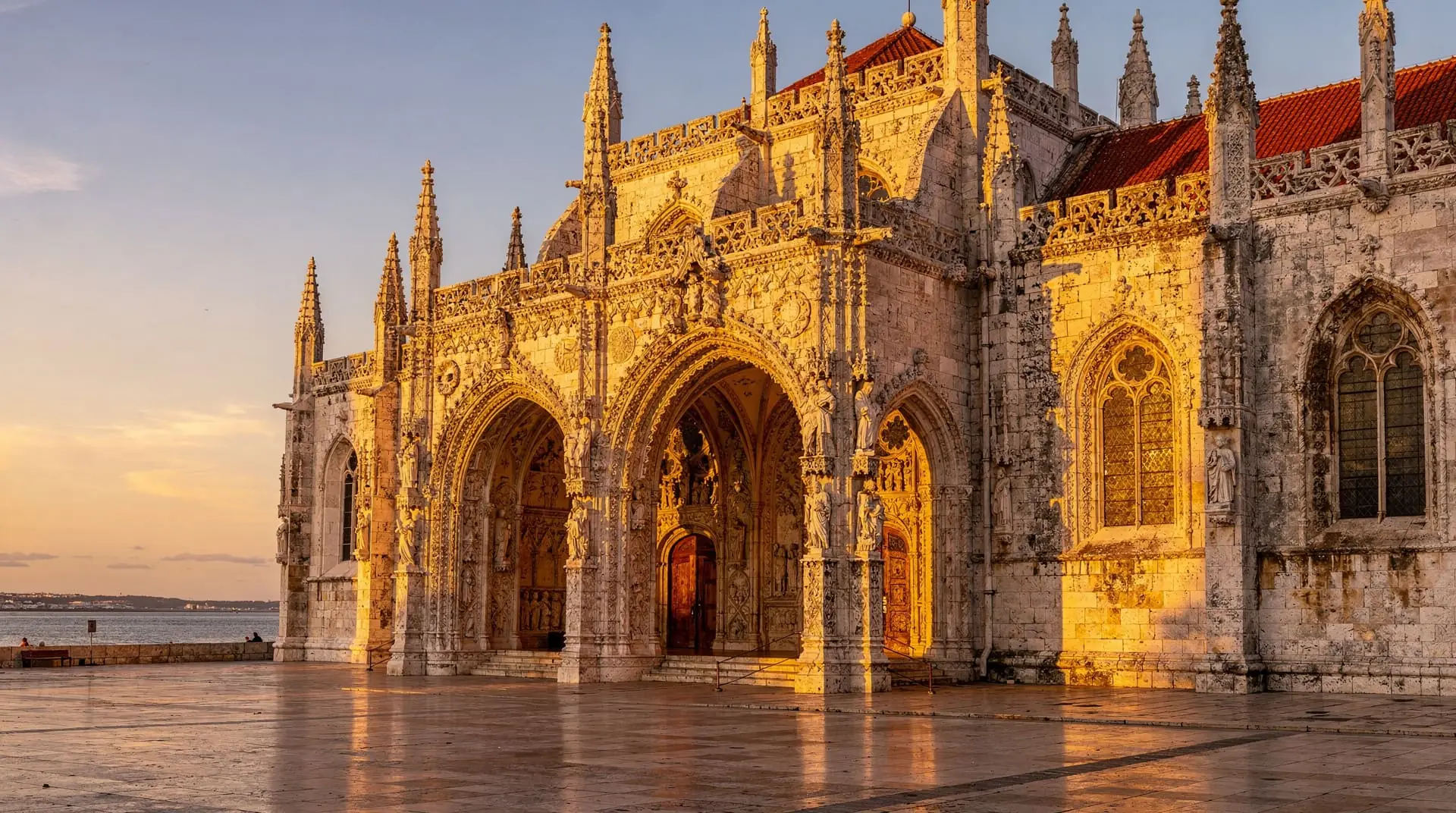
Jerónimos Monastery: the complete visit guide
Everything you need to visit Jerónimos Monastery in Belém — tickets, timed entry, the cloister, Vasco da Gama's tomb, and how long it really takes.

Pena Palace: tickets, queues and how to make the most of your visit
How to visit Pena Palace in Sintra — timed entry tickets, bus 434, park-only vs palace+park options, and what to expect inside the Romantic hilltop castle.
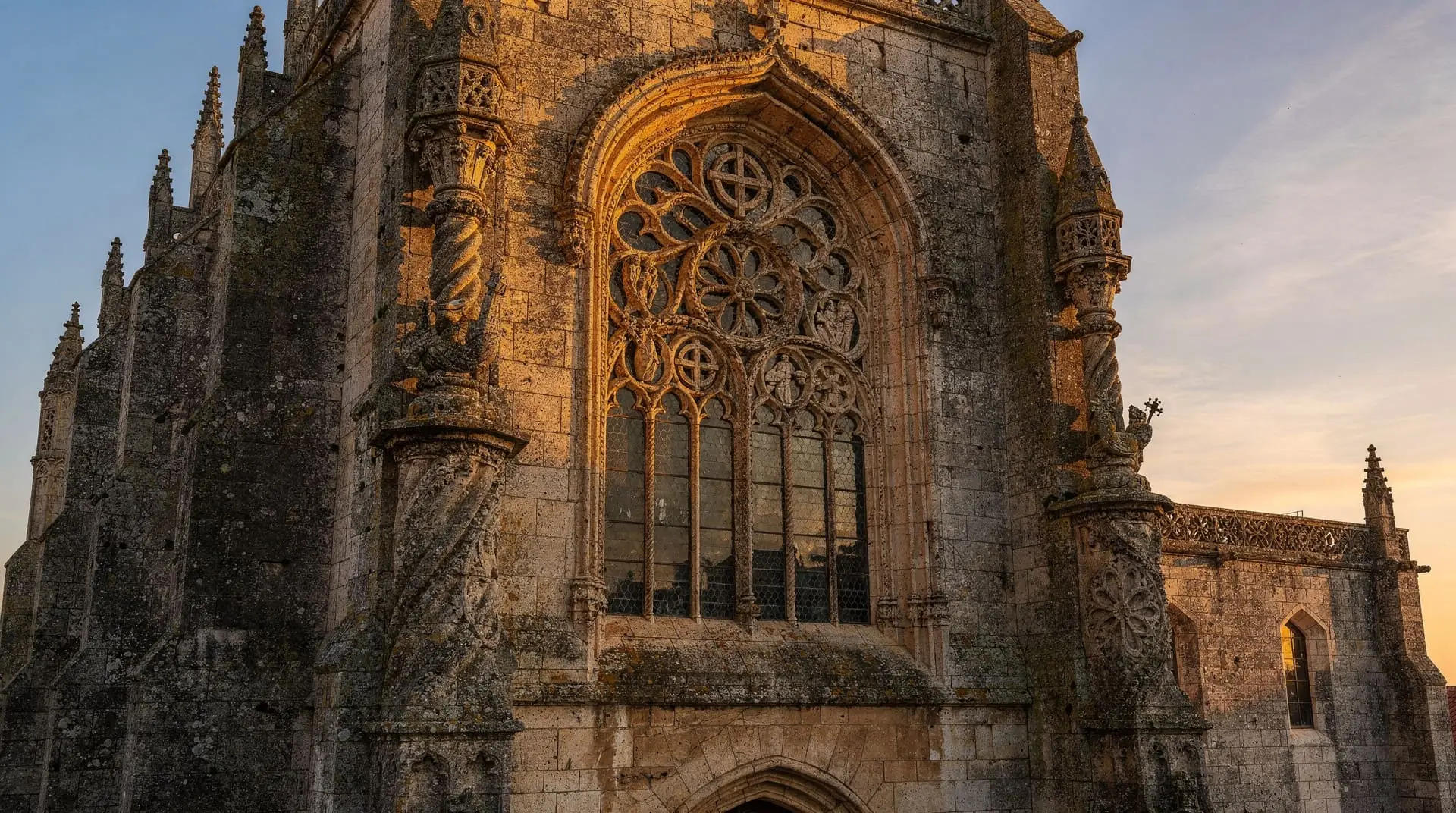
Convent of Christ in Tomar: the Templar headquarters and Manueline window
Visit guide for the Convent of Christ in Tomar — Templar castle, circular Charola, the most complex Manueline window in Portugal, and day trip logistics.

Cristo Rei Almada: the south-bank Christ statue and panoramic lift
Guide to Cristo Rei in Almada — ferry from Cais do Sodré, bus 101, lift to the viewing platform, best time to visit and what you see from the top.
Ready to book? Top tours for this guide
We earn a small commission if you book through GetYourGuide — at no extra cost to you. Every tour is hand-picked and verified.
Lisbon: 48-Hour Hop-On-Hop-Off Bus Tour and Oceanarium Entry
Lisbon: MAAT Entry Ticket & Dolphin Watching Boat Tour
Lisbon: Alfama, Mouraria Walking Tour with Fado Night, Tapas
Lisbon: Hop-On Hop-Off Bus Tour
Lisbon: 1-or 2-Day Hop-On Hop-Off Bus Tour