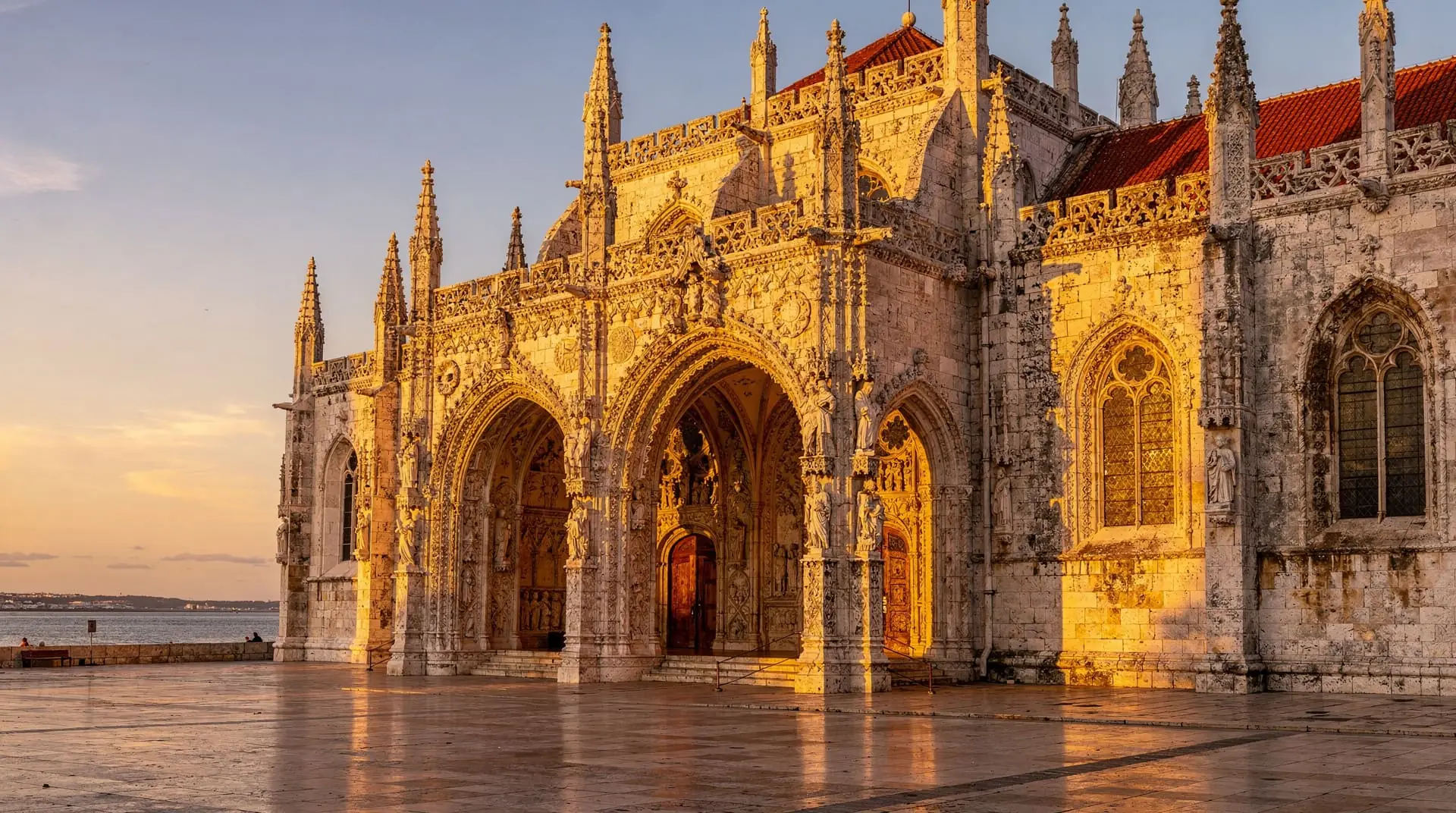
Jerónimos Monastery: the complete visit guide
Last reviewed
Do you need to book Jerónimos Monastery tickets online?
Yes. The monastery operates timed-entry slots and walk-up queues reach 45–75 minutes in high season. Online tickets are the same price as at the door and let you skip the ticket queue entirely. Book at least 24 hours ahead from May to September.
Jerónimos Monastery is one of the finest Gothic buildings in the world. The cloister alone — two floors of intricately carved limestone, combining Manueline maritime motifs with Renaissance structure — justifies the journey to Belém. Add the church of Santa Maria, the tomb of Vasco da Gama, the refectory, and the chapter house, and you have a 30,000 square metre complex that rewards at least two hours.
The monastery was funded directly by the spice trade: Manuel I used a portion of the tax levied on goods arriving from India and Africa. The wealth is visible in every carved surface. This was also the departure point for Vasco da Gama’s voyages — he and his crew spent their last night in prayer here before sailing for India in 1497.
| Where | Praça do Império, Belém |
| Full ticket | Around €15; church alone is free |
| Time needed | 90 minutes minimum, 2-2.5 hours unhurried |
| Getting there | Train from Cais do Sodré (~10 min) or tram 15E (~25 min) |
| Booking | Online timed-entry essential May-September |
What you are visiting and why it matters
The Mosteiro dos Jerónimos was built in the Hieronymite order’s tradition of contemplative enclosure, and construction took most of the 16th century. The church was finished first (1521), the cloister followed across several decades. The result is the defining building of the Manueline style — named after Manuel I — which fused late Gothic stone-carving with maritime motifs (anchors, armillary spheres, coral, rope) and Moorish geometric complexity.
UNESCO listed the monastery in 1983 alongside Belém Tower. Both buildings are on the same grounds and both are covered by the Lisboa Card.
What distinguishes Jerónimos from other great European monasteries is the specificity of its ornament. These are not generic Gothic traceries. The famous south portal, carved by João de Castilho, includes images of navigation instruments, knotted ropes and the armillary sphere — Manuel I’s personal emblem. The decoration is a direct reference to Portugal’s position as the dominant global maritime power in 1500.
Tickets and entry
Prices (2026):
- Church of Santa Maria: free entry (limited hours for silent prayer, controlled tourist entry)
- Full monastery (church + cloister + refectory + chapter house): €15 per adult, €7.50 for EU students/seniors, free for children under 12
The church can be visited separately and for free during tourist hours (generally 10:00–17:30 Tuesday–Sunday, except during religious services). The cloister, refectory and chapter house require the paid ticket.
Online booking: essential from May to September. Timed-entry slots are available through the official Patrimônio Cultural website and authorised resellers. Walk-up tickets are available at the box office but expect a 45–75 minute queue in peak season. For self-paced visitors who still want context on what they’re looking at, the Jerónimos Monastery e-ticket with audio guide pairs skip-the-line entry with an audio commentary you follow at your own pace.
Book skip-the-line Jerónimos Monastery ticketsGuided tours: worth considering if you want context on the Manueline symbolism and the history of the Hieronymite order. A guided visit typically adds 45 minutes to the experience.
Jerónimos Monastery guided tour with entry ticketLisboa Card: covers full monastery entry. If you plan to visit both Jerónimos and Belém Tower (€15 + €8 = €23), the Lisboa Card 24h (€22) already recoups its cost on those two sites alone, before any transport benefit.
Getting there from central Lisbon
By tram 15E (electric, not historic): from Praça da Figueira or Praça do Comércio. Alight at Belém/Mosteiro. Journey time approximately 25 minutes. Fare €1.65 with Viva Viagem.
By train from Cais do Sodré: Linha de Cascais to Belém station. Under 10 minutes. €1.65. Walk 600 m north from the station to the monastery. This is the fastest option and avoids riverside road traffic.
By Uber/Bolt: from Baixa, expect €7–12 and 15–25 minutes depending on traffic. No parking on the monastery forecourt — the nearest public parking is at the CCB (Centro Cultural de Belém) car park.
Jerónimos is on Praça do Império, the large square facing the Tagus. The south portal (the most ornate entrance) faces the square. The church’s main door faces west.
The visit: room by room
The south portal
Before entering, spend five minutes with the south portal — arguably the most elaborate stone carving in Portugal. João de Castilho completed it around 1517. The tympanum shows the Adoration of the Magi. The jamb columns feature monks, nobles and maritime imagery. Notice the armillary spheres and the twisted rope columns: these are repeated throughout the complex.
The church of Santa Maria
The nave is single-aisle with soaring palm-vault ribs supported on slender octagonal columns. The effect is simultaneously Gothic and tropical — the ribs spreading like fronds from the columns. The stonework is largely original, though the church was damaged in the 1755 earthquake and restored.
The tombs at the entrance level are important. To the left of the entrance: Vasco da Gama, reinterred here in 1880 from a church in Vidigueira. His tomb is supported by elephants — a nod to his voyages. Opposite: Luís de Camões, the poet who wrote the Lusiads, the epic poem of Portuguese maritime exploration. Both tombs are neo-Manueline, carved in the 19th century for the reinternment ceremony.
The high altar has an 18th-century gilded retable. The transept crossing is where the original royal patrons — Manuel I and his wife Maria — are buried.
The cloister
Access from the church or from the separate ticket entrance on the monastery’s east side. The cloister is 55 metres per side, two storeys, and is the most visited part of the complex. The lower arcade uses paired columns with elaborate bases; the upper gallery is lighter and more classically influenced, added by Diogo de Torralva after 1550.
Walk the lower level slowly. Each bay is different — the carving combinations of flora, marine life and geometric patterns never exactly repeat. The upper gallery offers views down into the garden and across to the church roofline.
The garden in the centre was a working garden for the Hieronymite monks until the order was suppressed in 1834. Now it is lawned and open to sky — the contrast between the carved stone darkness of the arcades and the green-and-light centre is the defining visual of a visit.
The refectory
Large, barrel-vaulted, decorated with 18th-century azulejo panels depicting the miracle of the loaves and fishes. Often quieter than the church and cloister. The bench seating along the walls is original.
The chapter house
Contains the tomb of the historian Alexandre Herculano. The vaulted ceiling is 16th century and well-preserved. Exit through the chapter house to the east wing corridor.
Combining with Belém Tower and the neighbourhood
The Belém Tower is a 300-metre walk west along the riverside promenade. Book your Jerónimos slot first (larger, more complex), then walk to the tower.
The National Coach Museum is 500 m east along the same riverside promenade — an underrated gem with the finest collection of 17th–19th century royal carriages in Europe. The new building opened in 2015 and is architecturally interesting.
The Pastéis de Belém bakery (Rua de Belém 84–92) is the source of the original pastéis de nata — the recipe is from 1837 and supposedly guarded by three people. Expect a queue in summer; the inside is a warren of tiled rooms seating 300, and the line moves. See Belém pastéis queue tips for timing advice.
Belém tour with pastéis tasting and Jerónimos entryPractical information
Opening hours: Tuesday–Sunday 10:00–18:30 (last entry 18:00); October–April 10:00–17:30 (last entry 17:00). Closed Monday, 1 January, Easter Sunday, 1 May, 25 December.
Photography: permitted throughout (no flash in the church). The cloister offers excellent natural light in the morning and early afternoon. Avoid harsh midday sun through the arcades — it creates contrast problems.
Accessibility: the church is accessible. The cloister lower level is accessible. The upper gallery involves steps. The refectory is accessible via a lift (ask staff).
Time needed: 90 minutes minimum for the full complex; 2.5 hours if you read the panels and photograph thoroughly.
Crowds: worst between 11:00 and 14:00 year-round. Arrive at opening (10:00) or after 16:00 for quieter conditions in the cloister.
What Jerónimos tells you about 16th-century Lisbon
The monastery is not simply a beautiful building. It is the physical embodiment of a very specific historical moment — 1497–1521, the two decades when Portugal was the dominant maritime power in the world and the most consequential state in global trade.
Vasco da Gama’s 1497–1499 voyage to India opened a direct sea route that broke the Venetian and Arab monopoly on the spice trade. The economic consequences were staggering: within a decade, 75% of Europe’s spice imports came through Lisbon rather than Venice. The tax that funded Jerónimos — the “vintena” (one-twentieth) levied on Asian trade — gave Manuel I resources that no previous Portuguese king had commanded.
The monastery was deliberately sited at the point where Da Gama’s ships left Lisbon. The monks of the Hieronymite order were charged with praying for the souls of sailors and merchants. The cloister, the tombs, the carved portals: all of this was paid for by the profits of those voyages.
Understanding this makes the Manueline ornament legible in a new way. The armillary spheres are not random decoration — they are navigational instruments, the technology that made the discoveries possible. The ropes and anchors carved on the columns are literal: the ropes of the ships. The exotic animals (elephants in the tombs, the rhinoceros on the Belém Tower corbel) are souvenirs of the new world of trade goods.
The monastery is the Age of Discovery in stone.
The Hieronymite order and its role
The Order of Saint Jerome (Hieronymites) was a relatively minor contemplative order founded in Spain in the 14th century, dedicated to the mystical writings of Saint Jerome (translator of the Vulgate Bible). They had no established presence in Portugal before Manuel I commissioned the Belém monastery.
Manuel I chose them specifically because their constitution required the monks to pray continuously for the royal patron and his intentions — in this case, for the safety of ships and the souls of sailors. It was an institutionalised system of spiritual insurance.
The monks inhabited the monastery from its completion until the suppression of all Portuguese religious orders in 1834 under the liberal government. The monastery then became a state institution and was partially used as an orphanage before its current museological status was established in the 20th century.
João de Castilho and the architects of Jerónimos
The monastery was not built by a single architect but by a succession of master builders under royal direction. Understanding who they were enriches the visit.
Diogo de Boitaca (c. 1460–1528): probably the original architect, credited with beginning construction around 1501–1502. He is also credited with the Setúbal Church of Jesus — the first Manueline building in Portugal — and is considered the founder of the Manueline style.
João de Castilho (c. 1470–1552): a Spanish-born architect who took over from Boitaca around 1516 and completed most of the significant work, including the south portal (the principal ornate entrance from Praça do Império) and the cloister. Castilho worked simultaneously on Belém Tower and Tomar’s Convent of Christ — he was the dominant architectural figure in Portugal in the first half of the 16th century.
Diogo de Torralva (c. 1500–1566): added the upper storey of the cloister after 1550, working in a more classical-Renaissance idiom that visibly differs from the Manueline lower storey. This stylistic shift — Manueline below, Renaissance above — is the most legible architectural seam in the building.
Jerónimo de Ruão (c. 1530–1601): completed the east wing and various later elements. By the time he was working on the monastery, the Manueline moment had passed and the Counter-Reformation aesthetic was dominant — hence the more restrained character of the later sections.
Portuguese tiles in the monastery
The 18th-century azulejo panels in the refectory deserve specific attention. The panels depict the biblical miracle of the loaves and fishes (appropriate for a refectory) and the Flight into Egypt, in the characteristic blue-and-white polychrome style of the period.
This style — narrative scenes in cobalt blue on white tin-glazed ground — was developed in the Netherlands in the 17th century and adopted enthusiastically in Portugal in the 18th century. The best examples in Lisbon are at the Jerónimos refectory, the National Tile Museum in Xabregas, and the cloister of São Vicente de Fora (near the National Pantheon in Alfama). The Jerónimos panels are relatively accessible for this type — you can get close without crowds, unlike at the Tile Museum where cases protect the panels.
The contrast between the 16th-century Manueline carved stone and the 18th-century azulejo panels in the same building is one of the useful juxtapositions Jerónimos offers: two centuries of Portuguese artistic production, two entirely different aesthetic moments, in the same space.
Jerónimos in the context of Lisbon’s itineraries
For a 2-day Lisbon itinerary, Jerónimos typically anchors a morning in Belém alongside the tower. Afternoon can include the MAAT gallery (free Sunday) or a return to central Lisbon via the Linha de Cascais for Alfama.
For a 3-day itinerary, dedicate the full Belém morning: train from Cais do Sodré, Jerónimos (pre-booked 10:00 slot), cloister, pastéis de Belém, Belém Tower (pre-booked 12:00 slot), Monument to the Discoveries, lunch at one of the riverside terraces, optional Coach Museum in the afternoon.
The Lisboa Card covers all entry and transport — use the Lisboa Card calculator to see if it works for your itinerary.
For visitors particularly interested in Manueline architecture, the Convent of Christ in Tomar is a full-day trip but shares the same architectural DNA — the famous Manueline window there is the most complex single piece of stone carving in Portugal.
The rest of the Belém monument cluster
Jerónimos is the centrepiece of a wider cluster of monuments on the same stretch of waterfront, and understanding how they relate helps with sequencing a visit. The Monument to the Discoveries (Padrão dos Descobrimentos), a 500-metre walk west along the river from the monastery, is a 1960 memorial shaped like a ship’s prow, with a viewing platform reached by lift (€6, worth it for the panorama across the Tagus and back toward the monastery roofline). It was built to commemorate the 500th anniversary of Henry the Navigator’s death and depicts 33 figures from the Age of Discovery, Henry at the prow.
MAAT, the striking undulating riverside gallery a short walk further west, is architecturally the opposite of Jerónimos — glass, tile and contemporary curves rather than carved limestone — and makes a deliberate contrast if you visit both on the same day. See the MAAT guide for current exhibitions and free-entry Sunday details.
For visitors who want the fullest possible Belém day: Jerónimos in the morning (10:00 slot), Monument to the Discoveries viewing platform, lunch on the riverside terraces, Belém Tower in the early afternoon, and MAAT or the Coach Museum to finish. This is a full day, not a half-day, if done at a comfortable pace rather than rushed.
Practical booking tips for peak season
Between June and September, Jerónimos regularly sells out its most popular morning slots (10:00-11:00) several days ahead. If your travel dates are fixed and you want a specific time, book as soon as your itinerary is confirmed rather than waiting until arrival. Afternoon slots (after 15:00) are usually easier to secure last-minute, though the light inside the cloister is less favourable later in the day.
Groups larger than six should check whether their preferred time slot has enough capacity — some tour operators reserve blocks of tickets for guided groups, which can reduce independent availability on popular dates. If a specific date shows fully booked online, checking again a day or two later sometimes reveals released allocation from cancelled group bookings.
A final practical note: tickets are typically non-transferable to a different time slot once purchased, so double-check your planned arrival time against real-world logistics (traffic to Belém, breakfast, the walk from the tram or train stop) before locking in a booking you cannot easily change.
Frequently asked questions about Jerónimos Monastery
Is Jerónimos Monastery church free to visit?
The church (Santa Maria) can be entered for free during tourist hours, typically 10:00–17:30. However, during religious services (usually Sunday morning) it is closed to tourists. The full monastery complex — cloister, refectory, chapter house — requires a paid ticket (€15 in 2026).
How long does it take to visit Jerónimos Monastery?
Budget 90 minutes for a thorough visit of the full complex. If you read the information panels and spend time in the cloister, allow 2–2.5 hours. The church alone takes 20–30 minutes.
Where exactly is Vasco da Gama buried?
His tomb is in the church of Santa Maria, immediately to the left as you enter through the west door. It was brought here in 1880 from Vidigueira in Alentejo, where he originally died in 1524. The tomb is supported by carved elephants, referencing his voyages to India. Camões’s tomb is directly opposite.
Can you visit Jerónimos on a Monday?
No. The monastery is closed on Mondays and on 1 January, Easter Sunday, 1 May and 25 December. Plan around this — it is one of the most common visitor disappointments.
Is the Lisboa Card worth it for Jerónimos?
If you also plan to visit Belém Tower and use public transport on the same day, the Lisboa Card 24h (€22) covers both monument entries (€15 + €8 = €23) plus transport, making it slightly cost-positive on day one. If you extend to 48h or 72h and add other included sites, the value improves significantly. Use the Lisboa Card calculator to run your specific numbers.
Is there a dress code for Jerónimos?
No official dress code, but the church remains an active place of worship. Shoulders and knees covered are appropriate — most visitors comply naturally given the setting. There is no enforcement.
What is the best time of year to visit?
April–June and September–October offer the best combination of mild weather, reasonable crowds and good light. July–August brings the longest queues and highest temperatures. Winter (November–March) is uncrowded but the light is flat for photography.
Should I book Jerónimos and Belém Tower for the same day or split them?
Same day works well for most visitors since the two sites are a 300-metre walk apart, but book Jerónimos for the earlier slot — it is the larger, more time-consuming visit, and doing it first means you are not rushing through the cloister to make a tower booking. See the Belém Tower guide for its own timing details.
Is a guided tour of Jerónimos worth the extra cost?
For most visitors, the free information panels and this guide’s room-by-room breakdown cover the essentials without a guide. A guided tour earns its cost mainly for visitors specifically interested in the Manueline symbolism, the Hieronymite order’s history, or the broader Age of Discoveries context — the added 45 minutes of expert narration genuinely deepens the visit for that audience rather than simply repeating what a panel already says. If in doubt, read this guide’s architecture and history sections beforehand and decide once you know what level of detail actually interests you.
Related guides
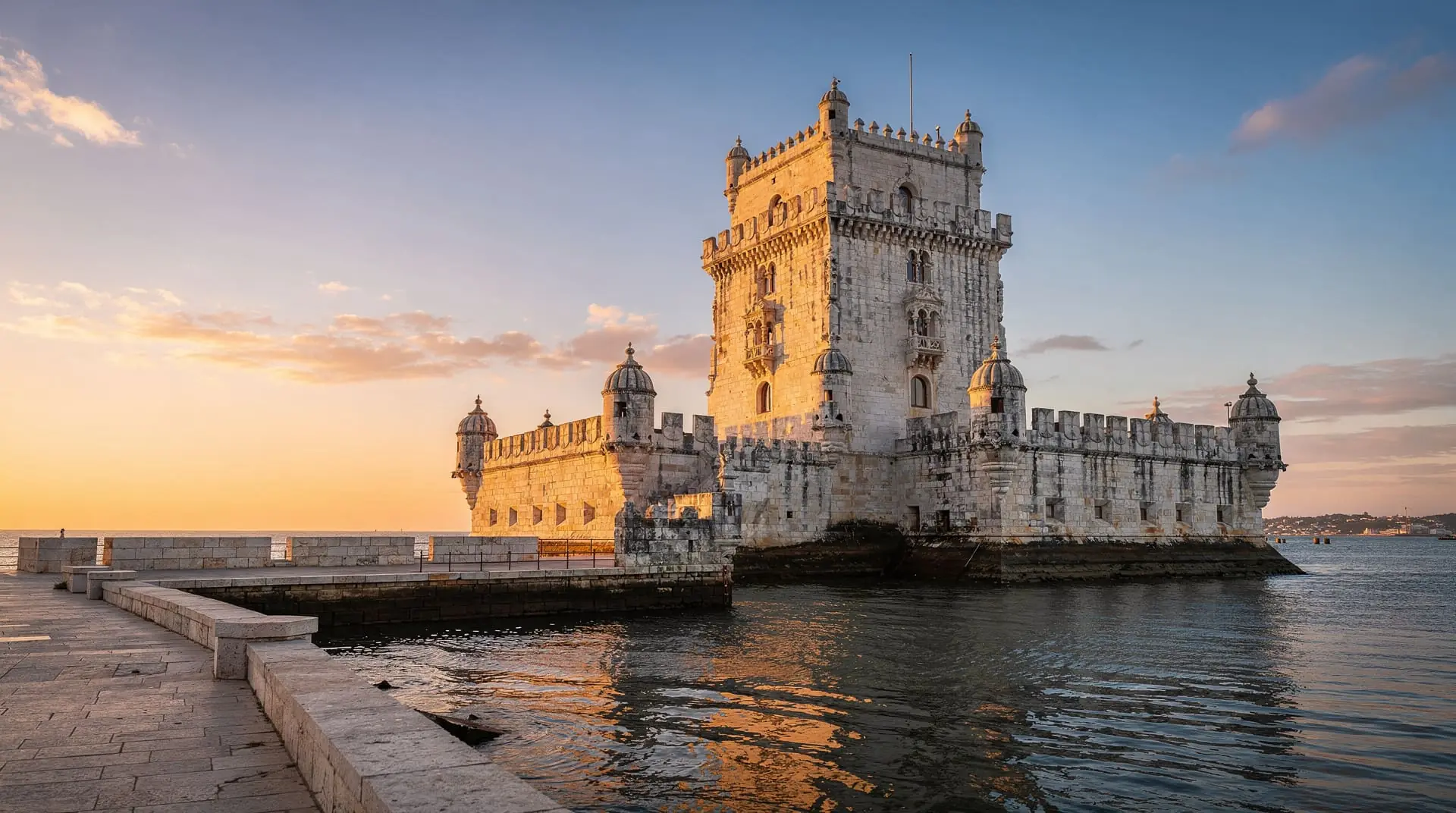
Belém Tower: tickets, queues and what to expect inside
How to visit Belém Tower without wasting an hour in the queue. Fast-track tickets, best time to go, and what the Manueline tower actually shows you.

Pena Palace: tickets, queues and how to make the most of your visit
How to visit Pena Palace in Sintra — timed entry tickets, bus 434, park-only vs palace+park options, and what to expect inside the Romantic hilltop castle.
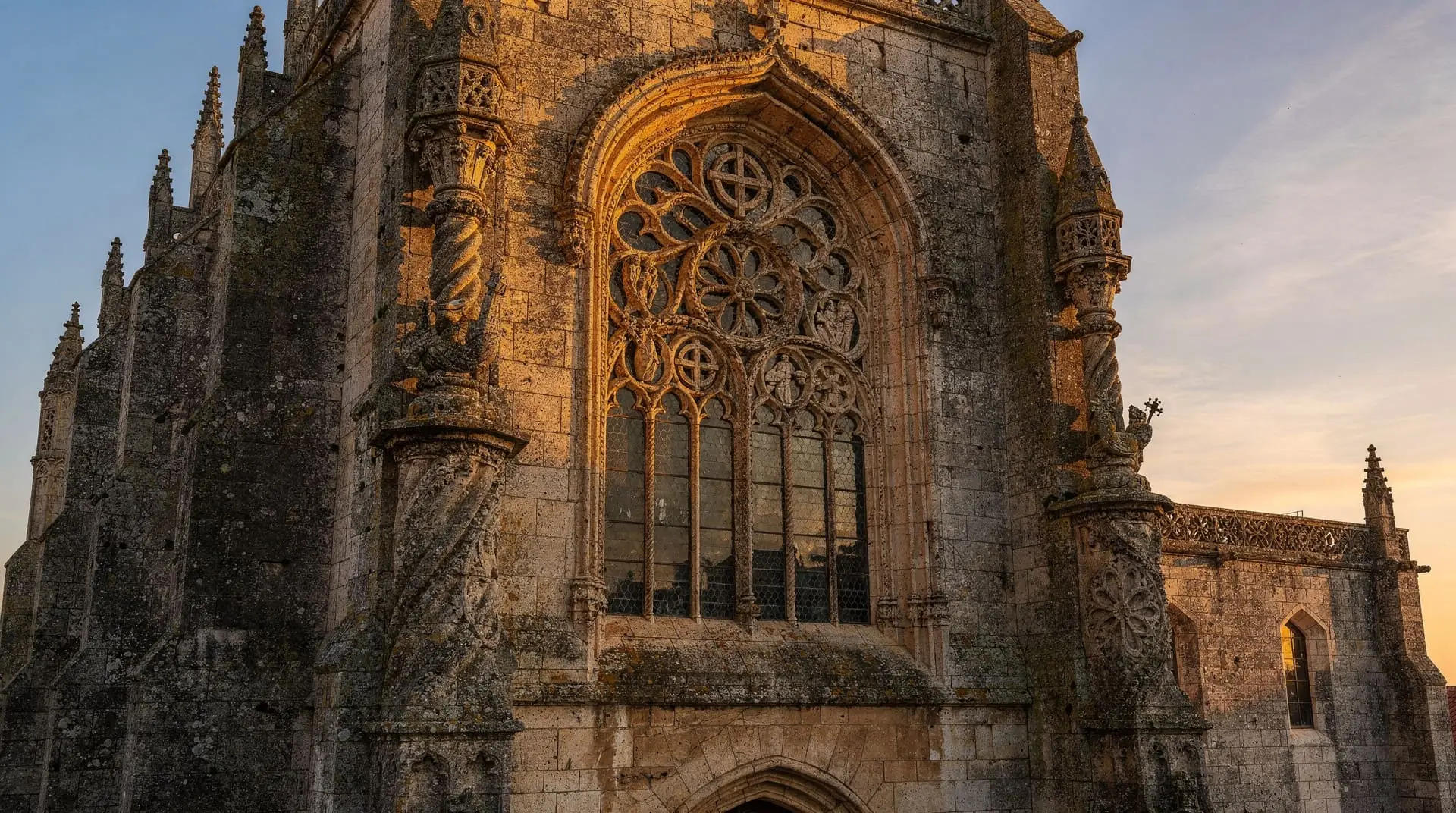
Convent of Christ in Tomar: the Templar headquarters and Manueline window
Visit guide for the Convent of Christ in Tomar — Templar castle, circular Charola, the most complex Manueline window in Portugal, and day trip logistics.

Cristo Rei Almada: the south-bank Christ statue and panoramic lift
Guide to Cristo Rei in Almada — ferry from Cais do Sodré, bus 101, lift to the viewing platform, best time to visit and what you see from the top.
Ready to book? Top tours for this guide
We earn a small commission if you book through GetYourGuide — at no extra cost to you. Every tour is hand-picked and verified.
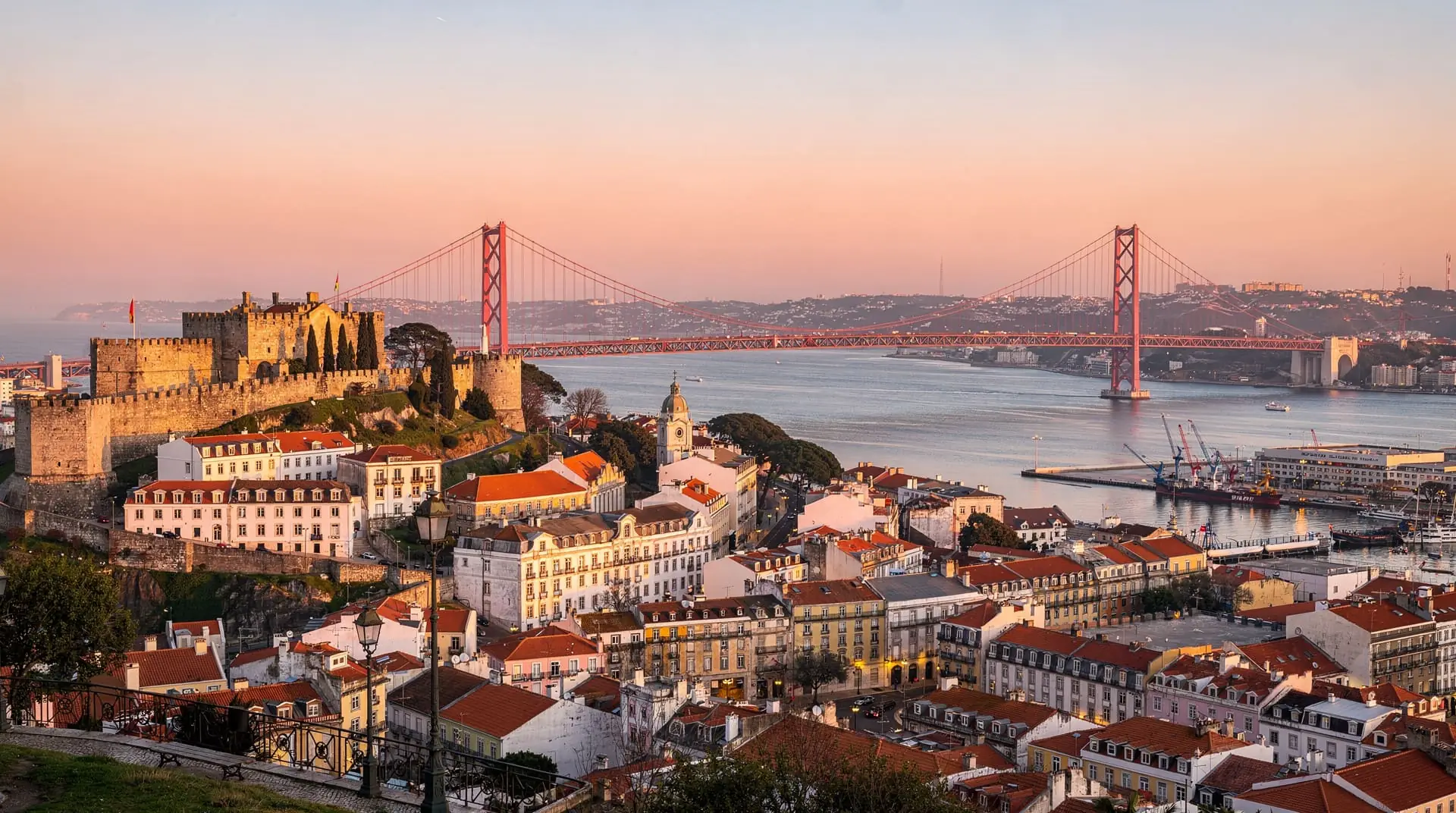
Lisbon: 48-Hour Hop-On-Hop-Off Bus Tour and Oceanarium Entry
Lisbon: MAAT Entry Ticket & Dolphin Watching Boat Tour
Lisbon: Alfama, Mouraria Walking Tour with Fado Night, Tapas
Lisbon: Hop-On Hop-Off Bus Tour
Lisbon: 1-or 2-Day Hop-On Hop-Off Bus Tour