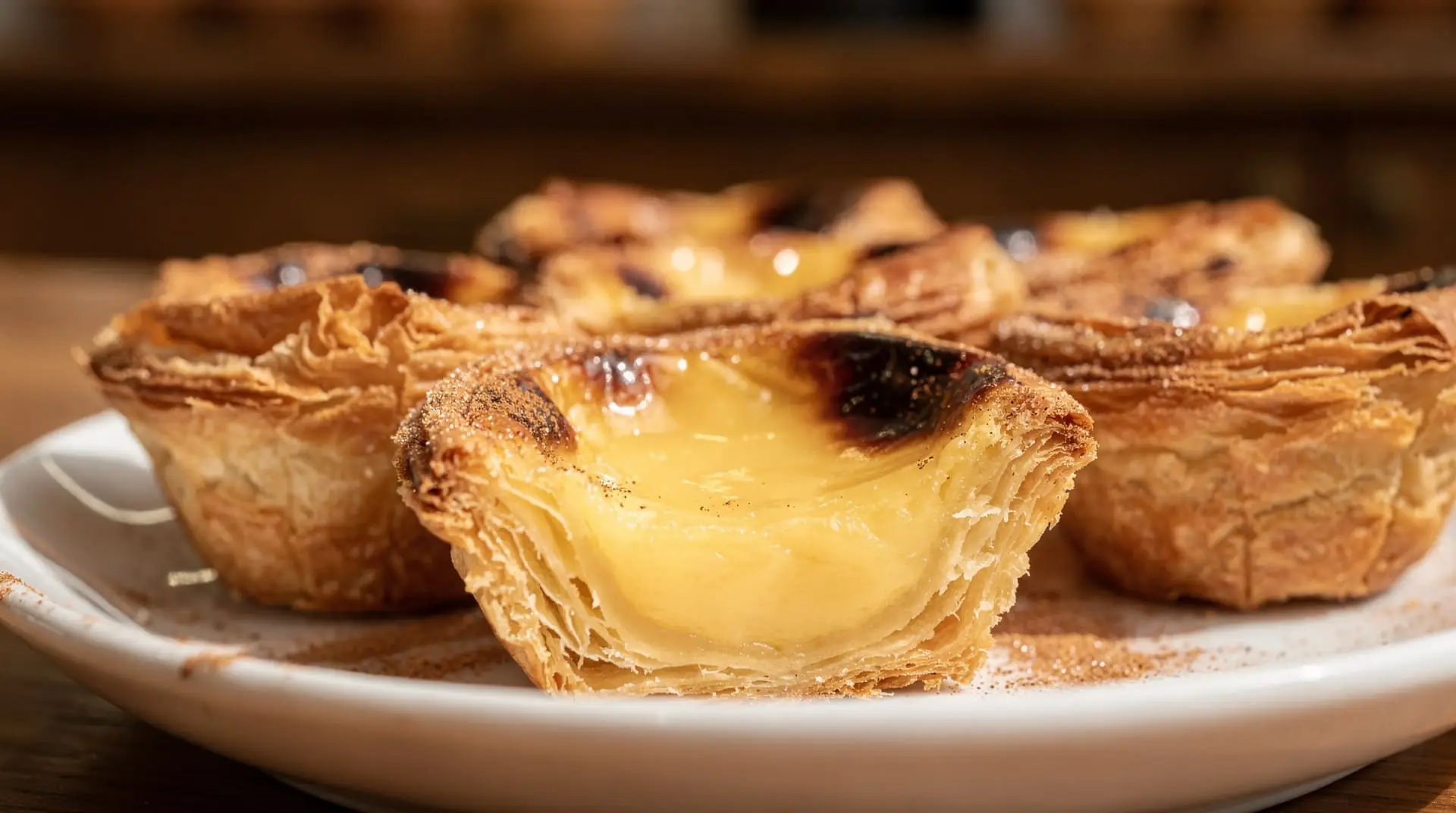
Pastéis de nata: where to eat the best in Lisbon
Last reviewed
Where can I eat the best pastéis de nata in Lisbon?
Pastéis de Belém (Rua de Belém 84) invented the recipe and remains the benchmark, but Manteigaria in Chiado (Rua do Loreto 2) has shorter queues and equally flaky pastry. Aloma in Campo de Ourique is the local favourite, open since 1943. Eat them warm, dusted with cinnamon and icing sugar.
Few foods define Lisbon as completely as the pastel de nata — a palm-sized custard tart baked until the cream is just set and the pastry is shatteringly crisp. Every café sells them, every pastelaria claims theirs are the best, and every visitor quickly develops a strong opinion. This guide cuts through the hype and tells you exactly where to go, when to go, and how to avoid wasting 45 minutes in a queue for a tart that is no better than one sold three streets away.
| Where | Belém, Chiado, Campo de Ourique — citywide |
| Cost | around €1.40–1.80 per tart |
| Time needed | 15 minutes to an hour, mostly queueing |
| Getting there | Tram 15E or train to Belém; tram 28 or metro to Chiado |
| Best time | Weekdays before 09:30 or after 16:00 |
The recipe and its origins
The pastel de nata was invented by monks at the Jerónimos Monastery in Belém sometime before 1834. The monks used egg whites to starch their habits, leaving a surplus of yolks. The solution was a rich custard tart baked in a lard-lined pastry shell. When the religious orders were dissolved in 1834, a monk sold the recipe to a sugar refinery next door. That refinery became the Fábrica dos Pastéis de Belém, which still operates today at Rua de Belém 84–92, making somewhere between 15,000 and 20,000 tarts daily.
The secret recipe — the precise blend of cinnamon, lemon zest, and vanilla in the custard; the ratio of lard to butter in the pastry — is known to only three people at any one time. Every other bakery makes pastéis de nata, a legal generic name. Most are excellent. A few are spectacular.
Pastéis de Belém: the original, stripped of romance
Address: Rua de Belém 84-92, Belém Hours: Daily 08:00–23:00 Price: €1.65 each; €9.90 for a box of 6; €18.90 for a box of 12 Transport: Tram 15E from Praça da Figueira (30 min) or train to Belém station (20 min from Cais do Sodré)
Let’s be honest: Pastéis de Belém is excellent and also one of the most over-touristed spots in Lisbon. The tarts are genuinely different from every other version — the pastry is slightly thicker and flakier, the custard has a deeper egg flavour, and the slightly burnt top carries a caramelised bitterness that is addictive.
The experience, however, depends entirely on when you arrive. On a Saturday morning in July, you are looking at 40 minutes of queuing before you sit down, another 10 minutes to be served, and then a slightly rushed meal surrounded by 300 other tourists. The tarts, eaten under those conditions, feel less magical.
The insider move: There is a takeaway counter on the right side of the entrance, almost hidden around a corner. Join that queue instead of the main door queue. It moves twice as fast. Buy a box, walk 200 metres to the gardens next to the Jerónimos Monastery, sit on the grass, and eat them in peace. They cool fast, so eat within 10 minutes of purchase.
Best times: Weekdays before 09:30 or after 16:00. Avoid Saturday and Sunday mornings from June to September entirely.
You can also combine a visit to the bakery with the Belém half-day experience — Jerónimos Monastery is a 4-minute walk, the Belém Tower is 1.2 km along the river. This is what most visitors do.
Book a guided Belém tour including Pastéis de Belém and JerónimosManteigaria: the best non-Belém tart in the city
Address: Rua do Loreto 2, Chiado (also Mercado da Ribeira, inside Time Out Market) Hours: Daily 08:00–00:00 Price: €1.60 each; €9.00 for a box of 6
Manteigaria opened in 2014 and quickly became the favourite of food-obsessed Lisboaners who did not want to make the trip to Belém. The recipe uses a higher proportion of cream in the custard, giving a silkier result with slightly less caramel intensity than Pastéis de Belém. The pastry achieves that difficult combination of crispy and tender.
The Chiado location has a open kitchen where you can watch bakers pull trays from the oven every 15 minutes or so. The queue, even on a busy Saturday, rarely exceeds 15 minutes. The Time Out Market branch inside Mercado da Ribeira has even less waiting, though the tarts there are the same recipe and quality.
If you are pressed for time or already in Chiado exploring Baixa-Chiado, Manteigaria is the obvious choice.
Aloma: the local institution since 1943
Address: Rua Francisco Metrass 67, Campo de Ourique Hours: Mon–Fri 07:30–20:00; Sat 08:00–20:00; closed Sunday Price: €1.45 each; €8.10 for a box of 6
Campo de Ourique is a residential neighbourhood that most tourists bypass entirely. Aloma has been selling pastéis de nata from the same counter since 1943, and it wins awards regularly — including a Michelin Bib Gourmand recognition for the bakery section. The custard is firmer and less sweet than Manteigaria’s; the pastry shell is thin and shatters on the first bite.
To get here, take the 758 bus from Cais do Sodré (20 minutes) or the 28 tram to its terminus at Campo de Ourique market. There is almost never a queue beyond four or five people. You will be standing next to grandmothers who have been shopping here for 40 years. That is worth something.
Castro: Belém’s quieter rival
Address: Rua de Belém 54, Belém (100 metres from Pastéis de Belém) Hours: Mon–Fri 08:00–20:00; Sat–Sun 08:00–21:00 Price: €1.50 each
Pastelaria Castro sits 100 metres from the famous bakery and serves a tart that many regulars prefer — slightly less sweet, more pronounced lemon zest, a thinner pastry cup. The queue is almost always manageable. Locals who work in Belém come here rather than fight the crowds at the famous address.
This is a solid strategic option: eat a Castro tart, then walk to Pastéis de Belém for the official version, compare them, and decide for yourself. Budget €3 and 20 minutes.
Fábrica da Nata: reliable citywide chain
Locations: Rua do Comércio 95, Praça do Comércio arcade; Rua dos Fanqueiros 228; Rua Augusta 32 (among others) Hours: Vary by location, generally 08:00–22:00 daily Price: €1.70 each
Fábrica da Nata is a small chain that has expanded across central Lisbon with consistent quality and no gimmicks. The tart is closer to Manteigaria’s style than to Pastéis de Belém — creamy, slightly sweet, good pastry. It is not the best tart in the city, but it is reliably good and the locations are convenient if you are already near Praça do Comércio or walking Rua Augusta. Better than most of the tourist-facing cafés nearby.
Other standout spots
Pastelaria Versailles (Av. da República 15A): A grand 1920s café that has served pastéis de nata to Lisbon’s bourgeoisie for generations. The tart is traditional, well-made, and the room is beautiful. Go for the atmosphere as much as the food.
Confeitaria Nacional (Praça da Figueira 18B): Operating since 1829, this historic shop in Baixa sells good tarts alongside every other Portuguese pastry. Good for a quick stop if you are already in Rossio.
Time Out Market stalls: Both Manteigaria and A Cevicheria (weekend brunch) sell versions inside the market. Fine for a quick tart alongside other food.
How to eat them properly
The locals have rules. The tarts come with a shaker of cinnamon powder and icing sugar — use both. Eat them within minutes of coming out of the oven; a cold pastel de nata is substantially less enjoyable than a warm one. Drink a bica (espresso) alongside. Do not order them with cream or jam — that is something done at other pastries.
At a café, you order “um pastel, se faz favor” (one tart, please) or “dois pastéis” (two). Payment at the counter is common; sit-down service usually comes with a bill at the end. A single tart at a counter is eaten standing up at most pastelarias, which keeps prices lower.
The baking class option
If you want to understand what goes into the tart — the making of the laminated pastry, the tempering of the custard, the specific oven temperature that creates the scorched top — several schools offer hands-on classes that take around 90 minutes.
Pastel de nata masterclass at a real Lisbon bakery Pastel de nata workshop with a professional chefClasses cost €45–65 per person and include eating everything you make, plus a box to take home. They are genuinely fun and teach you something about Portuguese food culture beyond the tourist surface. There’s also a 2-hour pastel de nata cooking class for a slightly longer, more thorough session. Book in advance — they sell out a week or more ahead in high season.
Price comparison and honest verdict
| Bakery | Price per tart | Queue time (peak) | Best for |
|---|---|---|---|
| Pastéis de Belém | €1.65 | 30–45 min sit-down; 10–15 min takeaway | The definitive experience |
| Manteigaria (Chiado) | €1.60 | 5–15 min | Best location in central Lisbon |
| Aloma | €1.45 | Almost none | Locals’ favourite, most authentic |
| Castro (Belém) | €1.50 | Almost none | Good alternative near Belém |
| Fábrica da Nata | €1.70 | Almost none | Convenient, reliable |
The honest answer is that Pastéis de Belém is worth visiting at least once, especially if you are combining it with Jerónimos Monastery or the Belém Tower. But it is not so dramatically superior to Aloma or Manteigaria that you should sacrifice 40 minutes of your holiday in a queue. Go to Belém on a weekday morning or use the takeaway counter. Visit Manteigaria in Chiado on any other occasion.
Neighbourhood strategy
If you are staying near Príncipe Real or Chiado: Manteigaria (Rua do Loreto 2) is your default. Walk there in the morning before crowds arrive.
If you are visiting Belém: Castro for no queue, Pastéis de Belém for the experience — use the takeaway counter.
If you are staying near Avenidas Novas or Campo de Ourique: Aloma. End of discussion.
If you are doing Alfama or Mouraria: A Padaria Portuguesa has branches throughout and makes a respectable tart. Not outstanding, but adequate for a quick stop before climbing to a miradouro.
Practical advice
Pastéis de nata keep at room temperature for about 6 hours before the pastry softens. If you are buying to take back to a hotel, eat within 2–3 hours or refrigerate (though cold tarts are substantially worse). Reheat at 180 °C for 4 minutes in any oven.
Boxes travel well in overhead bin luggage. Wrap each tart in paper if flying; the custard can shift in turbulence. Customs rules in the EU and US/UK permit cooked pastry in hand luggage.
For the full Lisbon food experience, pair your pastel de nata tour with a walk through Time Out Market for lunch, and ginjinha at A Ginjinha in Largo de São Domingos for an afternoon digestif. That is a proper Lisbon eating day.
Dietary notes and substitutions
Pastéis de nata are not vegetarian-friendly in the strict sense that concerns some travellers — the pastry is laminated with lard at the traditional bakeries, including Pastéis de Belém, which uses it for texture. Manteigaria and Fábrica da Nata use butter-based dough at some locations; ask before ordering if this matters to you. None of the well-known bakeries offer a genuinely vegan version, since the custard depends on egg yolks and dairy. A few specialist cafés around Príncipe Real and Intendente make plant-based versions on request, but they are the exception rather than the rule, and gluten-free pastry is rarer still. If dietary needs are a priority, plan around where to eat in Lisbon more broadly rather than around a single tart.
Doing it as part of a food tour
If queue-strategy and bakery-hopping sounds like more effort than you want on holiday, a guided food tour folds the pastel de nata stop into a wider afternoon of tastings — usually alongside a bifana, cheese, wine and a coffee culture primer. It removes the queue-timing guesswork entirely, since guides know which counter is quiet at any given hour.
Pastéis de nata and Lisbon food tasting tourFor a broader spread of Lisbon’s food scene beyond the tart, see the Lisbon food tours guide and the cheap eats guide for what to eat between bakery stops.
Queues by season
Queue length at Pastéis de Belém swings hard across the year, and it is worth planning around this if you have any flexibility. From June to September, expect the longest waits — 30 to 45 minutes is normal between 10:00 and 17:00, and cruise-ship days can push it further. Spring (April–May) and early autumn (October) are noticeably calmer, with waits usually under 15 minutes outside weekend late mornings. Winter (November–March) is the easiest window: you can often walk straight to a table on a weekday, even at midday. Manteigaria and Aloma are far less seasonal, since they rely on local footfall rather than tour groups, so they are a safer bet if you are visiting in peak summer and do not want to build your day around a bakery queue.
Related guides
Where to eat in Lisbon: the honest restaurant guide
Tascas, marisqueiras, and Michelin stars — the best restaurants in Lisbon by neighbourhood, with honest tips on prices and what to avoid.
Bifana, petiscos, and Portugal's essential small plates
The best bifanas, peixinhos da horta, pataniscas, and petiscos in Lisbon — where to find them, what they cost, and why they matter.
Cheap eats in Lisbon: tascas and lunch under 15 euros
Best cheap eats in Lisbon — tascas under €15 for lunch: Zé dos Cornos, Tasca do Chico, O Trevo bifanas, and Casa Independente. Real prices for 2026.

Coffee culture in Lisbon: bica, galão, and the specialty wave
How to order coffee in Lisbon — bica, galão, meia de leite explained. Best cafés from A Brasileira to Copenhagen Coffee Lab and Hello Kristof.
Ready to book? Top tours for this guide
We earn a small commission if you book through GetYourGuide — at no extra cost to you. Every tour is hand-picked and verified.

Lisbon: 48-Hour Hop-On-Hop-Off Bus Tour and Oceanarium Entry
Lisbon: MAAT Entry Ticket & Dolphin Watching Boat Tour
Lisbon: Alfama, Mouraria Walking Tour with Fado Night, Tapas
Lisbon: Hop-On Hop-Off Bus Tour
Lisbon: 1-or 2-Day Hop-On Hop-Off Bus Tour