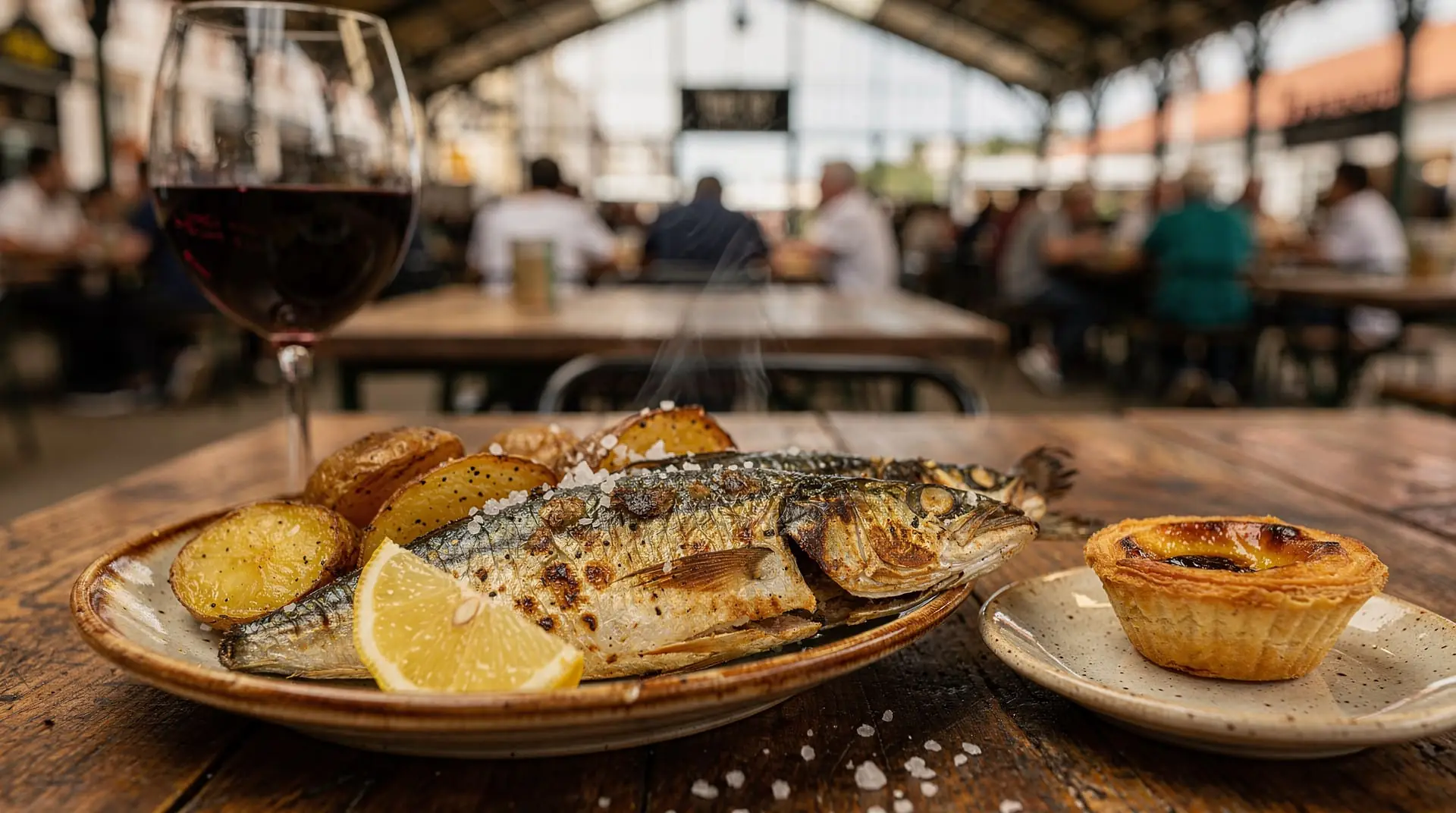
Time Out Market Lisbon: honest guide to Mercado da Ribeira
Last reviewed
Is Time Out Market Lisbon worth visiting?
Yes, particularly for solo travellers or groups where everyone wants something different. It is more upscale food hall than street market — expect €15–20 per person per meal. Best times are weekday lunches (11:30–13:00) before crowds arrive. Evenings and weekends from June to September are extremely busy.
| Where | Cais do Sodré, inside Mercado da Ribeira |
| Cost | around €20–30 per person for a full meal |
| Time needed | 45 minutes to 2 hours |
| Getting there | Cais do Sodré metro/train station, 2-minute walk |
| Best time | weekdays 11:30–12:30, or after 22:00 for a quieter evening |
Time Out Market Lisbon opened in 2014 inside the eastern wing of Mercado da Ribeira — a 19th-century iron market hall at Cais do Sodré — and became one of the most-visited spots in the city almost immediately. It is not cheap and it is not hidden, but it solves a genuine problem: a central location where every person in your group can eat what they want, all at once, with good quality control.
Understanding what it is helps you use it well. It is a curated food hall run by Time Out magazine, with around 35 vendor stalls selected for quality. It is not a traditional market — you cannot buy vegetables or raw fish. The prices are restaurant-level. The experience is urban and contemporary rather than traditional and neighbourhood.
The layout
The market occupies the eastern section of Mercado da Ribeira. Entry is free. The space is a large hall with long shared tables in the centre and stalls arranged around the perimeter and in central islands. A bar section runs along one side.
Upstairs, a terrace opens in spring and summer, providing a less chaotic space for eating with better ventilation. It fills up quickly but is worth heading for if you arrive early.
The traditional western section of Mercado da Ribeira — where local vendors sell flowers, fruit, and fish — is separate and accessed by a different entrance. Worth a look but not part of the food hall experience.
The standout stalls
Manteigaria: The Chiado pastelaria has a counter inside the market selling fresh pastéis de nata throughout the day. The queue here is consistently shorter than at the Rua do Loreto address. A reliable first stop for a warm tart and espresso before exploring the other stalls.
Café de São Bento: The original steakhouse has a counter here selling its famous prego (steak sandwich) and bifana alongside miniature versions of its classic dishes. A prego no pão from Café de São Bento costs around €10 and is substantial.
Croqueteria: Dedicated to the Portuguese croquete in every form — beef, bacalhau, alheira, and vegetarian versions. A plate of four costs around €8. One of the most interesting single-product concepts in the market.
A Cevicheria: Chef Kiko Martins brought his Príncipe Real restaurant’s ceviche concept to a stall here. The nikkei-inflected ceviche uses Portuguese fish — corvina, robalo — with South American citrus technique. €12–15 per portion.
Solar dos Presuntos: The Restauradores institution has a charcuterie and small plates counter. The presunto ibérico and chouriço de Barrancos are worth €12–15 for a plate to share.
Taberna da Rua das Flores: A petiscos counter with some of the chef’s signature dishes in smaller, sharing formats. More affordable than the restaurant.
Uma: Chef João Rodrigues’s stall features contemporary Portuguese cooking in plates designed for sharing. Changes seasonally; always interesting.
Other notable stalls worth knowing
Cervejaria do Bairro counter: A fishmonger-adjacent stall selling fresh shellfish — clams steamed to order, oysters, sometimes percebes. More expensive than the prepared food stalls but closer to the marisqueira experience. A plate of amêijoas: €12–15.
The Japanese counter: A sushi and Japanese-influenced seafood concept that fits Lisbon’s Atlantic identity better than it might seem — the fish (atum, salmão, robalo) are Portuguese Atlantic species. A good choice for visitors who want familiar forms with local ingredients.
Bairro do Avillez: José Avillez (the Belcanto chef) has a counter here serving a simplified version of his contemporary Portuguese cooking. Higher price point than most stalls (€16–22 per main) but strong quality control.
What to drink
The market has several bar counters selling wine by the glass, beer, and cocktails. The Portuguese wine selection is solid — ask for a recommendation from whoever is pouring rather than defaulting to Vinho Verde (though Vinho Verde is excellent here with seafood dishes).
Ginjinha by the shot is available at one of the counters. At €2–3 per shot, it is the correct price for Lisbon and the traditional way to punctuate a food hall visit.
Beer options: Sagres and Super Bock on draft, plus imported craft beers from Portuguese microbreweries (8a Avenida, Dois Corvos, Letra). A craft beer: €4–6.
Non-alcoholic: Freshly pressed fruit juice (€3–5), specialty coffee (Manteigaria counter also serves coffee), and water at bar prices.
The market’s place in Lisbon’s food history
The choice to take over Mercado da Ribeira was not accidental. The market had declined significantly from its peak function — by 2012, many stalls were empty and the building was underused. Time Out’s intervention preserved the iron frame while rebuilding the interior, and the resulting food hall became one of the most-imitated concepts in Europe (the model has since been replicated in New York, Miami, Boston, and several other cities).
From Lisbon’s perspective, the market represents the city’s transition from obscure European destination to international food tourism hotspot. The opening coincided with the Lisbon food wave — José Avillez’s Belcanto receiving its first Michelin star in 2012, Taberna da Rua das Flores opening the same year, a generation of chefs returning from training in Spain and France. The market was both a product of this moment and an accelerator of it.
Understanding this context makes the market more interesting: it is not just a food hall, it is a document of a specific moment in Lisbon’s recent history.
Combination visits
Time Out Market works well as part of a larger day in the Cais do Sodré neighbourhood. The logical sequence:
Morning: Coffee at Copenhagen Coffee Lab (5 minutes’ walk up Rua Nova do Carvalho). Explore the Pink Street area (Rua Nova do Carvalho) which has several interesting independent shops and bars.
Late morning: Ferry to Cacilhas (€1.35 each way, 6 minutes) for a view of Lisbon from the south bank. Walk along the Cacilhas waterfront. Ferry back.
Lunch (11:30–13:00): Time Out Market, arriving early for the best seating. Manteigaria pastel de nata at the counter first, then a main stall plate.
Afternoon: Walk east along the Tagus riverfront to Praça do Comércio (20 minutes). Alfama begins behind Praça do Comércio.
Seating strategy
The main challenge at Time Out Market is seating. Shared long tables fill up from about 12:30 on weekdays and 11:30 on weekends in summer. The strategy:
Send a scout: One person claims a table while others queue at stalls. This is how most experienced visitors handle it.
Arrive early: Before 12:30 on weekdays, before 12:00 on weekends, gives you your pick of tables.
Use the terrace: Open April–October, the terrace upstairs is less dense than the main hall and has a slightly more relaxed atmosphere.
Evening strategy: The market thins out significantly after 22:00, which makes late evening — a glass of wine and a plate of petiscos — genuinely pleasant.
Prices: what to expect
The market positions itself as mid-market: better than fast food, cheaper than a proper restaurant, but not cheap by Lisbon standards. A realistic meal budget:
- Starter or small plate: €8–12
- Main plate or substantial dish: €14–20
- Dessert (pastel de nata at Manteigaria): €1.60
- Glass of wine: €4–7
- Realistic total per person for lunch: €20–30
This is significantly more expensive than eating at a tasca or a café. If budget is a concern, the cheap eats guide covers alternatives within walking distance.
When to go and when to skip it
Good times:
- Weekdays 11:30–12:30 (before the lunch rush)
- Any weekday after 22:00 (the evening thins out considerably)
- Rainy days when outdoor alternatives are less appealing
Avoid:
- Saturday and Sunday lunches in July and August — crowds are extreme
- Any public holiday — lines at stalls can reach 20 minutes
- Friday and Saturday evenings 20:00–22:00 — peak time for groups and tourists
Getting there
Cais do Sodré station (Linha Amarela/Yellow Line, as well as suburban trains to Cascais and the Fertagus crossing) is a 2-minute walk. The Transprejo ferry terminal is adjacent. From Chiado, it is a 10-minute walk downhill along Rua Nova do Carvalho (Pink Street) — see the Cais do Sodré and Pink Street guide for what else is in the neighbourhood.
Trams 15E and 25E stop at Cais do Sodré. Buses 706, 728, and 760 serve the area.
Nearby: the rest of Cais do Sodré
The neighbourhood around the market has become one of Lisbon’s most interesting dining zones. Along Rua Nova do Carvalho (the Pink Street, painted its current colour in 2011), you will find: Copenhagen Coffee Lab (specialty coffee, excellent), Tasca do Chico (petiscos and informal fado some evenings), and several wine bars that are worth exploring after the market.
Across the road, the ferry terminal sends boats to Cacilhas (6 minutes, €1.35) where you can eat lunch at A Bica do Sapato or take the bus to the viewpoint at Cristo Rei for a view of the Tagus.
Is it tourist-focused?
Yes, substantially. The majority of visitors to Time Out Market are tourists. That does not make the food bad — the quality control is genuine, and the stalls are selected by editors who know Lisbon’s food scene. But if you want to eat like a Lisboan rather than with tourists, this is not the place. For the alternative, the traditional western wing of Mercado da Ribeira has a café where local market vendors eat lunch for €7–9 (closed by 14:00).
The Lisbon food tours guide covers operators who explicitly take you away from the tourist circuit. For comparison, the Alfama neighbourhood has several tascas that serve food of equal quality at half the price.
Lisbon market experience and cooking class — visit a local market then cook Portuguese dishesWhat happened to the original Mercado da Ribeira
Before Time Out took over the eastern wing in 2014, the entire Mercado da Ribeira was a traditional wholesale and retail market — fish merchants, flower stalls, vegetable sellers, and the same café serving market workers since 1882. The renovation preserved the 1892 iron structure (designed by architect Frederico Ressano Garcia) while gutting the interior to create the food hall. The western wing retains the original function.
Local opinion on the transformation divides along predictable lines: people who sell vegetables and fish in the western wing miss the community of the old space; food writers and restaurant critics mostly welcome the quality control. The building is legitimately beautiful — the ironwork skeleton is one of the finest examples of 19th-century industrial architecture in Lisbon.
The market across the river: Almada alternative
If you have time and the Tagus ferry appeals, the crossing to Cacilhas takes 6 minutes and costs €1.35. Cacilhas is a working-class waterfront town that has become interesting for food in the past few years. A Bica do Sapato (Largo de Alfama 1, Cacilhas) is a classic restaurant serving fresh fish by weight, with a view of Lisbon across the water and prices 20–30% below equivalent Lisbon restaurants. The Almada waterfront also has several traditional restaurants serving the same fresh fish at what feels like a different price universe from the time-out stalls.
This crossing makes a good alternative lunch plan on a clear day when you want river views and a more local experience.
The cooking class connection
One of the better uses of the area around Cais do Sodré and the Mercado is combining a market visit with a cooking class that uses fresh ingredients sourced from the market. These typically run 3–4 hours and include: a guided market walk, selection of seasonal ingredients, and a kitchen session producing two or three Portuguese dishes. The result is both a meal and a practical education in what makes Portuguese cooking work.
The Lisbon food tours guide covers the cooking class format in more detail. The cost (€90–130 per person) is more than a meal at Time Out Market but provides a more complete experience.
Practical details
Toilets: Available inside the market, signposted from the main hall. Clean and free.
Luggage storage: Not available at the market. The nearest Bounce or similar luggage storage is near Cais do Sodré metro.
Accessibility: Ground floor throughout, entrance from Av. 24 de Julho is step-free. Tables are communal long benches without back support — not ideal for extended seating for mobility-impaired visitors.
Baby-changing: Available in the main toilets.
Language: All stall menus in Portuguese and English. English spoken at all stalls without exception.
Verdict
Time Out Market is a well-run, quality food hall in a beautiful space. Use it strategically: arrive early, pick 2–3 stalls whose dishes genuinely interest you rather than trying to sample everything, and pair it with a coffee at Manteigaria and a ginjinha at the bar. It works well as part of a Cais do Sodré half-day or as a lazy rainy lunch. Do not let it be the defining Lisbon food experience of your trip — the tascas of Alfama and Mouraria are where Lisbon’s food culture actually lives.
For the broader food context, the where to eat guide and the Lisbon foodie itinerary show how to sequence a week of good eating.
Solo travellers and first-timers
Time Out Market solves a specific problem well: eating alone without feeling conspicuous. The long shared communal tables mean solo diners are the norm, not the exception, and striking up conversation with a neighbour over lunch is common and welcomed rather than odd. For a first Lisbon meal after landing — when jet lag makes decision fatigue real and you just want to see a range of options in one place — it is a genuinely sensible choice, more so than committing to a single restaurant menu you can’t preview. See first-time Lisbon tips for how it fits an arrival-day plan.
Dietary requirements and allergies
Vegetarian options are solid across several stalls — Uma and Bairro do Avillez both run seasonal vegetable-forward plates, and most stalls can point you toward a meat-free dish even where it isn’t the headline item. Vegan options are thinner but exist, particularly at the Japanese counter (vegetable maki, edamame) and among the fresh juice and coffee stalls for anyone piecing together a lighter meal. Gluten-free diners should ask directly at each stall — cross-contamination in a shared-kitchen food hall is a real risk with fried items like croquetes, so stick to grilled fish, ceviche, or salads if you need to be careful. English is spoken at every counter, so asking is straightforward.
Frequently asked questions about Time Out Market Lisbon
Do I need to book a table at Time Out Market?
No, there is no table reservation system — seating is first-come, communal, and shared. The strategy is arriving early or sending one person ahead to claim space while others order food, particularly during the weekday lunch rush or any weekend in summer.
Is Time Out Market open every day, including holidays?
Yes, the market operates daily including most public holidays, typically from around 10:00 to midnight (later on weekends). Individual stalls may have slightly different hours, and a handful close earlier on quieter weeknights, but the hall itself stays open across the week.
Can I pay by card at Time Out Market, or is it cash-only?
Card payment is standard and accepted at every stall and bar counter — cash works too, but most visitors and locals alike pay by card or contactless phone. Some stalls use a shared prepaid card system during peak hours to speed up service; if offered one at the entrance during a busy period, it can genuinely cut queue time across multiple stalls.
Related guides
Best markets in Lisbon: from Ribeira to Feira da Ladra
The best markets in Lisbon — Time Out Market (Ribeira), Campo de Ourique, Feira da Ladra flea market, and Mercado de Espanha. Honest guide with opening hours.

Pastéis de nata: where to eat the best in Lisbon
The honest guide to Lisbon's iconic custard tarts — Pastéis de Belém vs Manteigaria, Aloma, Castro and Fábrica da Nata, with queue strategies.
Where to eat in Lisbon: the honest restaurant guide
Tascas, marisqueiras, and Michelin stars — the best restaurants in Lisbon by neighbourhood, with honest tips on prices and what to avoid.
Bifana, petiscos, and Portugal's essential small plates
The best bifanas, peixinhos da horta, pataniscas, and petiscos in Lisbon — where to find them, what they cost, and why they matter.
Ready to book? Top tours for this guide
We earn a small commission if you book through GetYourGuide — at no extra cost to you. Every tour is hand-picked and verified.

Lisbon: 48-Hour Hop-On-Hop-Off Bus Tour and Oceanarium Entry
Lisbon: MAAT Entry Ticket & Dolphin Watching Boat Tour
Lisbon: Alfama, Mouraria Walking Tour with Fado Night, Tapas
Lisbon: Hop-On Hop-Off Bus Tour
Lisbon: 1-or 2-Day Hop-On Hop-Off Bus Tour