
Lisbon for first-timers: the complete 4-day plan
Last reviewed
First time in Lisbon is a particular kind of discovery. The city looks modest from photographs — low skyline, pastel houses, hillside trams — and then the Tagus hits you, and the azulejo tiles and the Manueline carved stone and the smell of pastéis de nata and the sound of fado from an open doorway, and you understand why people return. This itinerary gives you four proper days: unhurried enough to actually see things, focused enough that you don’t waste half a day wondering what to do next.
It covers the fundamentals honestly. No invented tourist highlights. No Instagram locations that turn out to be a wall. Real restaurants, real transport, real prices.
| Where | Baixa, Alfama, Belém, Príncipe Real, Sintra |
| Cost | around €300–380/person for four days, incl. Lisboa Card and Sintra tickets |
| Time needed | 4 full days |
| Getting there | tram, Cais do Sodré train, Rossio–Sintra train |
| Best time | year-round; book Jerónimos and Sintra weeks ahead in July–August |
Day-by-day summary
| Day | Focus | Evening |
|---|---|---|
| Day 1 | Baixa, São Jorge Castle, Alfama, Mouraria | fado dinner in Alfama |
| Day 2 | Belém (Jerónimos, tower), LX Factory | Tagus cruise, Chiado |
| Day 3 | Tile Museum, Time Out Market, Príncipe Real | wine and local dinner |
| Day 4 | Sintra: Pena Palace, Quinta da Regaleira | low-key final dinner |
Before your first day: the setup
The Lisboa Card
The 72-hour Lisboa Card (€43, 2026) is likely worth it for a first-timer: unlimited trams, metro, suburban trains, and free entry to São Jorge Castle, Jerónimos Monastery, Belém Tower, the Coach Museum, the National Pantheon and 30+ other museums and monuments. Buy it at the airport, at the main train stations, or online (pick up at partner kiosks). Read the full Lisboa Card analysis before deciding — if you’re planning lots of restaurant time and fewer monuments, it may not break even.
Book before you leave
- Jerónimos Monastery (Day 2): capacity is capped daily. In July–August, the daily allocation sells out online. Book at minimum 48 hours ahead.
- Pena Palace and Quinta da Regaleira (Day 4): both sell out completely in peak season. No on-the-day alternative exists.
- Fado dinner (Day 1 evening): the best Alfama venues book 1–2 weeks ahead in summer.
Honest things to know first
- Couverts at restaurants: the bread, olives and cheese brought to your table automatically are charged (€1.50–3 per person). Send them back if you don’t want them. See restaurant couvert scam.
- Tram 28: a genuinely fun ride but one of Lisbon’s top pickpocket environments. Keep bags in front, phones in pockets.
- Sintra needs a full day: 40 minutes by train each way + palace queues + walking in hill terrain. Do not plan Sintra as a half-day afternoon addition.
- Pastéis de Belém queue: typically 5–15 minutes, not the apocalypse described online. In July–August, 20–30 minutes max. It moves fast.
- See Lisbon tourist traps and first time Lisbon tips for the full honest picture.
Where to stay
For a first timer, Chiado is the best base: central, served by trams east and west, walkable to most restaurants, and on the same metro line as the airport. See where to stay in Lisbon for neighbourhood breakdowns and budget options.
Day 1: Getting oriented — Baixa, Alfama and fado
Morning — the city’s spine (9:00–12:30)
Start at Praça do Comércio — the 18th-century riverside square that was Lisbon’s front door to the world. The view across the Tagus to the opposite bank (Almada, with the Cristo Rei statue visible on the hillside) is the first of many moments that remind you this is a genuine Atlantic city, not just another European capital.
Walk through the Rua Augusta Arch (entry €5 if you want the tower view, otherwise free to walk through) and north along the pedestrianised Rua Augusta. The Baixa grid — rebuilt in perfect Pombaline rationalism after the 1755 earthquake — is genuinely interesting if you think about what it replaced (a medieval rabbit-warren city, wiped out in 30 seconds of seismic violence).
Rossio (Praça Dom Pedro IV) is Lisbon’s social centre. The wave-pattern mosaic pavement, the twin baroque fountains, and the Teatro Nacional D. Maria II (neoclassical, 1846) give you a sense of the city’s formal ceremonial identity. Coffee at Café Nicola (since 1929, €1.50 for a bica at the bar, more at a table) or Confeitaria Nacional across the square.
From Rossio, walk to the Sé de Lisboa via Rua da Madalena. The Romanesque cathedral — founded in 1147, the year Lisbon fell to the Christian reconquest — is the oldest continuously used building in the city. Entry to the nave is free; the cloister (€3) has Roman and Moorish ruins visible in the excavated floor.
Mid-morning — São Jorge Castle (10:30–12:30)
From the Sé, walk 15 minutes uphill (steep but straightforward) to São Jorge Castle — or take tram 28 one stop (buy a ticket at the stop or load a Viva Viagem card). Entry €15, free with Lisboa Card.
The castle was built by the Visigoths, reinforced by the Moors, and captured by the first King of Portugal (Afonso Henriques) in 1147. Inside the walls: the Moorish ramparts you can walk along, the inner village (medieval archaeological excavations), and the Ulysses Tower at the highest point — the best 360-degree view of Lisbon. Allow 60–75 minutes.
Lisbon: São Jorge Castle skip-the-line ticket with guideAfternoon — Alfama and Mouraria (12:30–18:00)
Descend from the castle east gate into Alfama. The neighbourhood is pre-earthquake Lisbon — the 1755 event destroyed the flat city but left these hillside alleys intact. Wander without a fixed plan: the streets lead you in circles, which is fine. Stop at Largo das Portas do Sol (good viewpoint, café) and then at Miradouro de Santa Luzia — a tiled garden with azulejo panels and Tagus views.
Lunch in Alfama: any small restaurant on Rua dos Remédios or Rua do Terreiro do Trigo. Mains €10–14. Petiscos (small Portuguese tapas) like croquettes, grilled linguiça and tuna salad are the best bet at lunch.
After lunch, walk north into Mouraria — historically the neighbourhood where Lisbon’s Moorish community was resettled after the reconquest, now diverse and genuine. The Largo do Intendente revival and the small restaurants on Rua do Benformoso are among the best-value eating in central Lisbon.
By 17:00, walk or tuk-tuk up to Miradouro da Graça for the famous castle-and-rooftops panorama. The sunset light in spring and autumn is exceptional here.
Evening — fado dinner (from 20:00)
Your first evening in Lisbon should include fado. Book in advance at one of the quality Alfama houses — Mesa de Frades, Tasca do Chico or Clube de Fado. The performance at these venues is not a tourist show: local musicians, often unrehearsed (vadio format), in a small room. Dinner included (Portuguese dishes, mains around €20). Budget €40–60 per person total.
Avoid anything billing itself as “fado dinner show” near Praça do Comércio or Rossio — these are tourist productions at premium prices with minimal connection to the real art form. Read best fado houses and fake fado warning.
Day 2: Belém and the Tagus
Morning — Belém (8:30–13:00)
Train from Cais do Sodré to Belém: 10 minutes, every 15 minutes, €1.55 (free with Lisboa Card). Arrive early — Jerónimos queues build by 10:00.
Jerónimos Monastery (pre-booked, €15 or free with Lisboa Card): 60 minutes for the UNESCO-listed Manueline cloisters and the tombs of Vasco da Gama and Luís de Camões. The cloisters are the finest piece of Manueline architecture in Portugal — carved limestone pillars, armillary spheres, ropes and coral all rendered in stone. First-timers consistently describe it as the most beautiful building they’ve seen.
Belém Tower (€8, free with Lisboa Card): the 16th-century fortress at the Tagus mouth, once the ceremonial gateway through which explorers departed and returned. 25 minutes for the interior and the river view from the top.
Pastéis de Belém: the original pastel de nata recipe, secret since 1837, made on the premises. Queue 5–15 minutes. Eat inside the blue-tiled café. Two pastéis and a coffee: €5.
Lisbon: São Jorge Castle and Belém e-ticket with audioAfternoon — LX Factory and the riverfront (13:00–17:30)
Tram 15E from Belém (or walk 15 minutes east) to LX Factory on Rua Rodrigues de Faria — a 19th-century industrial complex now filled with restaurants, a great bookshop (Ler Devagar, worth 20 minutes), design shops and street art. On Sundays, the market runs 10:00–18:00. Any day, lunch here is reliable and well-priced (mains €12–18).
At 16:30 or 17:00, catch a Tagus sunset cruise from Cais do Sodré or Terreiro do Paço. The 1–2 hour boats give you Belém Tower, the April 25th Bridge and the southern bank — the view that explains why the Tagus, not the Atlantic, defines Lisbon’s identity. Book ahead in summer.
Lisbon: sunset sailing cruise with wineEvening — Chiado (from 19:30)
After the cruise, Chiado for dinner. Taberna da Rua das Flores (book ahead, mains €18–24) or the simpler options on Rua do Loreto. Wine bars afterward: By the Wine or Park Bar (rooftop, open late, drinks €8–12). See Lisbon wine bars.
Day 3: Museums, Príncipe Real and local food
Day 3 deliberately eases the pace — deeper into Lisbon’s cultural life and the residential neighbourhoods that most tourists skip.
Morning — Tile Museum (9:30–12:30)
Museu Nacional do Azulejo: take an Uber (15 min from Chiado) or metro to Santa Apolónia then walk 10 minutes. The museum traces Portuguese tile-making from 15th-century Moorish geometric patterns through the Baroque period to the present. The 23-metre pre-earthquake Lisbon panorama panel (c.1738) and the Manueline chapel inside the convent are extraordinary. Entry €8, free with Lisboa Card. Allow 90 minutes.
Midday — Time Out Market and Chiado (12:30–15:30)
Metro or Uber back to the centre. Lunch at the Mercado da Ribeira (Time Out Market) at Cais do Sodré: over 40 stalls, open 10:00–24:00, no booking. Range from €8 petiscos plates to €20 steak. See Time Out Market guide.
Walk up through Chiado — the Livraria Bertrand (world’s oldest operating bookshop, since 1732, on Rua Garrett, free to enter) is worth 15 minutes. The FNAC bookshop at the top of Rua Nova do Almada has a good travel section.
Afternoon — Príncipe Real and Bairro Alto (15:30–19:00)
Príncipe Real is Lisbon’s quietest elegant neighbourhood: antique and vintage shops, a Saturday farmers’ market (9:00–15:00), the Jardim do Príncipe Real gardens (free), and some of the best independent wine shops in the city. Garrafeira Nacional and Garrafeira Global both stock excellent Portuguese wines at shop prices.
Walk back down through Bairro Alto — the area is mellow in the afternoon, atmospheric after 22:00. The Miradouro de São Pedro de Alcântara garden (free) at the top gives the day’s best Tagus panorama.
Evening — wine and local dinner
By the Wine (Rua das Flores) for an early glass. Dinner at Cervejaria da Esquina or A Cevicheria in Príncipe Real. Book ahead. Both are mid-range (€20–28 mains). Or return to a neighbourhood tasca where you feel comfortable — by Day 3, you should have found one. See where to eat in Lisbon.
Day 4: Sintra
The most logistically complex day — and the most rewarding.
Getting there (depart 8:15)
Rossio station to Sintra: 40 minutes, every 20–30 minutes, €2.25 each way (Viva Viagem Zapping, or buy at the machine). Be on the platform by 8:15 on weekends — trains fill up. See trains to Sintra and Cascais.
Tickets for Sintra must be pre-booked online. Both Pena Palace and Quinta da Regaleira sell out in summer. Walk-up on a busy day means no entry. See Sintra day trip guide.
Morning — Pena Palace and the forest (9:30–12:30)
Bus 434 from Sintra station (€5 return). Get off at the Moorish Castle stop for a 20-minute look at the 10th-century Moorish ramparts (€13 entry, worthwhile for the forest views). Then continue on foot or bus to Pena Palace.
Pena Palace (pre-booked, €22): the vivid Romanticist palace on the hilltop is Sintra’s defining image — yellow and red turrets emerging from pine forest. The exterior and upper gardens are more interesting than the interior. Allow 90 minutes. Pre-book: palace and park entry separate (park only €12.50, palace + park €22).
From Lisbon: Sintra, Pena Palace and Quinta da Regaleira tourAfternoon — Quinta da Regaleira and village (12:30–17:30)
Bus 434 down to Sintra village. Lunch in the village or one of the cafés near the National Palace (mains €14–18). Casa Piriquita for the famous travesseiros pastry.
Quinta da Regaleira (pre-booked, €15): the mysterious neo-Masonic estate with its underground initiation well — a 27-metre spiral staircase descending into the earth, connected by tunnels to grottos and fountains. For first-timers, this is the most genuinely surprising site in the entire Sintra circuit. Allow 90 minutes.
Train back to Rossio by 17:30.
Evening — final dinner in Lisbon
Tired after Sintra. Keep it simple: Time Out Market, or your favourite tasca from earlier in the trip. If energy permits, a final glass of wine at Park Bar rooftop (spectacular city view, opens at sunset, drinks €8–12). See rooftop bars in Lisbon.
Rough budget breakdown
| Category | Estimated cost (4 days) |
|---|---|
| 72-hour Lisboa Card | around €43 |
| Sintra tickets (Pena + Regaleira) | around €37 |
| Sintra train (return) | around €4.50 |
| Meals (3/day × 4 days, mid-range) | around €180–240 |
| Fado dinner (Day 1) | around €40–60 |
| Tagus sunset cruise (Day 2) | around €25–35 |
This lands most first-timers around €300–380 per person for four days, excluding accommodation and flights. See the Lisbon travel budget guide for a fuller line-by-line breakdown, or the 50-a-day budget version if you’re travelling tighter.
First-timer checklist: things not to miss
- Jerónimos Monastery cloisters
- São Jorge Castle battlements at 9 am
- Pastéis de Belém, eaten inside the 1837 café
- Tagus sunset from a boat or a miradouro
- Real fado in Alfama (not a tourist show)
- A prato do dia at a neighbourhood tasca (€10–12, carafe of wine included)
- The view from Miradouro da Graça at 17:00
- Sintra: Pena Palace exterior and the Regaleira initiation well
First-timer things to avoid
- “Fado dinner show” restaurants near Rossio — overpriced, formulaic
- Taking tram 28 with bags on your back
- Driving in central Lisbon
- Restaurants with photo menus near Praça do Comércio
- Paying for the couvert (bread/olives) if you don’t want it
- Booking Sintra without pre-buying tickets
If you’re travelling as a couple, solo, or with limited time
This itinerary is written for a generalist first-timer, but small adjustments help specific trips. Couples often prefer to swap Day 3’s museum morning for a longer Alfama or Príncipe Real wander with more café stops — see the Lisbon romantic itinerary for that variant. Solo travellers should read the solo travel in Lisbon guide for fado-house etiquette when dining alone. If you only have three days, drop Day 3 entirely and move straight from Belém to Sintra — the 3-day itinerary shows how that compresses.
Getting your bearings before Day 1
Landing jet-lagged and going straight into a packed Day 1 is a common first-timer mistake. If your flight lands the evening before, use that first night for a short, low-effort walk — Chiado to the riverfront and back — rather than diving into Alfama tired. The airport to city centre guide covers the metro and taxi options so you’re not figuring that out on arrival.
Alfama and Mouraria evening walking tour with fadoFrequently asked questions
How many days does Lisbon need for a first visit?
Four days is the right number for a first visit: enough to see the city properly (Days 1–3), with one full day for Sintra (Day 4). Three days is possible but rushed. Five days lets you add Cascais or the Tile Museum at a slower pace. See how many days in Lisbon.
Is Lisbon safe for first-time solo travellers?
Yes. Lisbon is among Europe’s safest cities for solo travel. The main risks are petty theft (tram 28, crowded tourist areas) and the occasional overcharging at tourist-facing restaurants. These are manageable. See Lisbon safety guide and solo travel in Lisbon.
What should I know before visiting Lisbon for the first time?
The seven things that matter most: book Jerónimos and Sintra tickets in advance; refuse couverts if you don’t want them; avoid tram 28 with visible valuables; eat lunch at tascas not tourist restaurants; speak a few words of Portuguese (obrigado/a for thank you goes a long way); carry a Viva Viagem card for transport; and don’t try to do Sintra as a half-day trip. See first time Lisbon tips.
What’s the most common mistake first-time visitors to Lisbon make?
Trying to do Sintra and Belém on the same day. Both deserve full half-days, and Sintra is 40 minutes by train from the wrong side of the city. Give them separate days. Second mistake: eating dinner at 19:00 (most good restaurants don’t fill up until 20:30 and some don’t open until 19:30). Plan accordingly.
Should I book a guided tour for my first day, or go independent?
Independent works fine for Day 1 if you’re comfortable using a map and public transport — everything above is written for that. If you’d rather have context without planning, an Alfama walking tour covers the same ground with a local guide explaining the history as you go, which some first-timers find eases the jet-lagged first morning.
What’s the single best thing to pre-book if I can only book one thing?
Jerónimos Monastery. It’s the most consistently sold-out attraction on this itinerary in summer, and unlike Sintra’s palaces, there’s no easy substitute nearby if you miss it. Sintra tickets are the second priority.
Related guides
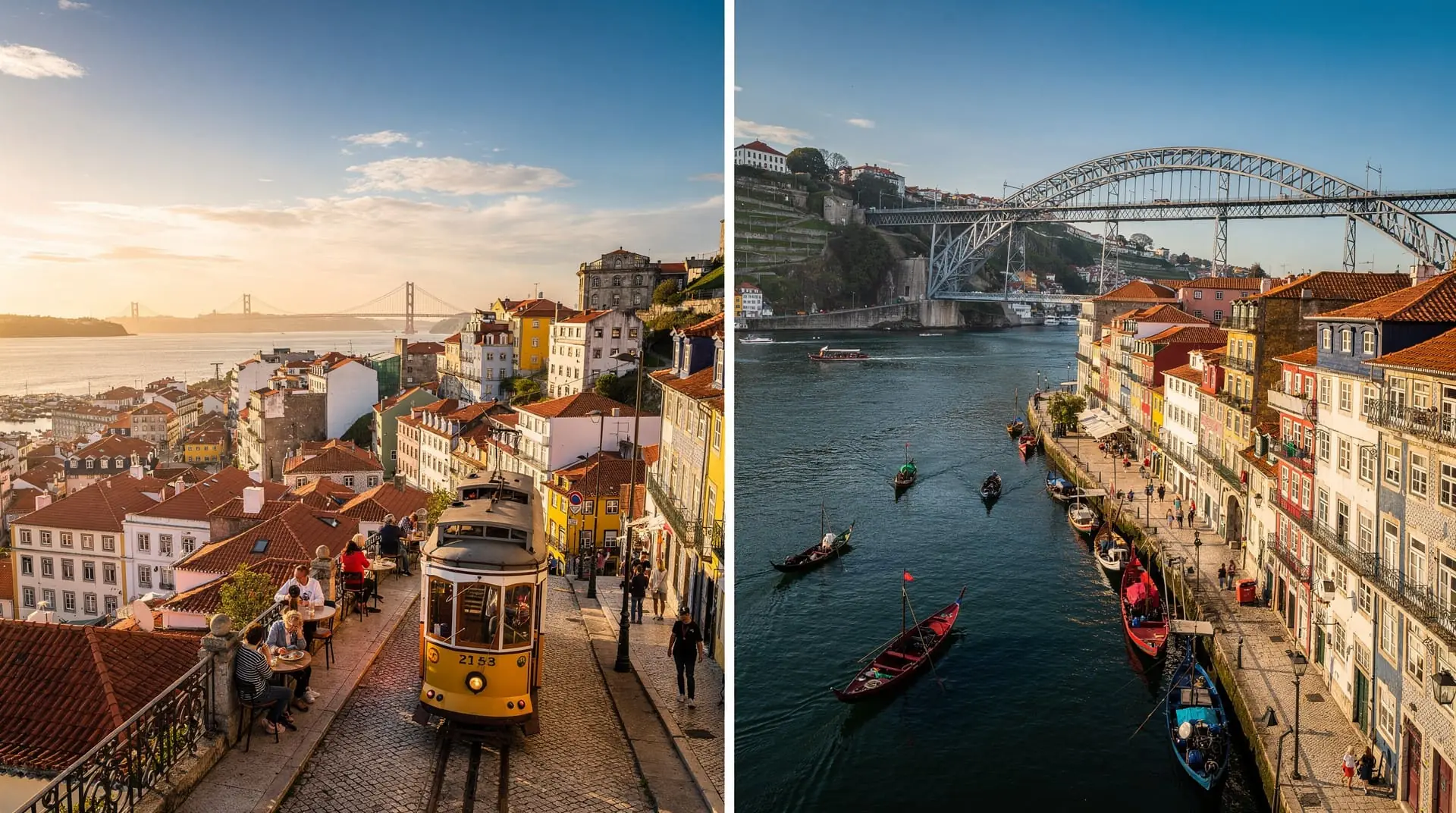
Lisbon vs Porto: which Portuguese city should you visit?
Honest head-to-head: vibe, weather, food, wine, day-trips and budget. Which city wins for your trip — and when to visit both.

Pena Palace: tickets, queues and how to make the most of your visit
How to visit Pena Palace in Sintra — timed entry tickets, bus 434, park-only vs palace+park options, and what to expect inside the Romantic hilltop castle.

Sintra vs Cascais: which day-trip should you pick?
Sintra offers palaces and hills but costs time and crowds. Cascais offers beaches and a marina and half the effort. Pick the right one for your trip.

Best family day trips from Lisbon: Sintra, Cascais, Óbidos, and more
Top family day trips from Lisbon in 2026: Sintra by train, Cascais beach, Óbidos chocolate, transport logistics, real age recommendations.
Ready to book? Top tours for this guide
We earn a small commission if you book through GetYourGuide — at no extra cost to you. Every tour is hand-picked and verified.

Lisbon: 48-Hour Hop-On-Hop-Off Bus Tour and Oceanarium Entry
Lisbon: MAAT Entry Ticket & Dolphin Watching Boat Tour
Lisbon: Alfama, Mouraria Walking Tour with Fado Night, Tapas
Lisbon: Hop-On Hop-Off Bus Tour
Lisbon: 1-or 2-Day Hop-On Hop-Off Bus Tour